

Healthcare Data Warehouse Architecture: Building an Enterprise Clinical Data Repository
A healthcare data warehouse (HDW) centralizes patient, clinical, financial, and operational data for analytics and reporting. A modern HDW uses FHIR-based data pipelines and typically costs $70,000–$1,000,000 depending on complexity.

Manish Patel
What if your healthcare data could flow seamlessly across every department instead of remaining trapped in disconnected systems?
As Head of Technology and Client Success at Acquaint Softtech, I have seen how skilled Python developers build secure healthcare data platforms that unify clinical, financial, and operational information into a single source of truth. The challenge is not collecting healthcare data. It is integrating dozens of siloed systems into a reliable, compliant foundation that supports AI, analytics, and value-based care.

- You are designing a clinical data repository for a health system.
- Your hospital has 50 or more disparate systems with no unified analytics layer.
- You need to train AI or ML models on multi-source clinical data.
- You want to understand ETL vs ELT and which is right for healthcare.
- You need verified cost data before presenting a data warehouse budget.
The healthcare data warehouse market is experiencing accelerated growth driven by value-based care, AI adoption, and regulatory interoperability mandates. The 21st Century Cures Act requires all EHR vendors to support FHIR R4 APIs, effectively mandating the interoperability infrastructure that makes a healthcare data warehouse possible. The ONC publishes its interoperability and health IT certification requirements. A healthcare data warehouse built on FHIR-native data pipelines satisfies the interoperability requirements of the Cures Act while simultaneously creating the analytics foundation for AI, population health, and clinical quality reporting.
This article explains the four-layer healthcare data warehouse architecture, the CDR versus EDW versus data lakehouse distinction, ETL versus ELT for clinical data, FHIR as the data standard spine, HIPAA compliance architecture, AI and ML use cases, tech stack, cost data, and a real case study from Acquaint Softtech's clinical analytics delivery portfolio. For the full healthcare software development context across all eight product categories, start with the guide to Healthcare Software Development.
Why Healthcare Organisations Build Data Warehouses in 2026

What is healthcare data warehouse architecture in business terms? It is the infrastructure decision that determines whether an organisation can use its own data for decisions or remains dependent on fragmented, system-specific reports. Healthcare data warehouse architecture market trends 2026 are driven by four converging forces: value-based care contracts that require outcome measurement across patient populations, AI and ML applications that require unified multi-source training data, regulatory interoperability mandates under the 21st Century Cures Act, and the growing volume of patient-generated data from wearables and remote monitoring devices.
Why businesses need healthcare data warehouse architecture is also a competitive survival question. Health systems without unified data infrastructure cannot participate in population health programmes, cannot demonstrate quality metrics for value-based care contracts, and cannot train AI models on their own clinical data. They remain dependent on off-the-shelf benchmarks that do not reflect their patient population.
Benefits of healthcare data warehouse architecture are measurable. A cancer centre with a unified data warehouse that included genomic data matched patients to clinical trials 70 per cent faster, a direct outcome of having all data in one queryable system rather than in department-specific silos. Acquaint Softtech's AI development services are built on top of data warehouse and data pipeline infrastructure. The analytics layer cannot function without a correctly architected data foundation.
CDR vs EDW vs Data Lake vs Data Lakehouse: The Right Architecture
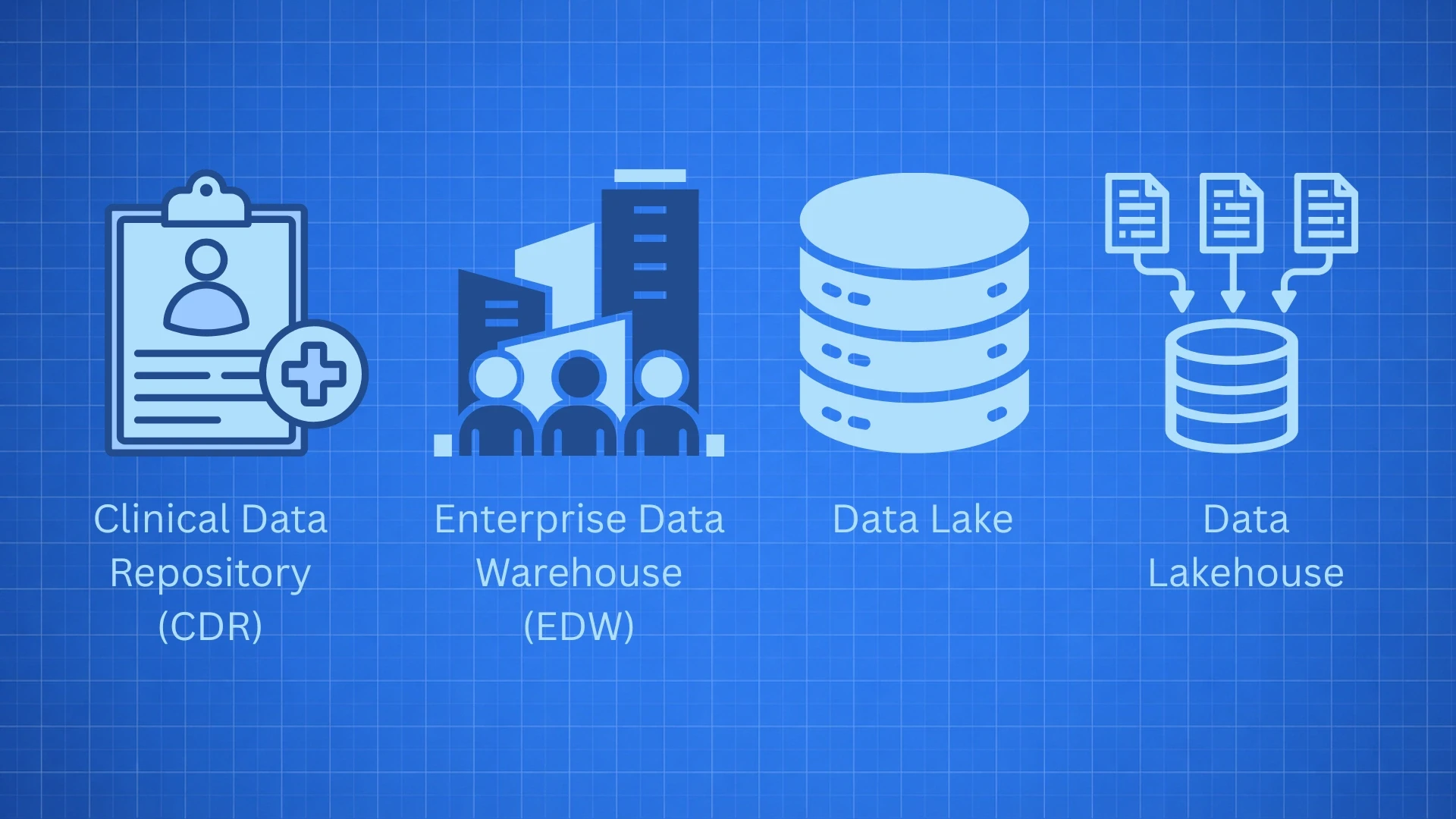
Healthcare data infrastructure uses four distinct architectural patterns. Choosing the wrong pattern adds 40 per cent or more to implementation costs through remediation and reconstruction. Understanding which pattern fits the use case is the first decision in any healthcare data project.
Pattern | Purpose | Best Use Case |
Clinical Data Repository (CDR) | Patient-centric data access | Real-time clinical care |
Enterprise Data Warehouse (EDW) | Analytics and reporting | Population health and BI |
Data Lake | Large-scale raw data storage | AI, imaging, genomics, IoT data |
Data Lakehouse | Combines analytics and scalability | Modern healthcare data platforms |
Most hospital systems in 2026 need a data lakehouse architecture: they need the structured query performance of a data warehouse for BI and quality reporting, and the unstructured data handling of a data lake for AI, imaging, and genomics. Pure EDW architectures cannot handle DICOM imaging data or free-text clinical notes. Pure data lakes cannot serve fast, reliable BI queries without additional engineering.
The distinction matters because the data lake and the warehouse require different technology choices, different schema strategies (schema-on-write for EDW, schema-on-read for data lake), and different engineering skills. Acquaint Softtech's DevOps engineers build the cloud infrastructure and data pipeline orchestration that underpins the data lakehouse architecture, while the Python team builds the ETL and transformation layer.
The Four-Layer Healthcare Data Warehouse Architecture
How to build healthcare data warehouse architecture: every production healthcare data warehouse follows a four-layer structure. Each layer has a specific engineering responsibility. Understanding what each layer does before selecting technology is the prerequisite for making correct stack decisions.
The Four-Layer Healthcare Data Warehouse Architecture
Data Source Layer: All clinical and operational data originates here. EHR and EMR systems (Epic, Cerner, AthenaHealth), LIS (lab results), RIS and PACS (radiology orders and images), pharmacy management systems, claims and billing systems, wearables and RPM devices, patient-generated data (portals, mobile apps), and public health databases. Each source uses different formats, protocols, and update frequencies.
Staging and Ingestion Layer: Raw data from all sources lands here first. This is temporary storage where data undergoes extraction from source APIs (FHIR R4, HL7 v2, ASTM, proprietary), initial format normalisation, duplicate detection, and basic quality checks. No transformations occur here; this layer preserves the raw source data as received, which is essential for audit and lineage tracking.
Data Storage Layer: Cleaned, transformed, and standardised data lives here permanently. This layer contains the core clinical data repository (CDR) for patient-level data, data marts for specific analytical domains (quality metrics, financial, pharmacy), and the data lake for unstructured data (imaging metadata, free-text notes, genomics). LOINC, SNOMED CT, ICD-10, and CPT code standardisation happens in this layer.
Analytics and Reporting Layer: The consumption layer. BI dashboards for hospital CFOs and clinical quality teams, population health risk stratification models, AI and ML model training pipelines, regulatory reporting automation (CMS quality measures, public health reporting), and self-service analytics for researchers and administrators. This layer never touches raw data directly; it queries the standardised Layer 3 store.
The most common architecture failure is collapsing Layers 1 and 2: loading data directly into the warehouse without a staging layer. When source systems change their schemas or data formats, a warehouse without a staging layer requires rebuilding every dependent transformation. A staging layer acts as a buffer that absorbs source system changes without propagating them to the analytical layer.
Acquaint Softtech's Python developers implement the staging layer as an immutable, append-only raw data store, typically using S3 in Parquet format or a FHIR server, ensuring complete data lineage from analytical outputs back to source records. For organisations building end-to-end healthcare data platforms, Acquaint Softtech also offers dedicated MERN Stack developers to develop scalable web applications that integrate seamlessly with these data engineering workflows.
Data Source Layer: What Goes Into a Clinical Data Repository
Healthcare data warehouse architecture features start with understanding what data the warehouse must consolidate. A production clinical data repository ingests from multiple source types simultaneously, each with different protocols, data quality challenges, and update frequencies.
Data Source | Format and Protocol | Update Frequency |
EHR and EMR (Epic, Cerner, AthenaHealth) | FHIR R4 RESTful API; HL7 v2 for legacy feeds | Real-time to nightly batch depending on EHR configuration |
Laboratory information system (LIS) | HL7 ORU for results; FHIR R4 DiagnosticReport for modern systems | Near real-time as results are verified |
Radiology and PACS | DICOM for images; HL7 ORM and ORU for orders and reports | Per-study completion |
Pharmacy management system | NCPDP SCRIPT for e-prescriptions; FHIR MedicationRequest | Per-dispensing event |
Insurance and claims (billing) | EDI 835 and 837; FHIR Claim and ExplanationOfBenefit | Daily to weekly claims processing batches |
RPM and wearables | FHIR Observation; IoT device APIs; Apple HealthKit and Google Health Connect | Continuous to daily depending on device |
Patient portal and PRO surveys | FHIR QuestionnaireResponse; proprietary API | Per patient submission |
Public health and social data | HL7 QRDA for quality reporting; REST APIs for SDOH data | Monthly to quarterly |
Most US hospitals manage more than 50 separate data systems. Not all of them need to be in the warehouse on day one. Phase 1 should include the three to five source systems that answer the top-priority analytical questions identified in the discovery phase. Every additional source system adds $15,000 to $60,000 in integration engineering and 4 to 12 weeks of pipeline development time.
Acquaint Softtech's DevOps team builds and manages source-system ingestion pipelines using Apache Airflow, ensuring reliable orchestration, monitoring, and end-to-end data lineage. Businesses looking to accelerate healthcare data platform development can also hire Laravel developers from Acquaint Softtech to build secure, scalable backend systems that integrate seamlessly with modern data pipelines.
ETL vs ELT for Healthcare: Processing Clinical Data at Scale
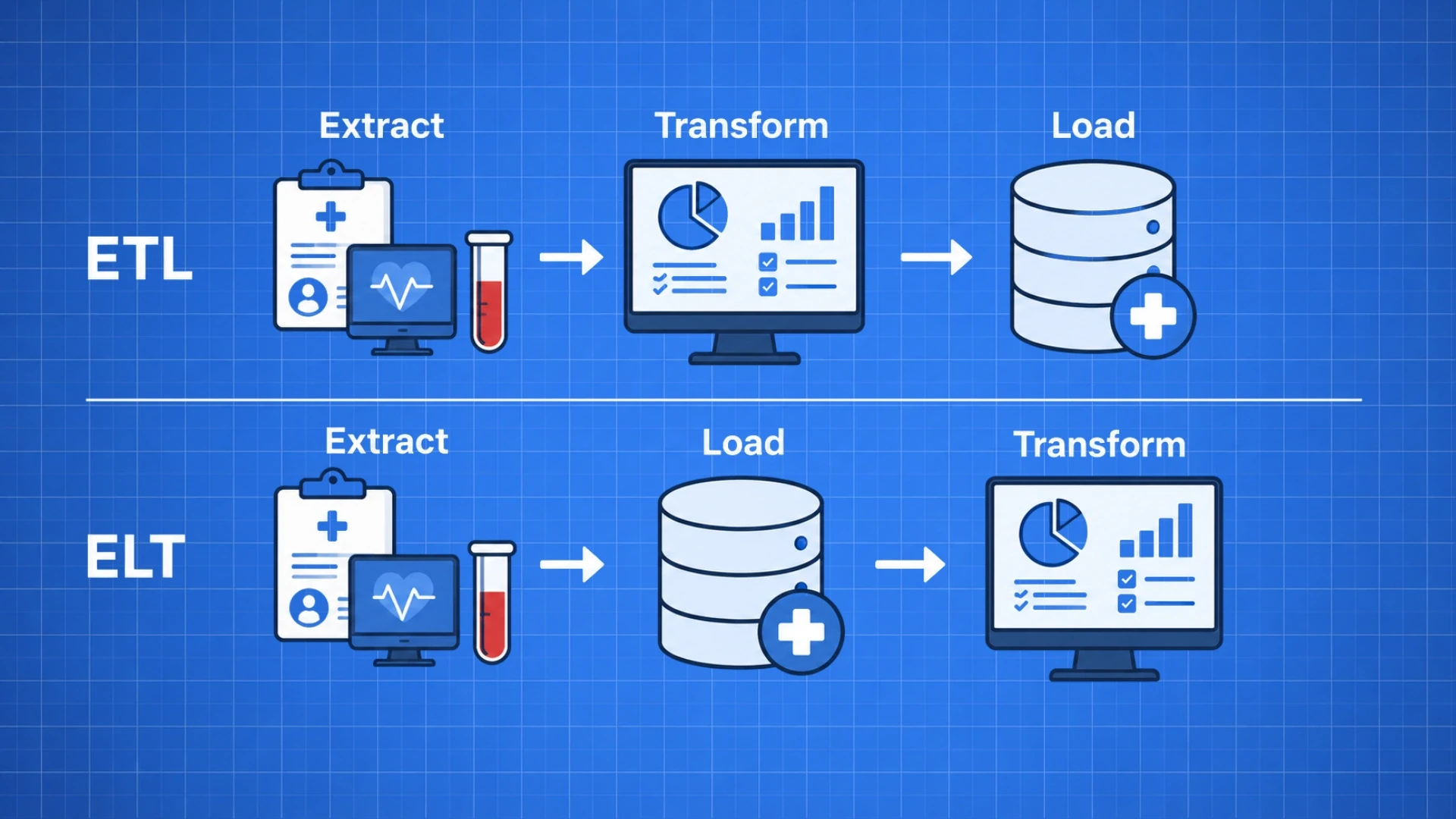
ETL (Extract, Transform, Load) and ELT (Extract, Load, Transform) are the two dominant data pipeline patterns. The choice between them determines the warehouse architecture, the transformation tool stack, and the time-to-analytics for new data sources. Healthcare has specific considerations that push most modern data warehouse builds toward ELT.
Factor | ETL | ELT |
When transformation happens | Before loading to warehouse (in staging) | After loading to warehouse (in-place) |
Raw data preservation | Raw data not retained after transformation | Raw data retained in staging layer — full lineage |
Schema flexibility | Schema defined before loading (rigid) | Schema defined on query (flexible — handles EHR schema changes) |
Best for | Known, stable schemas with regulatory audit requirements | Healthcare: diverse sources, frequent schema changes, audit lineage needs |
Tools | Python (pandas, PySpark), dbt, custom scripts | dbt (transformation), Apache Spark, Databricks, BigQuery or Snowflake |
Performance at scale | Slower for large datasets (transforms before load) | Better for large clinical datasets (leverage warehouse compute) |
ELT is the correct pattern for healthcare data warehouses in 2026 for two reasons specific to the clinical domain.
First, EHR vendors (Epic, Cerner) change their FHIR API schemas frequently. An ETL pipeline that transforms before loading breaks when the source schema changes. An ELT pipeline loads the raw FHIR JSON first and transforms in the warehouse, insulating the analytical layer from source schema changes.
Second, HIPAA audit requirements demand full data lineage, the ability to trace any analytical output back to the source record. ELT's raw data retention in the staging layer provides that lineage natively.
Key Insight
dbt (data build tool) is the 2026 standard for healthcare data transformation in ELT pipelines. It allows data engineers to write transformations in SQL with version control, testing, and documentation as first-class features. HIPAA-compliant data warehouses built with dbt have full transformation lineage automatically, because every dbt model documents its source dependencies.
For teams choosing between Snowflake, BigQuery, and Databricks as the warehouse compute layer, Acquaint Softtech's data engineering team published a cost and architecture comparison in the blog post What Does a Python Development Project Actually Cost?, which covers how Python dominates healthcare data engineering and the real cost ranges for data pipeline projects.
FHIR as the Data Spine: Standardising Clinical Data for Analytics
Healthcare data warehouse architecture step by step begins with selecting a data standard that all clinical data will conform to in the storage layer. FHIR R4 (Fast Healthcare Interoperability Resources) is the only viable choice for this role in 2026.
It is mandated by the 21st Century Cures Act, supported by every major EHR vendor, and provides a resource model that maps all clinical data types to standardised schemas that an analytics engine can query reliably.
Key FHIR R4 resources in a clinical data warehouse
FHIR Resource | Clinical Data It Standardises | Analytical Use Case |
Patient | Demographics, identifiers, contact info | Population segmentation, cohort definition |
Encounter | Each clinical visit, inpatient, outpatient, ED, telehealth | Utilisation analysis, readmission tracking |
Observation | Vital signs, lab results, social data (SDOH), survey responses | Trend analytics, risk stratification input |
Condition | Problem list, ICD-10 coded diagnoses | Disease burden analysis, chronic condition management |
MedicationRequest | Prescriptions ordered | Medication adherence, drug utilisation review |
DiagnosticReport | Lab and radiology reports | Quality metrics, lab turnaround time analytics |
Claim | Insurance claims and billing events | Revenue cycle analytics, cost-of-care reporting |
Procedure | Surgical and clinical procedures performed | Utilisation reporting, outcome correlation |
LOINC, SNOMED CT, ICD-10, and CPT provide the standardised terminology that makes FHIR data usable for analytics and interoperability. Without consistent code mapping, the same clinical concept can appear differently across systems, reducing data quality. For building scalable FHIR integration layers, solutions such as HAPI FHIR and Azure FHIR Service are widely used. Organisations looking to accelerate healthcare interoperability projects often hire MEAN stack developers to build secure FHIR APIs, data transformation pipelines, and healthcare application integrations that comply with US Core FHIR standards.
HIPAA and HITECH Compliance Architecture for Healthcare Data Warehouses
A healthcare data warehouse holds the most sensitive PHI in the organisation — not just current clinical records, but historical data going back years, combined across multiple source systems, in a queryable format. This makes the HIPAA attack surface of a data warehouse larger than any individual source system. Every architectural decision in the warehouse must be reviewed through a HIPAA compliance lens.
HIPAA technical safeguards for a clinical data warehouse
AES-256 encryption at rest for all PHI in the staging layer, warehouse storage, data marts, and backup storage. Encryption key management via AWS KMS, Azure Key Vault, or HashiCorp Vault.
TLS 1.3 for all PHI in transit: source system APIs to staging, staging to warehouse, warehouse to analytics tools, and warehouse to BI dashboards.
De-identification and pseudonymisation for the research and AI training layers. HIPAA's Safe Harbour de-identification standard (removing all 18 identifiers) or Expert Determination method must be applied before PHI is used for AI model training on datasets that may be shared.
Column-level access control: analysts querying population-level data must not have access to identified patient records. Row-level security and column masking at the warehouse level enforce the HIPAA Minimum Necessary Rule.
Comprehensive audit logging at the query level: every SELECT statement on PHI tables is logged with user ID, timestamp, query content, and rows returned. Query-level audit logging at the warehouse layer is beyond what most application-level audit logs provide.
BAAs are executed with the cloud infrastructure provider (AWS, Azure, GCP), the warehouse vendor (Snowflake, Databricks), the BI tool vendor (Tableau, Power BI, Looker), and the data engineering firm.
HITECH's Breach Notification Rule applies to data warehouses: a breach of the data warehouse affects all PHI from all source systems simultaneously, making the potential scope of a warehouse breach larger than any individual system breach. The HHS publishes HIPAA and HITECH requirements. Acquaint Softtech's DevOps engineers configure HIPAA-eligible cloud infrastructure for all data warehouse builds as a standard first-sprint deliverable, using Terraform to define all compliance controls as code, ensuring they are reproducible, version-controlled, and auditable.
AI and ML Use Cases That Depend on the Data Warehouse

Healthcare data warehouse architecture development company benefits are most clearly visible in the AI and ML applications it enables. Without a unified clinical data foundation, these use cases cannot be built, or they can be built only on narrow, single-source datasets that produce models too fragile to deploy in production.
AI/ML Use Case | Data Required | Outcome |
Readmission Prediction | Demographics, diagnoses, labs, medications | Reduce hospital readmissions |
Clinical Trial Matching | Diagnoses, labs, genomics | Faster trial enrollment |
Sepsis Early Warning | Vitals, labs, nursing notes | Early deterioration alerts |
Medication Adherence | Prescriptions, refill history | Detect non-adherence |
AI Radiology Reporting | Imaging metadata, prior reports | Automated report generation |
Risk Stratification | Clinical, claims, SDOH data | Identify high-risk patients |
Note: AI use cases listed here describe model training and inference applications, not autonomous clinical decision-making. All AI outputs feeding clinical decisions require human review and appropriate FDA classification assessment.
In 2026, agentic AI for radiology transcription and reporting is one of the fastest-adopted AI applications in US health systems, enabled by unified clinical data warehouses. Acquaint Softtech's AI and ML engineering services build the model training pipelines, feature engineering layers, and inference APIs that sit on top of the data warehouse infrastructure.
Tech Stack for Healthcare Data Warehouse Development in 2026
Healthcare data warehouse tech stack guide: the correct stack depends on the organisation's existing cloud provider, the volume of data, the query complexity, and whether the use case requires real-time streaming or batch analytics. The following stack represents Acquaint Softtech's production data engineering choices for HIPAA-compliant clinical data warehouses.
Layer | Technology | Purpose |
Pipeline Orchestration | Apache Airflow | Manage and schedule ETL/ELT workflows |
Data Transformation | dbt | Transform, test, and document data |
Warehouse Compute | Snowflake / BigQuery / Databricks | Analytics and data processing |
Data Lake Storage | AWS S3 / Azure Data Lake | Secure large-scale data storage |
FHIR Transformation | Python + FHIR Libraries | Process healthcare data standards |
Streaming Pipeline | Kafka / AWS Kinesis | Real-time data ingestion |
BI & Reporting | Tableau / Power BI / Superset | Dashboards and reporting |
Data Quality & Lineage | Great Expectations | Data validation and monitoring |
Python is the dominant language at every stage of healthcare data warehouse development: pipeline orchestration (Airflow), FHIR transformation (fhirclient), data quality validation (Great Expectations), AI model training (scikit-learn, PyTorch), and data analysis (pandas, PySpark). This is why the primary service page for this sub-pillar is the Acquaint Softtech Python development team.
Acquaint Softtech builds healthcare data warehouse and ETL infrastructure as part of broader healthcare platform engagements. The software product development service covers full-stack healthcare data platform builds, from source system integration through warehouse design, AI model development, and BI dashboard delivery.
Case Study: Clinical Analytics Platform for BIANALISI SPA, Italy
.webp "Case Study: Clinical Analytics Platform for BIANALISI SPA, Italy")
Client: BIANALISI SPA, Italy's largest integrated diagnostics group (1,001 to 5,000 employees)
Reviewer: Giovanni Gianolli, CEO, BIANALISI SPA
Project: Clinical Data Analysis and Predictive Health Intelligence Platform — a cross-facility clinical analytics layer connecting laboratory, imaging, and outpatient data across multiple regional facilities
Technology: Python (pandas, scikit-learn, FastAPI), PostgreSQL, React.js dashboard, European-compliant cloud infrastructure
Duration: April to November 2025 — 7 months. All milestones delivered on schedule.
Clutch Rating: 5.0 out of 5.0 across Overall, Quality, Schedule, and Cost | Verified: February 22, 2026
The data warehouse problem BIANALISI faced
BIANALISI SPA is Italy's largest integrated diagnostics group, operating multiple regional laboratory and diagnostic facilities. Their challenge was exactly the enterprise clinical data repository problem: laboratory test results, diagnostic imaging metadata, and outpatient service data existed in separate facility-level systems with no unified analytical layer. Regional medical directors had no cross-facility visibility. Identifying diagnostic trends across patient cohorts required weeks of manual data extraction and consolidation.
The engineering solution Acquaint Softtech delivered closely followed the healthcare data warehouse architecture outlined in this guide, combining secure clinical data ingestion, GDPR-compliant data processing, predictive analytics, and role-based dashboards for healthcare stakeholders. To support cross-platform healthcare applications and mobile access to clinical insights, organisations can also leverage React Native developers' services for building secure, scalable iOS and Android healthcare solutions.
Verified outcomes from the data warehouse deployment
Clinical directors identified clusters of abnormal diagnostic trends within the same reporting cycle, previously only visible after monthly manual audits across facility-level paper and system reports
A regional supervisor identified an unusual spike in related laboratory indicators within a specific patient cohort and initiated immediate clinical review, rather than waiting for routine analysis
Cross-facility trend analysis consolidated from multiple manual extraction processes into a single operational dashboard, removing weeks of monthly data preparation time
Every project milestone delivered on schedule despite mid-project regulatory clarifications requiring scope adjustments to the data privacy layer
Healthcare data warehouse development company: scoped correctly in 2 weeks.
Acquaint Softtech's data engineering team builds HIPAA-compliant clinical data warehouses with FHIR-native ETL pipelines, debt transformation layers, Airflow orchestration, and AI-ready data foundations. Fixed-scope proposal in 2 weeks. 50 or more Clutch reviews. $25 to $49/hour.
Healthcare Data Warehouse Development Cost in 2026
Healthcare data warehouse development costs in 2026 typically range from $70,000 to over $1,000,000, depending on the number of data sources, data transformation complexity, AI requirements, and infrastructure needs. For organisations building advanced analytics, predictive modelling, or healthcare AI solutions, partnering with experienced teams that hire Django developers can help accelerate the development of scalable and secure data platforms.
Warehouse Tier | Scope and Cost | Timeline |
Foundational CDR | 3 to 5 source systems, basic ETL, HIPAA infrastructure, core BI. $70,000 to $180,000. | 4 to 9 months |
Enterprise EDW | 10 to 20 source systems, FHIR standardisation, dbt transformations, advanced BI. $180,000 to $450,000. | 9 to 18 months |
AI-ready data lakehouse | 20 or more sources, streaming pipeline, ML model training, agentic AI layer. $350,000 to $1,000,000+. | 15 to 28 months |
What healthcare data warehouse projects consistently underestimate
Each additional data source (EHR vendor, lab system, payer claims feed) adds $15,000 to $60,000 in integration engineering and 4 to 12 weeks of pipeline development. Labs with 10 or more source systems discover this cost after scoping.
Terminology standardisation (LOINC, SNOMED CT, ICD-10 mapping across source systems) adds $20,000 to $60,000 per major source system when code mappings are not provided by the source vendor.
Ongoing infrastructure cost: a mid-tier healthcare data warehouse on Snowflake or BigQuery costs $3,000 to $15,000 per month in cloud compute and storage, depending on query volume and data size.
HIPAA compliance infrastructure adds 20 to 30 per cent to base development cost when designed from day one, or 40 to 60 per cent when retrofitted after the warehouse is built.
Outsource healthcare data warehouse architecture development India: Acquaint Softtech delivers at $25 to $49 per hour (Clutch-verified), representing 40 per cent average cost savings versus US agency rates. Hire developers for healthcare data warehouse through the staff augmentation model for flexible scaling across intensive data integration phases.
Hire developers for healthcare data warehouse, HIPAA-compliant from sprint one
Acquaint Softtech builds healthcare data warehouses with FHIR-native ETL pipelines, dbt transformations, Airflow orchestration, HIPAA-compliant cloud infrastructure, and AI model foundations. 4.9/5, 50 or more Clutch reviews. Premier Verified. 1,300 or more projects in 13 or more years.
Frequently Asked Questions
-
How much does healthcare data warehouse development cost?
Healthcare data warehouse development costs range from $70,000 to $1,000,000+. Small implementations with 3 to 5 data sources start around $70,000, while enterprise AI-ready data lakehouses can exceed $1 million.
-
What features should a healthcare data warehouse include?
A healthcare data warehouse should include FHIR-standardized data integration, ETL/ELT pipelines, terminology mapping (LOINC, SNOMED CT, ICD-10), HIPAA-compliant security, audit logging, de-identification capabilities, and BI reporting dashboards.
-
How long does it take to build a healthcare data warehouse?
Healthcare data warehouse projects typically take 4 to 28 months. Small clinical data repositories require 4 to 9 months, while enterprise AI-ready platforms may take 15 to 28 months.
-
What is the best tech stack for healthcare data warehouse architecture?
A modern healthcare data warehouse uses Apache Airflow for orchestration, dbt for data transformation, Snowflake or BigQuery for analytics, AWS S3 or Azure Data Lake for storage, Python for data processing, Kafka for streaming, and Power BI or Tableau for reporting.
-
What is the difference between a healthcare data warehouse and a clinical data repository?
A Clinical Data Repository (CDR) supports real-time patient care and stores individual patient records. A Healthcare Data Warehouse (HDW) supports analytics, population health management, reporting, and AI model development across large patient populations.
-
Does a healthcare data warehouse need HIPAA compliance?
Yes. Healthcare data warehouses store protected health information (PHI) and must comply with HIPAA requirements, including AES-256 encryption, access controls, audit logs, secure data transmission, and Business Associate Agreements (BAAs).
-
What is ETL vs. ELT in healthcare data warehouses?
ETL transforms data before loading it into the warehouse, while ELT loads raw data first and performs transformations later. ELT is often preferred in healthcare because it preserves source data and supports changing FHIR-based data structures.
I lead technology and client success at Acquaint Softtech with one goal in mind. Deliver work that feels personal, reliable, and worthy of long term trust. I stay close to both our clients and our developers to make sure every project moves with clarity, quality, and accountability.
Table of Contents
Get Started with Acquaint Softtech
- 13+ Years Delivering Software Excellence
- 1300+ Projects Delivered With Precision
- Official Laravel & Laravel News Partner
- Official Statamic Partner
Related Blog

Remote Patient Monitoring App Development: From Wearable to Dashboard
Remote patient monitoring (RPM) app development connects wearable and medical devices to a clinical dashboard using IoT data pipelines, real-time alerting, and HIPAA-compliant cloud infrastructure. A production RPM system collects biometric data via Bluetooth or cellular, transmits it through an encrypted MQTT or HTTPS pipeline, stores it in a time-series database, and surfaces it in a clinical dashboard with threshold-based alerts, trend visualisation, and EHR write-back via HL7 FHIR.

Ahmed Ginani
June 9, 2026
What Does a Python Development Project Actually Cost? A Breakdown by Type
Discover the real cost of a Python development project in 2026, broken down by type. From MVPs and automation to AI/ML platforms. Includes fresh data, expert sources, and Acquaint Softtech pricing starting at $20/hr.

Acquaint Softtech
March 13, 2026India (Head Office)
203/204, Shapath-II, Near Silver Leaf Hotel, Opp. Rajpath Club, SG Highway, Ahmedabad-380054, Gujarat
USA
7838 Camino Cielo St, Highland, CA 92346
UK
The Powerhouse, 21 Woodthorpe Road, Ashford, England, TW15 2RP
New Zealand
42 Exler Place, Avondale, Auckland 0600, New Zealand
Canada
141 Skyview Bay NE , Calgary, Alberta, T3N 2K6