

Exploring Healthcare Website and Apps Development
Healthcare website and mobile app development involves building secure, user-friendly digital platforms for patients, clinicians, and administrators. Key solutions include patient portals, electronic health record (EHR/EMR) integrations, telemedicine video consultations, and automated appointment booking systems, all tailored to strict regulatory standards. With the global digital health market worth hundreds of billions and growing fast, well-built, compliant platforms are now a competitive necessity.

Mukesh Ram
As the Founder and CEO at Acquaint Softtech, I have watched healthcare web application development become one of the most demanding and rewarding areas of modern software. It is crucial to keep up with the latest technological trends, and this applies to the healthcare industry as much as any other. There are many advancements in medical app and website development, from apps that help people manage medications to platforms that connect patients with others with similar conditions.
This article explores the medical apps and websites making waves in the medical community. At Acquaint Softtech, we treat every healthcare build as a practical exercise in security, usability, and compliance. It offers a real look at how technology is implemented in mobile apps and websites for the healthcare industry, and what it takes to build them well in 2027.

- You are planning healthcare web application development or a medical app.
- You need to understand patient portals, EHR/EMR, telemedicine, and booking systems.
- You want to know the compliance and security standards that apply.
- You want a clear, step-by-step process to build a healthcare app.
Healthcare is now digital-first. According to Grand View Research, the global digital health market is valued at roughly 420 billion dollars in 2027 and is projected to grow past 1.8 trillion dollars by 2033. Telehealthcare is the largest segment, and mobile health (mHealth) apps are among the fastest-growing, so the demand for secure medical platforms keeps rising.
But healthcare software is not ordinary software. It moves sensitive patient data, integrates with hospital systems, and must satisfy strict rules. Get the architecture right, and you improve care and efficiency; get it wrong, and you risk compliance failures. That is why this guide covers not just app and website types, but the solutions, standards, and process behind them.
Want to build a healthcare platform that is secure and compliant?
Partner with our experienced team to design a healthcare website or app around patient safety, data privacy, and real clinical workflows. Book a free consultation to scope your project.
Healthcare Website and Apps Development: Core Features
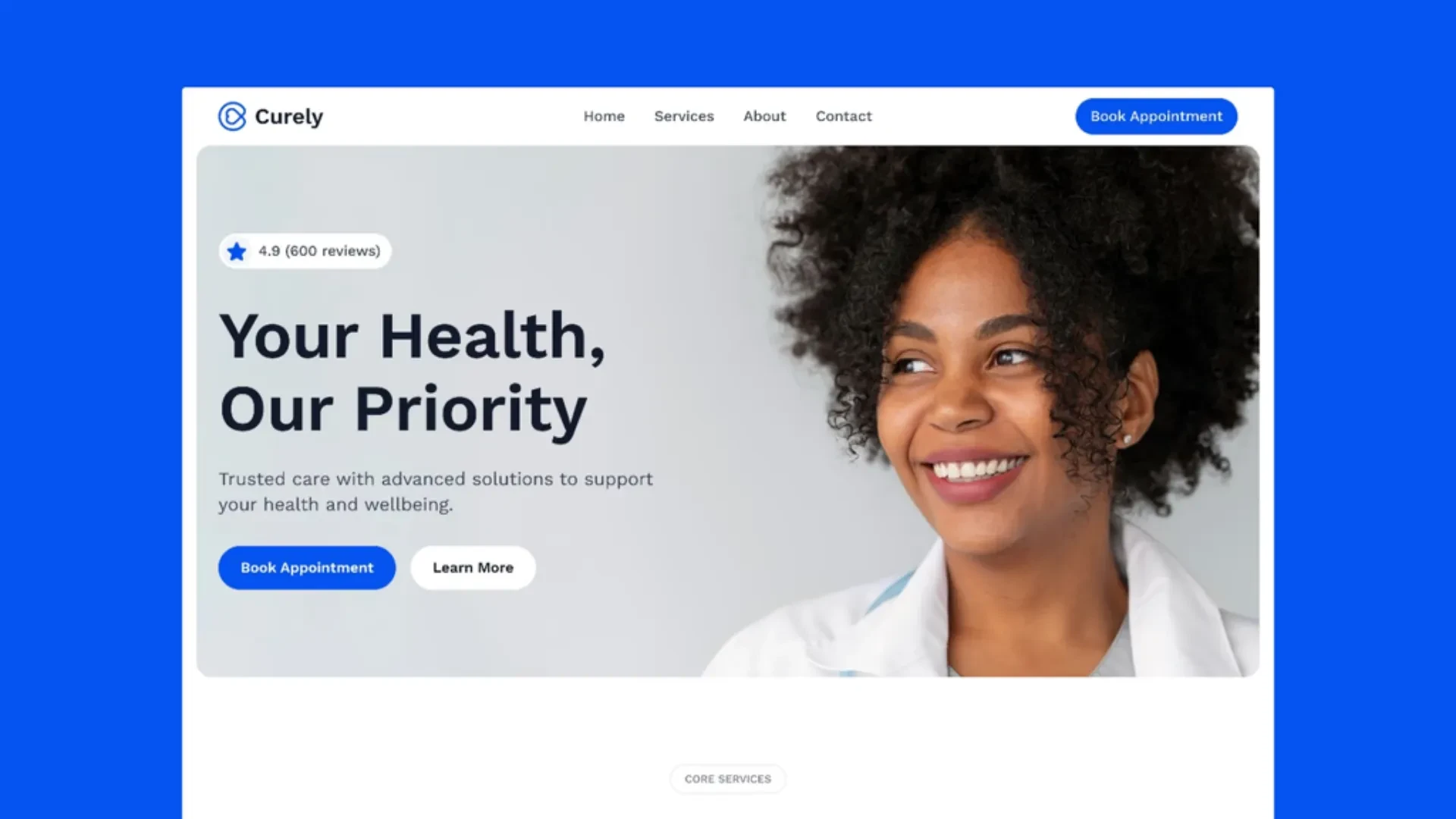
Healthcare website and mobile app development involves building secure, user-friendly digital tools for patients, clinicians, and administrators. Key components include appointment systems, electronic health record (EHR) integrations, and strict adherence to data privacy regulations like GDPR and UK health standards. When Acquaint Softtech scopes medical web application development, these core features come first:
Patient portals: for booking appointments and viewing test results.
Telehealth tools: video consultations and secure messaging between care teams and patients.
Wearable integration: for real-time health data tracking.
Provider dashboards: for managing clinical workflows and electronic records.
Compliance and Security

Compliance is not a feature you bolt on at the end; it is an engineering decision that starts on day one. The standards that matter most are:
Data protection: complying with GDPR and local clinical governance, alongside HIPAA for US projects.
Accessibility: meeting WCAG standards for inclusive user design so all patient demographics can navigate care tools easily.
System interoperability: using standards like HL7 and FHIR to connect medical databases and services such as the NHS App.
Getting these right early is far cheaper than retrofitting them later. Our teams treat privacy, interoperability, and accessibility as core requirements, not afterthoughts. For the full technical view, see our HIPAA compliance checklist for developers.
Medical App Development
Medical app development is a hot topic among healthcare professionals because of its benefits for patients. Medical apps are software applications that run on mobile devices, and they play a crucial role in modern healthcare by improving patient outcomes, enhancing access to services, and enabling more efficient care delivery.
They range from simple tools that track well-being to complex platforms that help patients manage chronic conditions and medications. When teams develop website apps for healthcare, security and usability sit at the core, which is exactly how Acquaint Softtech approaches every medical build.
Did you know? The healthcare tech sector is growing fast. The global digital health market is worth around 420 billion dollars in 2027; telehealthcare is the largest segment, and the mHealth app market alone is near 46 billion dollars, with hundreds of thousands of health apps now available. |
Telemedicine Apps for Virtual Consultations
Telemedicine uses technology to connect patients with providers remotely. With telemedicine apps, patients communicate with a doctor or nurse via video chat, engage in secure messaging, receive diagnoses, and obtain prescriptions from anywhere.
This is a lifeline for people in remote areas or with limited mobility. For a deeper look, read our guide to telemedicine application development. Cross-platform frameworks make this efficient, which is why our React Native app development team is often involved.
Health Monitoring and Fitness Apps
Health monitoring and fitness apps support personalized wellness tracking. Examples like Apple Health and Samsung Health track steps, heart rate, calories burned, and more in real time, helping users stay on track with their goals.
Medication Management Apps
Medication management apps help patients track medication and side effects, consult with doctors, and receive reminders for the next dose. This is especially useful for anyone who struggles to remember whether they have taken their pills.
Medical Education and Appointment Apps
Medical education apps empower patients with articles, videos, and infographics so they can make informed decisions about treatment and lifestyle. Appointment scheduling apps let patients book online and message their provider through secure channels. For robust, secure booking logic, many teams choose a scalable framework such as Laravel development services.
Research, Mental Health, and Well-being Apps
Medical research apps collect and analyze patient data to advance scientific knowledge, while mental health and well-being apps offer guided meditation, stress management, and mood tracking. Each app has different functionality, so the development cost varies widely. If you plan to build a healthcare app, research the type you need first. You can also hire remote developers once you know the scope.
Medical Website Development
Just as apps are reshaping care, medical websites play a vital role too. They bridge the gap between providers, patients, and the public, empowering people to make informed decisions, access services, and stay up to date. Across many healthcare web development projects, Acquaint Softtech has used WordPress development for content-driven medical sites, while custom stacks power more complex portals.
Hospital, Clinic, and Portal Websites
Hospital and clinic websites establish an online presence, share institutional details and expertise, and offer online booking so patients can schedule without hassle. Health information portals provide reliable, professionally produced content that educates patients and encourages proactive care.
eCommerce, Telemedicine, and Research Sites
eCommerce platforms let users browse, compare, and buy medical supplies and equipment with reviews and specifications. Telemedicine websites connect patients with providers through live chat, video, or phone. Medical research databases and academic sites give students and professionals access to scientific articles and education.
Insurance, Billing, and Support Communities
Health insurance and billing websites streamline administrative work, letting people manage plans, submit claims, and check coverage, while providers process claims efficiently. Online support communities help patients with shared conditions connect, share stories, and get advice, which is invaluable for those with limited access to in-person care.
Healthcare Platform Types at a Glance

Different healthcare products carry different feature sets and compliance burdens. Choosing the right platform for developing healthcare website applications starts with knowing these differences, and Acquaint Softtech helps teams weigh them early. Here is a quick comparison:
Platform type | Core features | Compliance focus |
Patient portal | Records, e-prescriptions, messaging | GDPR, HIPAA, access control |
Telemedicine app | Video, chat, e-prescribing | Encryption, HL7/FHIR |
Hospital/clinic site | Info, booking, maps | Data privacy, WCAG |
RPM / wearable app | Vitals sync, alerts, dashboards | Device security, audit logs |
Billing/insurance | Claims, coverage, payments | PCI DSS, data protection |
How Much Does Healthcare Development Cost?
Cost depends on features, integrations, and compliance scope. These directional ranges reflect an offshore delivery model, and EHR integration in particular can add significantly:
Project type | Typical cost range | Timeline |
Healthcare website | 3,000 to 15,000 dollars | 3 to 8 weeks |
Basic medical app (MVP) | 20,000 to 60,000 dollars | 2 to 4 months |
Telemedicine platform | 60,000 to 150,000 dollars | 4 to 8 months |
EHR integration (add-on) | 30,000 to 80,000 dollars | Varies |
For a full breakdown, see our guide to healthcare app development cost.
Not sure which build or budget fits your idea?
Tell us your goals, and we will map the right features, integrations, compliance scope, and timeline, with a clear estimate and no obligation.
How to Build a Healthcare App: Step-by-Step
Here is a simple, compliance-first process to build a healthcare app.
Define the use case and users: clinical, wellness, or administrative, and who touches patient data.
Map compliance early: decide which rules apply (GDPR, HIPAA) before writing code.
Design accessible UX: build to WCAG so every patient demographic can use it.
Choose a secure stack: encrypted storage, role-based access, and HL7/FHIR for integrations.
Build core features: portals, booking, video, or monitoring, depending on the use case.
Integrate and test: connect EHR/EMR and devices, then test for security and accuracy.
Launch and monitor: deploy on compliant infrastructure and monitor uptime, audits, and feedback.
Case Study: A Secure Clinician Platform
Healthcare software succeeds when it supports clinicians rather than replacing them. Acquaint Softtech built an AI engine and clinician dashboard for Systole Health, a technology platform that helps health systems deliver group-based care.
The account below is drawn from the client's verified Clutch review, which rated the engagement 4.5 out of 5 with perfect 5.0 scores for quality, schedule, and cost.
Client | Systole Health (health technology platform) |
Challenge | Build a backend AI engine that drafts structured medical notes from session data, with a clinician review step, all within strict healthcare privacy standards. |
What we did | Delivered a controlled AI note-drafting system with human validation: a custom NLP backend, a web-based clinician dashboard for fast review and sign-off, and secure data-handling protocols. |
Smart detail | A feedback loop lets the system learn from clinician edits, improving drafting accuracy over time without ever removing human oversight. |
Outcome | Documentation time dropped, after-hours charting eased, note formatting became more consistent, and adoption ran higher than expected because the AI assisted rather than replaced staff. |
In the client's words, our strength was building “privacy-aware AI in a way that feels seamless to the end user.” You can view the full secure clinician web app case study on our website.
Company-wide proof: Acquaint Softtech has delivered 1,300+ projects across 20+ industries over 13+ years, with 70+ in-house engineers, a 95% on-time delivery rate, and a 4.9/5 rating from 80+ verified Clutch reviews.
To Sum Up
We hope you have gained insight into the different types of medical apps and websites. The more informed you are about your options, the easier it is to decide what fits your practice or product. Whether you need a patient portal, a telemedicine app, or a full clinical platform, the right foundation is always the same: secure, compliant, accessible, and built around real users.
If you have questions about this process or want a partner who treats healthcare compliance as a starting point rather than an afterthought, the team at Acquaint Softtech is ready to help you build it right.
Ready to start your healthcare development project?
Talk to our HealthTech engineers about your platform, integrations, and compliance needs, and get a clear plan with no obligation.
FAQs: Healthcare Website and Apps Development
-
How to build an app for healthcare?
Define the use case and users, map compliance (GDPR or HIPAA) early, design an accessible WCAG interface, and choose a secure stack with encryption and role-based access. Build core features, integrate EHR/EMR and devices, then test and launch on compliant infrastructure.
-
What are medical apps and healthcare tech?
Medical apps and healthcare tech are digital solutions that enhance medical services, patient care, and healthcare management. They include mobile apps and websites such as patient portals, telemedicine tools, and monitoring apps, each serving specific clinical or wellness needs.
-
Which website is best for app development?
There is no single best site; it depends on your needs. For content-driven medical sites, WordPress works well, while patient portals and telemedicine platforms usually need a custom build for security, integrations, and scale.
-
Who develops the NHS app?
The NHS App is developed and maintained by NHS England, following strict UK data protection and interoperability standards. It connects patients to GP services, records, and prescriptions through secure, standards-based integrations.
-
What is the most used software in healthcare?
Electronic Health Record (EHR) and Electronic Medical Record (EMR) systems are the most widely used, alongside practice management, telemedicine, and billing software. Interoperability standards like HL7 and FHIR let these systems exchange data.
-
How long does developing a medical app or healthcare website take?
A healthcare website typically takes 3 to 8 weeks. A basic medical app MVP runs 2 to 4 months, while a full telemedicine or clinical platform can take 4 to 8 months, depending on features and integrations.
I love to make a difference. Thus, I started Acquaint Softtech with the vision of making developers easily accessible and affordable to all. Me and my beloved team have been fulfilling this vision for over 15 years now and will continue to get even bigger and better.
Table of Contents
Get Started with Acquaint Softtech
- 13+ Years Delivering Software Excellence
- 1300+ Projects Delivered With Precision
- Official Laravel & Laravel News Partner
- Official Statamic Partner
Related Reading

Hospital Management System Development: Modules, Architecture, and Integration Map
A hospital management system (HMS) is integrated software that connects every operational and clinical function in a hospital: patient registration, appointment scheduling, EHR and EMR, pharmacy, laboratory, radiology, billing, and inventory, in a single platform with role-based access. Modern HMS builds in 2026 use microservices architecture, HL7 FHIR for integration, HIPAA-compliant cloud infrastructure, and role-based access control as the baseline.

Manish Patel
June 24, 2026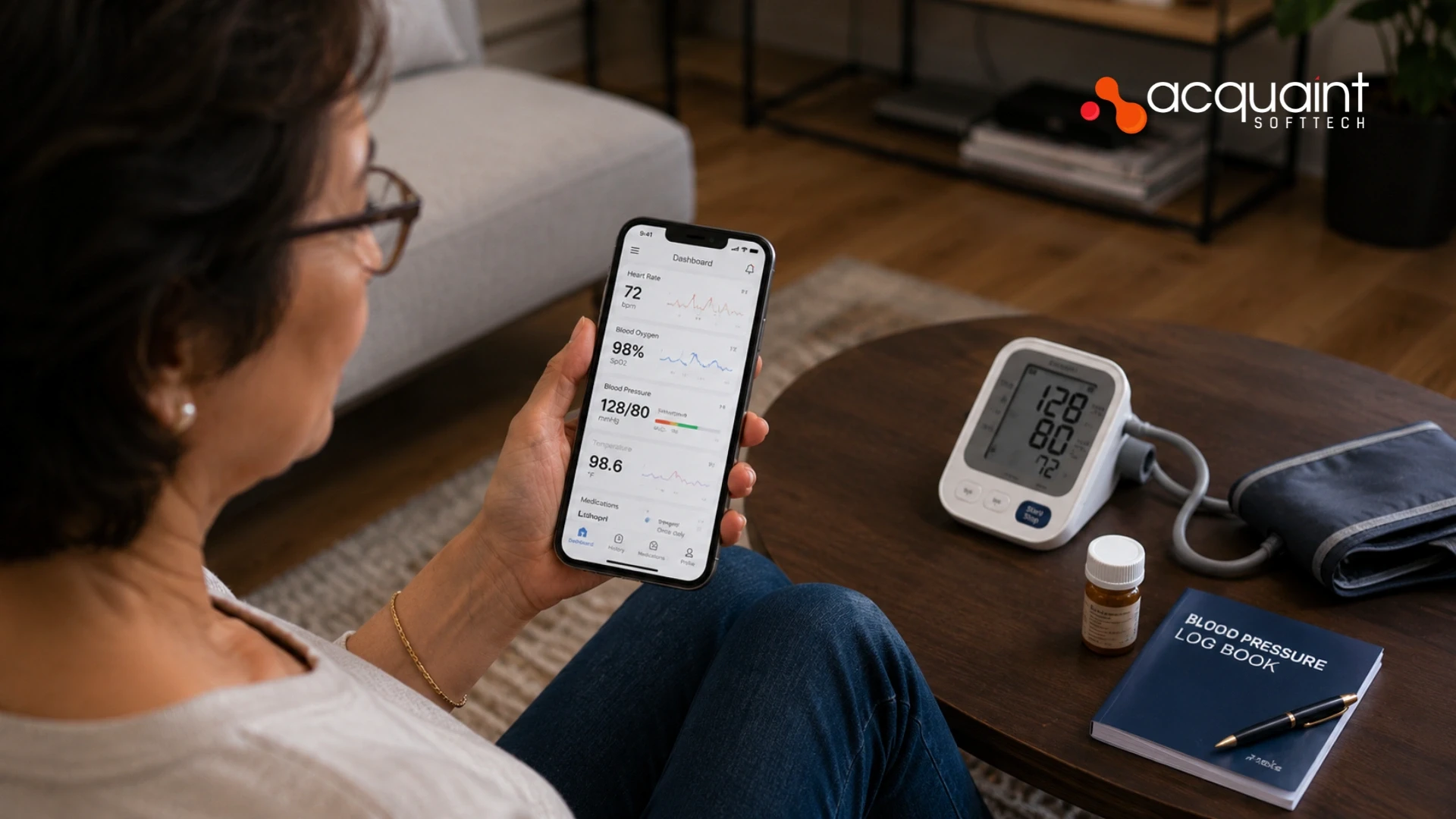
Remote Patient Monitoring App Development: From Wearable to Dashboard
Remote patient monitoring (RPM) app development connects wearable and medical devices to a clinical dashboard using IoT data pipelines, real-time alerting, and HIPAA-compliant cloud infrastructure. A production RPM system collects biometric data via Bluetooth or cellular, transmits it through an encrypted MQTT or HTTPS pipeline, stores it in a time-series database, and surfaces it in a clinical dashboard with threshold-based alerts, trend visualisation, and EHR write-back via HL7 FHIR.

Ahmed Ginani
June 9, 2026
Building a Home Healthcare Management Platform: Scheduling, Routing, and Documentation
A home healthcare management platform manages patient care, caregiver scheduling, EVV, documentation, and billing. Development typically costs $80,000–$500,000 depending on features and agency size.

Acquaint Softtech
August 4, 2026India (Head Office)
203/204, Shapath-II, Near Silver Leaf Hotel, Opp. Rajpath Club, SG Highway, Ahmedabad-380054, Gujarat
USA
7838 Camino Cielo St, Highland, CA 92346
UK
The Powerhouse, 21 Woodthorpe Road, Ashford, England, TW15 2RP
New Zealand
42 Exler Place, Avondale, Auckland 0600, New Zealand
Canada
141 Skyview Bay NE , Calgary, Alberta, T3N 2K6