

How to Add E-Prescribing to Your Telemedicine Platform
To add e-prescribing to a telemedicine platform, integrate a certified e-prescribing API (such as DoseSpot in the US or the NHS Electronic Prescription Service in the UK), verify each clinician's identity, sync patient data, route the script to the pharmacy, and log every action. Add two-factor sign-off for controlled substances and meet HIPAA or GDPR for your region.

Chirag Daxini
As a Technical Project Manager at Acquaint Softtech, an Official Laravel Partner with 1,300 or more delivered projects across 13 or more years, I have led enough clinical builds to know prescribing is where telehealth products win or stall, and it begins with custom software product development that turns a consultation into a completed prescription. A platform that can diagnose but not prescribe still sends the patient elsewhere, and that broken loop is what e-prescribing fixes.
In my eleven years across eCommerce, ERP, and Laravel and React platforms, the lesson repeats: the network you connect to, not the code you write, is what makes a prescription legally valid. I have shipped this for founders across the USA, UK, Europe, Australia, and New Zealand. Integrate the right network correctly and prescribing becomes a durable advantage.
Get the compliance wrong and it becomes your biggest liability, which is exactly why this guide leads with the rules and the flow before the build.

- A CEO, CTO, or COO adding prescribing to a telehealth product.
- Deciding whether to build e-prescribing or integrate an API.
- Trying to understand Surescripts, DoseSpot, and NHS EPS before you commit.
- Responsible for HIPAA, GDPR, or EPCS compliance on your platform.
- Budgeting an e-prescribing module and need a real cost and timeline.
- Looking for a proven partner to integrate e-scripts for providers.
Prescribing is one module inside a larger clinical system, so it helps to see where it fits before you scope it. Our telemedicine app development guide maps the full architecture, from video and scheduling to EHR and prescribing, and it shows why the prescribing loop is the piece that most teams bolt on far too late. I point every founder there first, because a prescribing module designed in isolation almost always has to be reworked once it meets the rest of the platform.
Prescribing data is also protected health information, which shapes every decision around it. Before I let a network touch an app, I apply the standards in our HIPAA compliance checklist for developers so audit logging, encryption, and access control are built in from the first sprint rather than retrofitted in month eleven, when they cost three to five times more to add.
What is e-prescribing in telemedicine?

E-prescribing in telemedicine is the electronic creation, signing, and transmission of a prescription from a remote clinician straight to the patient's pharmacy, with no paper or fax. The clinician picks the medication, dose, and directions inside the platform, the system checks that choice against the patient's allergies and current medicines, and the signed order travels over a secure network to be dispensed. In practice, this is how electronic prescriptions work: a structured drug record replaces a handwritten note, and the pharmacy receives clean, machine-readable data.
The phrase e-scripts for providers simply describes the same workflow from the clinician's side, and it is worth internalizing because it defines what you actually have to build: a searchable drug list, structured dosing fields, a digital signature, secure routing, and a status trail that shows whether the script was received and filled. Every one of those is a distinct piece of the integration.
Modern platforms then layer clinical decision support on top, and this is one place where AI development services add real value, flagging drug interactions, duplicate therapy, and dosing risks in real time before the script is ever sent. Two things are worth remembering.
First, e-prescribing is now the default for outpatient medicines in mature markets, not a niche extra.
Second, the term e-script transcript refers to the readable record of that exchange, and keeping it complete and immutable is a compliance requirement, not a nice-to-have.
Is e-prescribing required for telehealth platforms?
E-prescribing is not universally mandated, but the digital prescription rules and regulations that govern it are strict and region specific, so any serious telehealth platform needs it. Whether it is legally required, and how it must be built, depends entirely on where your clinicians and patients are sitting.
United States and New York City
Most US states now require electronic prescribing for controlled substances, and New York was an early mandate under I-STOP, so a platform serving New York City must support the electronic prescribing of controlled substances from day one.
Prescriptions route through the Surescripts network, which connects the large majority of US pharmacies, prescribers, and pharmacy benefit managers, and you reach it through a certified vendor rather than connecting directly. This is the single most common point of confusion I correct on discovery calls.
United Kingdom and Europe
NHS prescriptions in England flow through the NHS Electronic Prescription Service, which handles well over a billion prescription items a year, while private telehealth scripts sit outside EPS and are issued as secure tokens or digital documents. Across the EU, national systems and cross-border ePrescription rules apply per country, so a platform serving several European markets needs a routing layer that adapts to each one rather than a single hardcoded path.
Australia and New Zealand
Australia and New Zealand each run their own electronic prescription and token models with active conformance requirements that change over time. Because prescribing is a moving compliance surface rather than a one-off API task, it is best owned by dedicated software development teams with genuine healthcare experience, so the rules stay current as your markets expand.
How electronic prescriptions work: the data flow
A single electronic prescription moves through six stages, from the clinician's decision to dispensing confirmation, usually in seconds. Understanding this flow is the fastest way to see exactly where your telehealth platform has to plug in, and where the safety-critical checkpoints live.
The clinician selects a medication, dose, and directions from a structured formulary inside the consultation screen.
The system runs clinical decision support, checking the patient's allergies, active medicines, and dosing limits, and warns on any conflict.
The clinician authenticates and applies a digital signature; for controlled substances this step requires two-factor sign-off.
The signed order is formatted to the network standard and transmitted to the patient's chosen pharmacy, or a secure token is issued.
The pharmacy receives and dispenses the medication and can send refill requests back to the clinician for approval.
The platform records every status update and writes an immutable audit entry into the patient's clinical record.
On the technical side, new UK integrations are built to the EPS FHIR Prescribing API, and FHIR is now the common language for clinical data exchange worldwide. This is compliance-critical backend work, so teams building it often hire Python developers who have shipped FHIR interfaces before, because the edge cases in stages two and three are where patient safety is actually protected.
How to integrate e-prescribing into a telehealth app (7 steps)
.webp "How to integrate e-prescribing into a telehealth app (7 steps)")
To integrate e-prescribing into a telehealth app, connect a certified API, add clinician identity proofing, sync patient data, enable secure routing, meet your regional privacy law, verify security standards, and log everything. That is how to set up e-prescribing without rebuilding the pharmacy network from scratch, and the seven steps below are the exact sequence my teams follow on client builds.
Choose a certified e-prescribing API provider. Connect your backend to an approved medication and prescribing network such as DoseSpot, or a regional equivalent, rather than building a drug database and pharmacy directory yourself.
Implement clinician identity proofing. Require prescribers to complete identity checks and set up digital signatures plus two-factor authentication, which is crucial and legally required for controlled substances.
Connect patient demographic data. Sync patient records, allergies, and pharmacy selection preferences directly into the prescription workflow so decision support has full context.
Enable token or direct routing. Configure the system to transmit secure tokens by SMS or email, or route prescriptions straight to national SPINE or pharmacy clearinghouses, depending on the market.
Meet your regional data law. Comply with GDPR or HIPAA depending on where you operate, including a lawful basis for processing and clear retention policies.
Verify local security frameworks. Meet each region's health data security standard, such as the NHS Data Security and Protection Toolkit in the UK, with encryption in transit and at rest and role-based access.
Maintain full audit logs. Track every prescription event, modification, and clinician sign-off within the patient's clinical file so the trail survives any inspection.
From experience, steps one through four are integration work and steps five through seven are where projects quietly fail when compliance is treated as a launch task. When you are ready to build the production workflow around the API, you can hire Laravel developers from Acquaint Softtech, onboarded within 48 hours, to own the clinical backend end to end.
Surescripts API integration guide: choosing your network
Surescripts integration means connecting your platform to the national US e-prescribing network, almost always through a certified vendor such as DoseSpot rather than directly. Getting certified on the network yourself can take many months of paperwork and testing, so the practical path in this Surescripts API integration guide is to inherit a vendor's certification and go live in weeks.
Your choice depends on region, whether you need controlled substances, and how much of the interface you want to own. Teams that want a native-feeling prescribing screen, rather than an embedded vendor widget, usually hire MERN stack developers to build a custom front end on top of the vendor API while the certified network does the regulated heavy lifting underneath.
E-prescribing networks at a glance
Network / vendor | Region | Best for |
Surescripts (via vendor) | United States | Broad pharmacy reach |
DoseSpot | United States | Fast embedded eRx |
NHS EPS (FHIR API) | England (NHS) | NHS scripts |
Private token services | UK / EU / AU / NZ | Private telehealth scripts |
Whichever you pick, put a thin middleware layer between your app and the vendor. It keeps you free to switch networks or add a second region later without a rewrite, and that routing tier is commonly delivered with Node.js development for predictable async behavior under load.
EPCS compliance for telemedicine platforms
EPCS compliance for telemedicine platforms means the electronic prescribing of controlled substances, which adds legally required identity proofing and two-factor authentication on top of standard e-prescribing. It is the part of any US prescribing build that regulators scrutinize hardest, and for scheduled drugs it cannot be skipped or simulated.
Three controls define EPCS, and your platform has to enforce each one in software, not by policy or trust:
Identity proofing. Each prescriber proves who they are through a trusted process, for example Experian identity verification with an ID.me fallback, before sending any controlled script.
Two-factor sign-off. The clinician signs each controlled prescription with a second factor, typically a one-time passcode from an authenticator app such as Duo, tied to their verified identity.
Reporting and audit. Every controlled prescription is logged and reportable so the responsible clinician can always be traced, satisfying oversight from the DEA Diversion Control Division.
The UK equivalent is about data assurance rather than the DEA: platforms touching NHS systems must meet the NHS Data Security and Protection Toolkit, and controlled drugs carry extra prescribing constraints. If your in-house team is thin on this specialism, IT staff augmentation lets you add compliance-experienced engineers within 48 hours instead of pausing the roadmap while people learn the rules.
Not sure which network or controls you need?
Send Acquaint Softtech your target regions and drug categories. We map the exact network, EPCS or NHS requirements, and a fixed integration scope so you can budget with confidence.
E-prescribing software development cost by region
For almost every telehealth platform, integrating a certified e-prescribing API is faster, cheaper, and safer than building a prescribing engine and network from scratch. Building your own would mean licensing a drug database, maintaining a pharmacy directory, and pursuing network certification, which is years of specialist work. Integration turns that into a scoped project measured in weeks.
The figures below are typical 2026 market ranges for e-prescribing module development, priced in each target market's currency. They are planning estimates, not a fixed quote, and the real number depends on your regions, whether you need controlled substances, and how custom the prescribing interface is.
Estimated e-prescribing integration cost by market (2026)
Target market | Basic integration | EPCS or multi-region |
United States / New York City | $15,000 to $40,000 | $35,000 to $90,000 |
United Kingdom | GBP 12,000 to 32,000 | GBP 28,000 to 70,000 |
Europe (EU) | EUR 14,000 to 38,000 | EUR 32,000 to 82,000 |
Australia | AUD 22,000 to 60,000 | AUD 52,000 to 130,000 |
New Zealand | NZD 24,000 to 65,000 | NZD 56,000 to 140,000 |
You can lower the cost meaningfully by outsourcing the software development to a vetted healthcare team instead of hiring locally at three to five times the rate, without cutting compliance corners.
Agencies and platforms that want to resell a ready prescribing capability under their own brand can use white label software development so the entire flow feels native to their product rather than a bolted-on third party.
What to check before you hire developers for e-prescription integration
Before you hire developers for e-prescription integration, verify five things: healthcare compliance history, certified network experience, EPCS capability, audit logging depth, and regional coverage. These are the checks that separate a team that has shipped prescribing before from one that will learn the hard way on your budget and timeline.
Compliance track record. Ask for HIPAA and GDPR project history with references, not just a general claim of awareness.
Network experience. Confirm they have integrated Surescripts via a vendor, DoseSpot, or NHS EPS before, and can name the projects.
EPCS readiness. Check they can implement identity proofing and two-factor controlled-substance sign-off correctly the first time.
Audit and security. Require immutable audit logging, encryption in transit and at rest, and role-based access as defaults, not add-ons.
Regional fit. Make sure they understand the specific rules of every market you serve, not only your home country.
Because prescribing runs on phones as much as desktops, a partner who can also hire React Native developers keeps the clinician and patient experience consistent across web and mobile, which matters more than teams expect once real prescribers start using it daily.
Case study: enabling controlled-substance prescribing for a telehealth platform
Here is a real engagement from our HealthTech delivery portfolio, verified against our public Clutch reputation, walking through the issue, the challenges, how we solved them, and the result.
Telehealth platform, e-prescribing and EPCS enabled
The issue: A private telehealth provider serving patients across several US states, including New York, could run full video consultations but could not issue prescriptions. Every patient who needed medication was referred back to their own doctor, which broke the experience and capped the value of each consultation.
The challenges: Three problems stacked up at once, and each had to be solved without slowing the others.
New York's mandate meant controlled-substance prescribing (EPCS) was required from day one, not a later phase.
Clinician identity proofing and two-factor sign-off had to be enforced in software, with no usable manual fallback.
Prescribing data is protected health information, so audit logging and access control could not be retrofitted later.
How we solved it: A dedicated team integrated a certified DoseSpot connection behind a thin middleware layer, wired patient demographics and allergies into the prescribing screen, and built identity proofing plus Duo-based two-factor sign-off into the clinician flow. Compliance, audit logging, and encryption were designed in from sprint one rather than bolted on before launch.
The result: The platform sent its first live prescription inside the target timeline, controlled substances were supported through compliant EPCS, and every script now carries a complete, immutable audit trail. The patient journey collapsed from two visits into one.
Before and after at a glance
Measure | Before | After |
Prescribing | Referred out | Sent in-app |
Controlled substances | Not supported | EPCS enabled |
Audit trail | Partial | Every script logged |
Patient journey | Two visits | One visit |
Company-wide proof is public: Acquaint Softtech has delivered 1,300 or more projects over 13 or more years with 70 or more in-house engineers and a public 5-star rating on Clutch, as an Official Laravel Partner serving founders across the USA, UK, Europe, Australia, and New Zealand.
You can explore more healthcare, SaaS, and platform builds on the Acquaint Softtech case studies page.
Why build your e-prescribing integration with Acquaint Softtech
Choose a partner with healthcare compliance depth, an in-house team, and proven delivery, and Acquaint Softtech offers all three. From my seat as Technical Project Manager, that combination is what keeps a prescribing project on schedule, and most clients save 40 to 75 percent versus hiring equivalent talent in the US, UK, or Australia, without cutting quality.
Compliance first: HIPAA, GDPR, EPCS, and NHS data standards handled from the first sprint, not the last.
Verified trust: 5-star Clutch rating and 1,300 or more delivered projects.
In-house talent: 70 or more full-time engineers, deployable within 48 hours.
Global reach: serving telehealth founders across the USA, UK, Europe, Australia, and New Zealand.
Whether you need a single integration engineer or a full squad, you can hire remote developers who have shipped compliant prescribing workflows before, so the learning curve is ours, not yours.
To Sum Up
Adding e-prescribing turns a telehealth platform from advice-only into complete care. The technical integration is achievable in weeks, but the real win comes from choosing the right network, enforcing identity and audit controls in software, and respecting the rules of every market you serve.
Get those three right and prescribing becomes a durable advantage rather than a compliance risk. After eleven years of delivering exactly this kind of work, I can tell you it is worth doing properly the first time.
Ready to add e-prescribing to your platform?
Talk with Acquaint Softtech about your telehealth product. You leave with a recommended network, a compliance checklist for your regions, and a fixed integration plan and timeline.
Frequently Asked Questions
-
How do you add e-prescribing to a telemedicine app?
Integrate a certified e-prescribing API such as DoseSpot, add clinician identity proofing and two-factor sign-off, and sync patient data into the workflow. Then meet your regional privacy law and log every prescription event.
-
What is Surescripts integration?
Surescripts integration connects a platform to the national US e-prescribing network that links most pharmacies, prescribers, and benefit managers. Telehealth platforms usually reach it through a certified vendor rather than connecting directly.
-
Is e-prescribing required for telehealth platforms?
It is not universally mandated, but most US states require it for controlled substances and payers strongly favor it elsewhere. Any credible telehealth platform needs e-prescribing to deliver complete care.
-
How much does e-prescription integration cost?
A basic single-region integration typically runs $15,000 to $40,000, while EPCS or multi-region builds run higher. Final cost depends on regions, controlled-substance support, and how custom the interface is.
-
How to set up e-prescribing?
Pick a certified network provider, verify each clinician's identity, and connect patient demographics and allergies into the prescribing screen. Then enable secure routing to pharmacies and switch on full audit logging.
-
Is there a free e-prescribing software?
Some standalone tools offer free or trial tiers, but connecting to a certified network for a telehealth platform almost always carries a per-clinician or usage fee. Budget for identity proofing, network access, and ongoing compliance rather than a purely free option.
-
How to create an e-prescription?
Inside the consultation, select the medication, dose, and directions, then review the automatic interaction and allergy checks. Apply your digital signature, add a second factor for controlled drugs, and send it to the pharmacy.
-
How to do an eScript?
An eScript is created like any electronic prescription: choose the drug and dosing, confirm the safety checks, and sign electronically. The signed script is then sent as a secure token or routed straight to the nominated pharmacy.
With over 11 years of experience in web application development and project management, I excel in leading cross-functional teams to deliver innovative digital solutions. My expertise spans eCommerce platforms, ERP systems, and JS & PHP-based frameworks, including WordPress, React JS, and Laravel. As a Technical Project Manager, I specialize in strategic planning, system design, and end-to-end project execution, transforming complex ideas into scalable, high-impact applications.
Table of Contents
Get Started with Acquaint Softtech
- 13+ Years Delivering Software Excellence
- 1300+ Projects Delivered With Precision
- Official Laravel & Laravel News Partner
- Official Statamic Partner
Related Blog
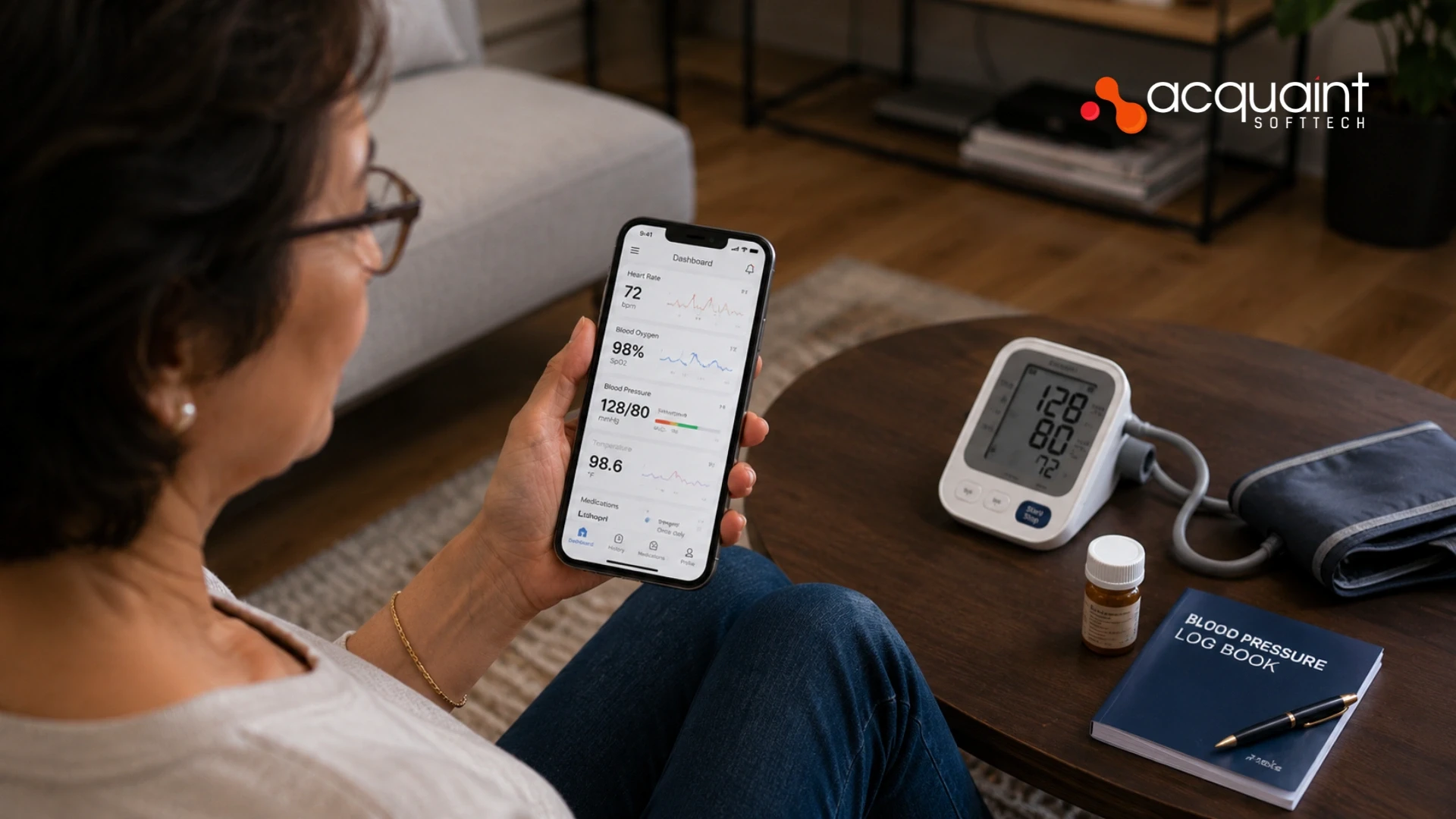
Remote Patient Monitoring App Development: From Wearable to Dashboard
Remote patient monitoring (RPM) app development connects wearable and medical devices to a clinical dashboard using IoT data pipelines, real-time alerting, and HIPAA-compliant cloud infrastructure. A production RPM system collects biometric data via Bluetooth or cellular, transmits it through an encrypted MQTT or HTTPS pipeline, stores it in a time-series database, and surfaces it in a clinical dashboard with threshold-based alerts, trend visualisation, and EHR write-back via HL7 FHIR.

Ahmed Ginani
June 9, 2026
Hospital Management System Development: Modules, Architecture, and Integration Map
A hospital management system (HMS) is integrated software that connects every operational and clinical function in a hospital: patient registration, appointment scheduling, EHR and EMR, pharmacy, laboratory, radiology, billing, and inventory, in a single platform with role-based access. Modern HMS builds in 2026 use microservices architecture, HL7 FHIR for integration, HIPAA-compliant cloud infrastructure, and role-based access control as the baseline.

Manish Patel
June 24, 2026.webp "Health Insurance Platform Development: Payer Systems, Member Portals, and Telehealth Integration")
Health Insurance Platform Development: Payer Systems, Member Portals, and Telehealth Integration
Health insurance platform development is the building of the technology a health payer needs to enrol members, adjudicate claims, manage benefits, and connect care. It spans three pillars: a payer core system for eligibility, claims, and benefits; a member portal and app for self-service; and FHIR-based integration with telehealth, EHRs, and pharmacy systems. A custom payer platform typically costs $300,000 to $1.5M and must be HIPAA-compliant and CMS interoperability-ready from day one.
Manish Patel
June 23, 2026India (Head Office)
203/204, Shapath-II, Near Silver Leaf Hotel, Opp. Rajpath Club, SG Highway, Ahmedabad-380054, Gujarat
USA
7838 Camino Cielo St, Highland, CA 92346
UK
The Powerhouse, 21 Woodthorpe Road, Ashford, England, TW15 2RP
New Zealand
42 Exler Place, Avondale, Auckland 0600, New Zealand
Canada
141 Skyview Bay NE , Calgary, Alberta, T3N 2K6