

Hotel Search and Filtering: Building Fast, Faceted Search With Map View, Price Ranges
You can filter hotels by map view, amenities, and price range using popular travel platforms like Google Hotels. To build your own, faceted hotel search combines a search index that returns results in milliseconds, filters for price ranges and amenities, and an interactive map with clustered markers that updates results as the user pans and zooms.

Sagar P
As a Business Analyst at Acquaint Softtech, I have watched more booking products lose users at the search screen than at checkout, which is why we treat hotel search as a software product development problem, not a UI afterthought. If a guest cannot narrow a thousand listings to the right ten in seconds, they leave for a platform that lets them.
This is a build article, not a how-to-use-Google-Hotels tutorial. Most articles on this topic either explain how to search on Google or how to scrape prices. This one explains how to engineer the search itself: the index, the facets, the map, and the filters, so a technical team can build a hotel search engine that feels instant.

- A travel or hotel founder whose search feels slow or returns the wrong results.
- A CTO choosing between a database query and a search engine like Elasticsearch for hotel listings.
- A product owner mapping faceted filters, a map-based hotel finder, and price and amenity controls.
- A team designing map-based search with clusters that update as the user moves the map.
- A leader weighing an off-the-shelf search widget against a custom, fast faceted search build.
For where this fits in the bigger picture, our complete guide to travel and hospitality software development maps how search sits inside a booking engine alongside availability, pricing, and payments. Search is the front door to all of it.
For the layer search feeds into, our guide on how hotel booking engines work covers availability and reservation architecture. Here we go deep on the discovery layer that comes first.
What is faceted hotel search?
Faceted hotel search is a search interface where multiple filters, such as price range, amenities, star rating, and location, can be combined and refined at once, with live counts showing how many hotels match each option. It is the standard behind every major hotel search engine.
A facet is a filterable attribute of a listing, like free Wi-Fi, a pool, or a nightly price band. Faceted search lets a guest stack facets (pet-friendly plus parking plus under 150 dollars) and see results and counts update instantly, instead of running a fresh search each time.
The hard part is doing all of that in milliseconds across thousands of listings. That is a search-engineering problem, which is why teams hire MERN stack developers who have built faceted interfaces on a real search index rather than filtering a database in the browser.
How to use filters and map view (Google Hotels)
On a platform like Google Hotels, you set a price range, pick amenities, and toggle the map. The same three controls are what any custom hotel search must deliver well.
How to use filters and map view
Price range: use the per-night price slider at the top of the search page to set your minimum and maximum budget.
Amenities: click the amenities tab to select specific needs like free Wi-Fi, a swimming pool, parking, air conditioning, or a fitness center.
Map view: toggle the interactive map to see hotel locations, compare nearby alternatives, and automatically update results as you move the map area.
Google documents this flow in its own guide to searching for hotels on Google. Acquaint Softtech uses that behavior as the baseline every custom search should match or beat, because it is the interaction guests already expect.
How faceted search works for hotels
Faceted search works by pre-indexing every listing's attributes so the engine can filter and count matches in one pass. When a guest applies a filter, the index returns both the matching hotels and updated counts for every other facet, all in milliseconds.
Behind the scenes, a search engine stores an inverted index: for each amenity, price band, and location, it already knows which listings qualify. Applying a facet is then a fast set intersection, not a slow scan of every row. This is why a proper index feels instant where a database query crawls.
Getting the index schema and analyzers right is the foundation of the whole feature, so teams often hire Python developers to build the indexing pipeline that keeps listings, prices, and availability in sync with the search engine. For work that spans months, a dedicated software development team keeps that pipeline consistent from launch through scale.
Best search engine for hotel listings: Elasticsearch and alternatives
Elasticsearch (and its fork OpenSearch) is the most common engine for hotel listings, because it does full-text search, faceted aggregations, and geo queries in one system. Typesense, Meilisearch, and Algolia are faster-to-adopt alternatives for smaller catalogs.
Engine | Best for | Trade-off |
Elasticsearch / OpenSearch | Large catalogs, geo + facets + full text | More ops effort to run and tune |
Typesense / Meilisearch | Small to mid catalogs, fast setup | Fewer advanced geo and scaling options |
Algolia | Managed, instant search UX | Recurring cost scales with usage |
PostgreSQL + PostGIS | Simple listings, tight budgets | Slower facets and search at scale |
For most hotel platforms with real geo and facet needs, Elasticsearch is the durable default. Standing it up and tuning relevance is specialist work, so teams hire Django developers to wrap it in a clean API rather than exposing the raw engine.
How to build hotel search with map view, step by step
To build hotel search with a map view, index your listings, build the facet API, wire the map to the search viewport, and keep the index fresh. Here is the build in six steps.
Model and index the listings. Define a search schema with amenities, price bands, geo coordinates, and availability, and load it into the search engine.
Build the facet API. Return matching hotels plus live counts for every filter in a single query so the UI never runs multiple round trips.
Add geo search. Support radius and bounding-box queries so results can be filtered to the map's current viewport.
Wire the map to the results. Sync the map viewport, marker clusters, and the result list so panning or zooming updates both together.
Build the filter UI. Add a price slider, amenity checkboxes, and instant result and count updates with no full page reload.
Keep the index fresh. Stream listing, price, and availability changes into the index so search never shows stale rooms.
This is genuine AI development services territory once you add relevance ranking and typo tolerance, because good search is a model as much as an index.
Scoping the schema and facets up front is exactly what a product discovery workshop is for, and many teams then hire remote developers to build the index and API while their product team owns the UX.
Not sure whether to use a database or a real search engine?
Picking wrong here means rebuilding search under load a year later. We map your listing volume, filters, and map needs to the right engine, Elasticsearch, Typesense, or a database, with a fixed scope, clear milestones, and IP that is yours from day one. You interview the engineers before you commit.
Map-based hotel search design: clusters and viewport
Good map-based hotel search design uses marker clustering to keep the map readable, a synced viewport so results match what is on screen, and price-pin markers so guests compare cost and location at a glance.
Clustering groups nearby markers into one pin with a count, so a dense city does not become an unreadable wall of pins. As the guest zooms in, clusters split into individual price pins. Without clustering, a map-based hotel finder becomes slow and cluttered exactly where inventory is densest.
The viewport is the second half: when a guest pans the map, the search re-runs a bounding-box query and the list updates to match. Keeping that loop smooth is front-end and geo work, so teams hire React Native developers when the same map-based booking experience must also ship in a mobile app. For smarter ranking that learns from what guests click and book, teams also hire AI/ML engineers to tune relevance over time.
Price range and amenities filters that stay fast
Price and amenity filters stay fast when they run as aggregations inside the search engine, not as loops in application code. The engine returns filtered results and a live count for every option in one query.
A price slider maps to a range query, and a histogram of results per price band helps guests set a sensible budget. Amenity checkboxes map to facet filters that intersect instantly. The rule is simple: every filter change is one query to the index, never a re-fetch and re-filter in the browser.
Because these queries run constantly under real traffic, they must be tuned and monitored, so teams hire DevOps engineers to keep the search cluster fast and stable. Acquaint Softtech treats search latency as a product metric, not an afterthought, because a slow filter quietly costs bookings.
Hotel search tech stack
A dependable hotel search stack pairs a search engine for the index with a mapping library for the map, a fast front end, and an indexing pipeline that keeps everything in sync.
Layer | Common choice | Why |
Search index | Elasticsearch / OpenSearch | Full-text, facets, and geo queries |
API / backend | Node.js or Django | Serve facet and geo results fast |
Front end | React or Next.js | Instant filters and result updates |
Map | Mapbox or Google Maps + clustering | Readable, interactive map view |
Database | PostgreSQL (+ PostGIS) | Source of truth for listings |
Indexing pipeline | Queue + sync workers | Keep the index fresh in real time |
For the results interface, teams often hire MEAN stack developers to build a fast, filter-heavy front end over the search API.
Accessibility matters here too. Building filters that work with a keyboard and screen readers to the W3C's WCAG 2.2 accessibility guidelines widens your audience and reduces legal risk across the US, UK, and EU.
How Google Hotels works, and what to learn from it
Google Hotels is a free hotel listing and search product, not a booking platform. It shows Google hotel prices from partners, offers Google hotel price alerts, and lets you search hotels by map, then sends you to an OTA or the hotel to book.
It is worth studying because it sets guest expectations. A Google hotel listing free of charge, a map that answers hotel near me Google Maps queries, and Google Travel hotel filters for price and amenities are now the baseline. When a guest asks how to search for hotels near an address on Google Maps or how to search for hotels in Google Maps, they learn a pattern your product will be measured against.
The lesson for a custom build is not to copy Google, but to match its speed and clarity while owning your own inventory and conversion. Many operators use software development outsourcing to reach that bar without a large in-house team. For teams that want a senior hand to set search architecture before the first sprint, virtual CTO services provide that experience on demand.
Hotel search module cost by market
Hotel search module cost depends on scope and where your team sits. A basic filtered list is far cheaper than a full faceted search with a synced map, geo queries, and a real-time indexing pipeline.
The ranges below are 2026 planning estimates at local agency rates, not fixed quotes. Offshore delivery from India typically lands well below these numbers.
Target market | Basic search module | Full faceted + map search |
United States / New York | $15,000 to $35,000 | $50,000 to $130,000+ |
United Kingdom | GBP 12,000 to 28,000 | GBP 40,000 to 104,000+ |
Europe (EU) | EUR 14,000 to 32,000 | EUR 46,000 to 118,000+ |
Australia | AUD 24,000 to 52,000 | AUD 78,000 to 195,000+ |
New Zealand | NZD 26,000 to 56,000 | NZD 84,000 to 210,000+ |
The biggest lever is engineering rate, not the feature list, which is why many teams add IT staff augmentation from India to build the same search at a fraction of local cost.
Real case study: a homestay booking platform
No two builds are identical, but the closest documented parallel from our own work is Hiran Holidays, a homestay booking platform for which Acquaint Softtech built the search, booking, and reservation layers that let travelers find and compare stays. The discovery challenges there map directly onto hotel search and filtering.
Field | Hiran Holidays (homestay booking platform, Clutch verified, 4.5 / 5.0) |
Client | Hiran Holidays, owner Savdasbhai Lakhnotra, a homestay booking business. |
Issue faced | Travelers had no fast way to search, compare, and book stays in one place, with reviews and pricing scattered. |
Challenge | Build a searchable booking platform with a central reservation system, payments, and review management that stayed reliable as listings grew. |
How we solved it | Acquaint Softtech designed and built the search and booking flow, online booking system, payment integration, review management, and a central reservation system, iterating on the design with the client before development and testing on both sides. |
How it helped | Travelers could search, filter, and book stays in one place, and the platform stayed stable enough to grow its audience. |
Result | Organic traffic grew by roughly 40 to 50 percent, delivered on schedule with prompt, well-communicated support. |
Why Acquaint Softtech | Outstanding availability, prompt problem-solving, and clean delivery, verified on our Clutch profile at 4.5 out of 5.0 overall with 5.0 for quality, schedule, and cost. |
Why teams struggle, and what to check before you hire
Most hotel search builds do not fail at the UI. They fail at the index and the sync, where a stale listing, a slow facet query, or a map that fights the results list quietly pushes guests to a faster competitor.
Before you commit to a partner for a hotel search build, check for these:
Do they use a real search index for facets, not a database filter that slows down at scale?
Is the map viewport synced to the results and the geo query, not bolted on?
Does an indexing pipeline keep listings, prices, and availability fresh in real time?
Do they have verifiable booking-platform and search delivery experience?
That last point is where track record matters. Acquaint Softtech has delivered 1,300 or more projects over 13 or more years with 70 or more in-house engineers and 50 or more Clutch reviews, and can deploy vetted developers within 48 hours. After launch, search needs tuning as inventory and query patterns shift, so ongoing support and maintenance services keep relevance, speed, and the index healthy.
Not sure if your search is a quick fix or a rebuild?
The wrong call here costs either months of patching a slow search or a stalled from-scratch build. Share your listing volume, filters, and map needs, and we will give you a straight read on whether a tune-up, a new index, or a full faceted search fits, with the scope and cost to match. No sales pitch, just honest engineering advice.
Frequently Asked Questions
-
How do you build hotel search with a map view?
Index your listings in a search engine with geo coordinates, build a facet API that returns matches and counts in one query, add bounding-box geo search, then sync an interactive map with clustered markers to the result list so panning and zooming update both together.
-
What is the best search engine for hotel listings?
Elasticsearch or its fork, OpenSearch, is the common default because it handles full-text search, faceted filters, and geo queries together. For smaller catalogs, Typesense, Meilisearch, or a managed option like Algolia are faster to adopt.
-
How does faceted search work for hotels?
Faceted search pre-indexes each listing's attributes, so applying a filter like a price range or an amenity is a fast set intersection. The engine returns matching hotels plus live counts for every other facet in one pass, all in milliseconds.
-
What is good map-based hotel search design?
Good map-based hotel search design uses marker clustering to keep dense areas readable, price-pin markers so guests compare cost and location at a glance, and a viewport synced to the results, so moving the map re-runs the search and updates the list.
-
What is the best hotel search engine for prices?
For travelers, Google Hotels, Kayak, and Trivago compare prices across many booking sites in one view. For a business building its own, the best engine is the one powering your index, usually Elasticsearch, feeding a clear price filter and comparison UI.
-
Is there a price tracker for hotels?
Yes. Google Hotels offers price tracking, and tools like Kayak and Hopper track rates and alert you to changes. In a custom build, you add price tracking by storing rate history and notifying users when a watched hotel drops below their target.
-
Can you set a Google Alert for hotel prices?
Not through classic Google Alerts, which track web mentions. Instead, use Google hotel price alerts inside Google Hotels: open a hotel or search, turn on price tracking, and Google emails you when prices for your dates change.
With over 9 years of hands-on experience in web application analysis, design, planning, and management, I have had the privilege of transforming ideas into dynamic digital solutions. From handling eCommerce platforms to robust ERP systems, my expertise spans across JS & PHP-based frameworks and CMS like: WordPress, React JS, and Laravel.
Table of Contents
Get Started with Acquaint Softtech
- 13+ Years Delivering Software Excellence
- 1300+ Projects Delivered With Precision
- Official Laravel & Laravel News Partner
- Official Statamic Partner
Related Blog
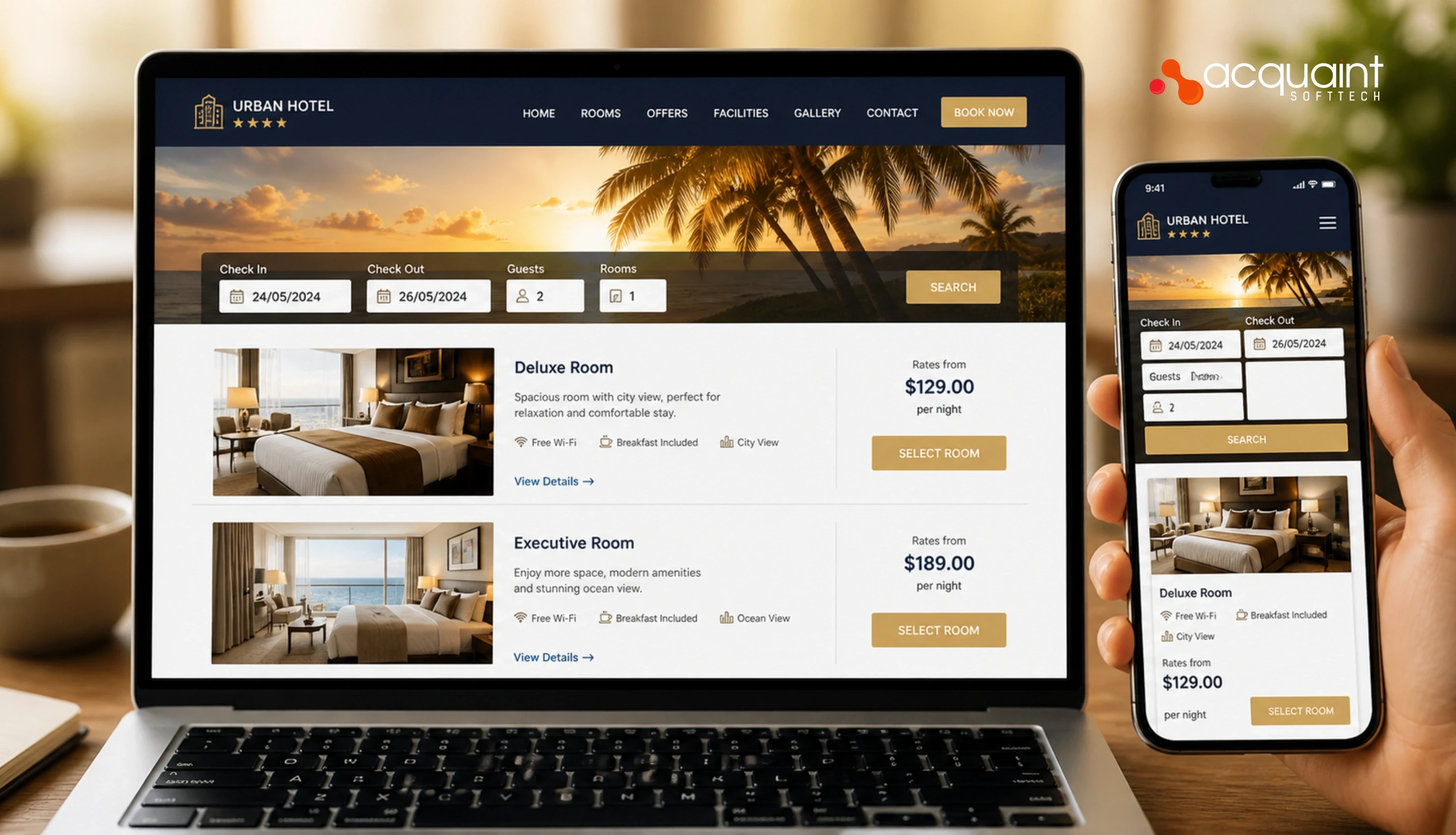
How Hotel Booking Engines Work: Search, Availability, Pricing, and Reservation Architecture
A hotel booking engine is not a search bar. It is an availability engine, a pricing decision system, a payment pre-authorisation layer, and a channel inventory synchroniser, all running simultaneously. This guide explains every architectural layer and how each one connects in a production system.

Manish Patel
May 12, 2026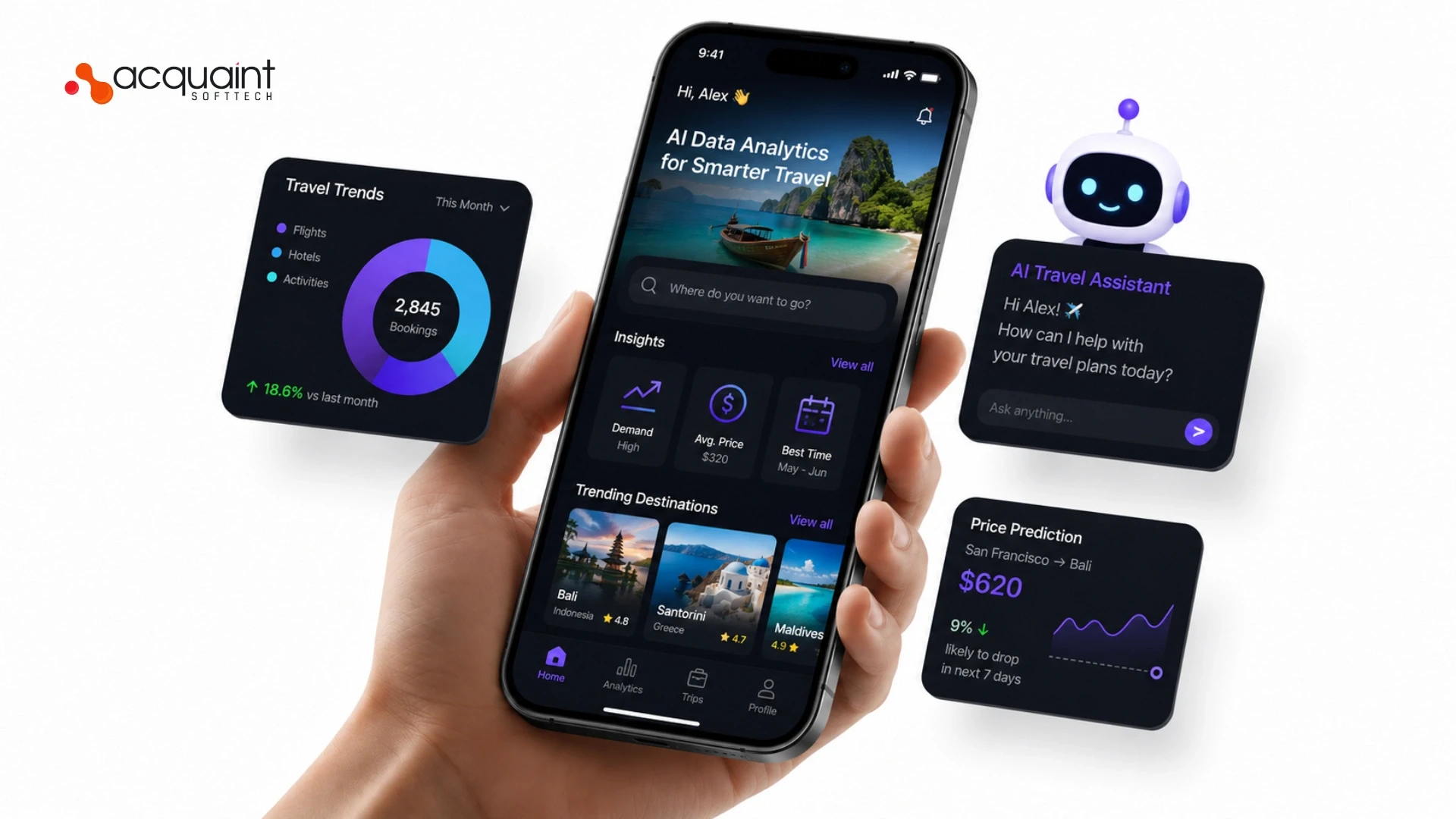
AI and Data Analytics in Travel: Demand Forecasting, Price Optimization, and Customer Intelligence
AI and data analytics in travel use machine learning to turn booking, search, and customer data into revenue. The three core engines are demand forecasting, which predicts future occupancy and bookings; price optimization, which sets the best price in real time based on demand; and customer intelligence, which identifies high-value travellers and predicts who will book or cancel. Hotels using AI-driven pricing report revenue gains of 5 to 14%.
Manish Patel
June 29, 2026
How to Build an OTA: Online Travel Agency Architecture for Flight, Hotel & Package Booking
Most OTA builds fail not on the booking logic but on the integration layer. Here is the complete architecture map, GDS, hotel aggregation, package bundling, payments, and what each module actually costs to build in 2026.
Manish Patel
May 27, 2026India (Head Office)
203/204, Shapath-II, Near Silver Leaf Hotel, Opp. Rajpath Club, SG Highway, Ahmedabad-380054, Gujarat
USA
7838 Camino Cielo St, Highland, CA 92346
UK
The Powerhouse, 21 Woodthorpe Road, Ashford, England, TW15 2RP
New Zealand
42 Exler Place, Avondale, Auckland 0600, New Zealand
Canada
141 Skyview Bay NE , Calgary, Alberta, T3N 2K6