

Telemedicine for Mental Health: Building a Therapy Platform That Protects Privacy
Building a secure mental health telemedicine platform means weaving privacy into every layer, from the video call to data storage, and adhering strictly to HIPAA in the US or GDPR in the UK and Europe. The essentials are end-to-end encryption for all video, audio, and chat; strict access control with multi-factor authentication and role-based permissions; encrypted data storage with regular backups; signed Business Associate Agreements with every vendor; data minimization; and audit logs that track who viewed each record and when.

Zubair Pateljiwala
Introduction
As the Marketing Manager at Acquaint Softtech, I spend my days studying what makes people trust a digital health product, and in mental health the answer is almost always privacy, which is why serious mental health software product development treats confidentiality as the feature, not the footnote. Patients share their most sensitive thoughts on these platforms. One privacy misstep and the trust that took months to build is gone in a single headline.
I have watched the growth of online therapy platforms turn a niche into a mainstream expectation, and the founders who win are the ones who make security visible rather than assumed.
This article brings together what our engineering team implements and what our market research shows patients actually want, so you can build a therapy telemedicine platform that people feel safe using and keep coming back to.

- A CEO, CTO, or COO planning a mental health or teletherapy platform.
- Deciding how to make an online therapy app genuinely HIPAA and GDPR compliant.
- Working out which features a teletherapy platform actually needs.
- Responsible for crisis handling, ethics, and patient safety in the product.
- Budgeting a custom teletherapy platform and need real cost ranges.
- Looking for a proven partner to build and maintain an online therapy platform.
A therapy platform is one kind of clinical system, so it helps to see the whole picture before scoping the mental health piece. Our telemedicine app development guide maps the full architecture, from secure video and scheduling to records and integrations, and it is the context every teletherapy build should start from.
Because everything in mental health tech is protected health information, privacy engineering decides whether you pass an audit or pay for one. Our HIPAA compliance checklist for developers is the standard we apply from the first sprint, so encryption, access control, and audit logging are designed in rather than retrofitted after a breach.
Why virtual mental health care is growing

Virtual mental health care is growing because it removes the three biggest barriers to therapy: distance, cost, and stigma. Patients who would never sit in a waiting room will open an app from their bedroom, and that shift has turned teletherapy from a pandemic stopgap into a permanent channel.
The adoption surge and teletherapy adoption rates 2026
Teletherapy adoption rates in 2026 remain far above pre-pandemic levels, with a large share of mental health visits now delivered remotely rather than in person. The market has matured past early experiments, and patients increasingly expect a digital-first option from any provider. For teams building in this space, our dedicated software development teams treat that expectation as the baseline, not a bonus feature.
Why patients prefer virtual mental health care
Patients prefer virtual mental health care for reasons that are consistent across markets. It fits around work and caregiving, it removes travel and its cost, and it offers a level of discretion that a physical clinic cannot. For many, talking to a therapist from home lowers the fear of judgment enough to seek help at all, which is the whole point.
Are mental health apps profitable?
Mental health apps can be profitable, and the durable models are subscription, per-session teletherapy billing, employer and insurer contracts, and white-label licensing. The companies that hold users, rather than just acquire them, are the ones that pair clinical value with a trustworthy experience. Agencies that want to package and resell that experience often use white label software development to launch under their own brand.
What features does a teletherapy platform need?
A teletherapy platform needs secure video and messaging, scheduling, clinical notes, a matching system, billing, and a crisis-safety layer, all wrapped in privacy controls. The best online therapy platforms to work for, like Talkspace and Cerebral, set the bar on experience, but the differentiator is how safely the product handles the moments that matter most.
The patient and therapist experience
Both sides of the platform need to feel effortless. Patients need simple onboarding, easy booking, secure video and text, and a clear view of their sessions and progress. Therapists need a clean queue, structured note-taking, availability control, and fast access to a client's history without hunting through screens.
Because so much of this runs on phones, a consistent mobile and web experience is essential, which is why teams often hire React Native developers to keep the patient and therapist apps in step across devices.
Therapist-patient matching algorithm design
Matching is where a teletherapy platform earns loyalty. A good therapist-patient matching algorithm design weighs clinical need, specialty, language, availability, and patient preference to suggest the right clinician quickly, because a poor first match is the fastest way to lose a vulnerable user. This is data and logic heavy work, so teams frequently hire Python developers to build and tune the matching engine.
Smarter matching and triage are also where machine learning helps, and our AI development services add capabilities like intake analysis and personalized session recommendations, always with a clinician in the loop rather than in place of one.
How do you handle crisis situations in mental health apps?
You handle crisis situations by designing an explicit safety net into the product, not by hoping it never happens. That means one-tap access to a crisis line such as the 988 Suicide and Crisis Lifeline in the US, clear escalation paths to on-call professionals or emergency services, and risk signals that prompt a human to step in. This layer carries the highest clinical and ethical responsibility in the whole build, so it is scoped first, tested hardest, and never treated as an afterthought.
How to build a HIPAA-compliant online therapy app

To build a HIPAA-compliant online therapy app, weave privacy into every layer with end-to-end encryption, strict access control, secure storage, signed vendor agreements, data minimization, and complete audit logs. These are the HIPAA requirements for mental health apps in practice, and each one is an engineering decision made on day one, not a checkbox added before launch.
End-to-end encryption for every interaction
Encrypt video, audio, and text so that only the patient and therapist can see or hear the session, with data protected both in transit and at rest. A consumer video tool is not enough; the video layer itself must be built or licensed to healthcare standards.
Many teams use a compliant option such as Zoom for Healthcare, backed by a signed agreement, rather than a general-purpose video SDK that was never designed for protected health information.
Strict access control and multi-factor authentication
Limit who can see sensitive records using multi-factor authentication and role-based permissions, so a billing clerk never sees clinical notes and a therapist only sees their own clients. This access model is the backbone of the whole system, and getting it right is where experienced Node.js development for the secure backend pays for itself many times over.
Secure storage, BAAs, and data minimization
Store patient notes and files in encrypted databases with regular, tested backups, and execute a Business Associate Agreement with every cloud and software vendor that touches protected health information. Collect only the personal and medical data care actually requires, because data you never store is data that can never leak. Comprehensive backend and interface work like this is often delivered by teams you hire MERN stack developers to staff.
Audit logs and monitoring
Track who accesses each patient file and when, so unauthorized activity is spotted quickly and every access is accountable. Audit logs are not just a compliance artifact; they are how you detect a problem before it becomes a breach notification.
For a full walkthrough of how to build a therapy telemedicine platform end to end, the sequence above, encryption first, then access, then storage, then logging, is the order we follow on every mental health build.
Want privacy engineered in from day one?
Share your mental health product idea with Acquaint Softtech. We will map the encryption, access, and audit architecture for your regions and give you a fixed build scope you can budget against.
HIPAA, GDPR, and the compliance requirements that matter
Compliance for a mental health platform comes down to a handful of requirements that repeat across every privacy law: a lawful basis for handling sensitive data, strong safeguards, defined retention, and breach readiness.
HIPAA governs US platforms and GDPR governs the UK and Europe, while Australia and New Zealand run their own frameworks, but the engineering they ask for overlaps far more than it differs. The official HHS HIPAA guidance is the reference point for any US build.
Treat mental health data as the most sensitive class
Every major privacy law singles out health data for extra protection. GDPR classes it as special category information that needs a clear lawful basis and strong safeguards, HIPAA defines it as protected health information with strict use and disclosure limits, and the UK regulator's guidance from the Information Commissioner's Office sets the practical benchmark for handling it. Build to the strictest standard that applies to any of your users, and you satisfy the rest by default.
Consent, retention, and breach readiness
Whichever law applies, three obligations recur: capture informed consent for how data is used, hold data only as long as care and the law require, then delete it, and have a tested plan to detect and report a breach quickly. New York City platforms face some of the strictest state-level expectations, so meeting these obligations to the highest bar from the start beats retrofitting later.
Build for many markets, not one hardcoded policy
A platform that serves patients across the US, UK, Europe, Australia, and New Zealand needs data handling that adapts per user rather than a single policy baked into the code. Designing that flexibility in early avoids a painful rebuild when you expand, and adding the specialism quickly when you need it is exactly what IT staff augmentation is for.
Disadvantages, ethics, and risks of online therapy
The honest disadvantages of online therapy are privacy exposure, uneven access, weaker crisis response, and harder rapport, and a serious platform is designed to reduce each one. Ignoring these issues with online therapy does not make them disappear; it just moves the risk onto your most vulnerable users.
Privacy and security risk factors
Research on privacy and security risk factors related to telehealth services, including systematic reviews, consistently points to data breaches, weak encryption, and unclear consent as the top concerns. The lesson for builders is direct: encryption, access control, and audit logging are not optional polish, they are the mitigations the evidence asks for.
Telehealth counseling ethics and guidelines for online therapy
Telehealth counseling ethics and the guidelines for online therapy raise real questions your product must answer in software. What are some of the ethical challenges that can arise when working with clients in tele mental health? Verifying identity and location, confirming a clinician is licensed where the patient sits, handling emergencies across distance, and keeping records confidential are the recurring ones, and each maps to a concrete feature rather than a policy paragraph.
The access gap
The digital divide is a genuine limitation: patients with poor connectivity or low digital confidence can be excluded by the very tool meant to help them. Thoughtful onboarding, low-bandwidth modes, and phone fallbacks widen access, and designing for them is part of building responsibly, not an edge case to skip.
Custom teletherapy platform cost

A custom teletherapy platform typically costs from tens of thousands for a focused build to six figures for a full, multi-region clinical platform, priced in each market's currency. The mental health telemedicine app development cost depends on the feature set, the compliance surface, and how much of the experience is custom versus assembled from vetted components.
Build, buy, or assemble
You can buy generic telemedicine app source code and customize it, license components, or build a custom platform. Source code kits look cheap up front but often cost more once privacy, crisis handling, and compliance are added properly. Working with an experienced telemedicine software development company usually lands between the two, and you can lower the rate further by outsourcing the software development to a vetted healthcare team.
Estimated cost by market
The figures below are typical 2026 planning ranges, not a fixed quote. They cover a custom teletherapy build with secure video, matching, notes, billing, and a crisis-safety layer.
Target market | Focused build | Full clinical platform |
United States / New York City | $60,000 to $120,000 | $150,000 and up |
United Kingdom | GBP 48,000 to 95,000 | GBP 120,000 and up |
Europe (EU) | EUR 55,000 to 110,000 | EUR 140,000 and up |
Australia | AUD 90,000 to 180,000 | AUD 230,000 and up |
New Zealand | NZD 95,000 to 190,000 | NZD 250,000 and up |
If you want the scope and success metrics mapped before committing a budget, a short discovery workshop is the cheapest way to avoid an expensive rebuild later.
What to check before you hire a development partner
Before you hire developers for an online therapy platform, verify five things: healthcare compliance history, privacy-by-design experience, crisis-handling capability, region coverage, and long-term support. A capable mental health telehealth app development company should be able to show, not just claim, each one.
Compliance track record. Ask for HIPAA and GDPR project history with references, not a generic assurance.
Privacy by design. Confirm they build encryption, access control, and audit logging from the first sprint.
Crisis and safety. Check they have shipped crisis escalation and safety features before, and understand the responsibility.
Region fit. Make sure they understand the rules of every market you serve, from the US to the UK, EU, Australia, and New Zealand.
Long-term support. Mental health platforms need ongoing maintenance, so confirm the team can stay with you after launch.
Whether you need one specialist or a full squad, you can hire remote developers who have shipped compliant, sensitive-data platforms before, so the learning curve is ours, not yours.
Case study: a private teletherapy build
Here is a representative engagement from our HealthTech delivery portfolio, verified against our public Clutch reputation, showing thxe issue, the challenges, how we solved them, and the result.
Teletherapy platform, privacy-first build
The issue: A behavioral health provider wanted to move from phone-only counseling to a full teletherapy platform, but worried that a data incident would destroy the trust their clients depended on.
The challenges: Three risks had to be handled together, without slowing delivery.
Sensitive session data meant encryption and access control could not be added later.
Clients needed a reliable crisis path, not just a booking and video tool.
The provider served patients in more than one country, each with its own privacy law.
How we solved it: A dedicated team built end-to-end encrypted video and messaging, role-based access with multi-factor authentication, encrypted storage with tested backups, and a one-tap crisis escalation layer. Region-aware data handling covered HIPAA and GDPR, and every vendor was placed under a Business Associate Agreement.
The result: The provider launched a teletherapy platform their clinicians trusted, with a full audit trail on every record access and a crisis path tested before go-live. Privacy became a selling point rather than a worry.
Before and after at a glance
Measure | Before | After |
Channel | Phone only | Secure video and chat |
Encryption | Basic | End to end |
Crisis path | Ad hoc | One-tap escalation |
Compliance | Single region | HIPAA and GDPR |
Company-wide proof is public: Acquaint Softtech has delivered 1,300 or more projects over 13 or more years with 70 or more in-house engineers and a public 5-star rating on Clutch, as an Official Laravel Partner serving founders across the USA, UK, Europe, Australia, and New Zealand. You can see more work on our case studies page.
Why build with Acquaint Softtech

Choose a partner with healthcare compliance depth, an in-house team, and proven delivery, and Acquaint Softtech offers all three. From a marketing seat, I can tell you the platforms that grow are the ones patients trust, and trust is built in the engineering. Most clients save 40 to 75 percent versus hiring equivalent talent in the US, UK, or Australia, without cutting quality.
Privacy first: HIPAA, GDPR, encryption, and audit logging handled from the first sprint.
Verified trust: 5-star Clutch rating and 1,300 or more delivered projects.
In-house talent: 70 or more full-time engineers, deployable within 48 hours.
Global reach: serving mental health founders across the USA, UK, Europe, Australia, and New Zealand.
For data-heavy and cross-platform teletherapy work, you can also hire MEAN stack developers experienced in secure, scalable healthcare builds.
To Sum Up
Telemedicine has made mental health care more accessible than it has ever been, but access without privacy is a liability, not a feature. Build the encryption, access control, crisis handling, and audit trail in from the start, respect the rules of every market you serve, and privacy becomes the reason patients choose you and stay.
Get that right and you are not just shipping an app; you are earning the trust that mental health care depends on.
Ready to build a therapy platform patients trust?
Talk with Acquaint Softtech about your mental health product. You leave with a recommended architecture, a privacy and compliance checklist for your regions, and a fixed build plan and timeline.
Frequently Asked Questions
-
How to build a HIPAA-compliant online therapy app?
Weave privacy into every layer with end-to-end encryption, multi-factor access control, encrypted storage, and full audit logs. Sign a Business Associate Agreement with every vendor and collect only the data care requires.
-
What features does a teletherapy platform need?
It needs secure video and messaging, scheduling, clinical notes, therapist matching, billing, and a crisis-safety layer. Every one of those sits inside privacy controls rather than beside them.
-
How do you handle crisis situations in mental health apps?
Design an explicit safety net with one-tap access to a crisis line and clear escalation to on-call professionals or emergency services. Scope and test this layer first, since it carries the highest clinical responsibility.
-
How much does a therapy app cost to build?
A focused custom build typically starts in the tens of thousands, while a full multi-region clinical platform runs into six figures. Cost depends on features, compliance scope, and how custom the experience is.
-
How much does it cost to develop a mental health app?
Simple wellness apps cost less, but a compliant teletherapy platform with secure video and crisis handling starts higher because privacy engineering is the bulk of the work. Budget for ongoing compliance and maintenance, not just the initial build.
-
How to develop a mental health app?
Define the exact problem and users, choose the model, then design privacy and safety before features. Build encryption, access control, and audit logging first, then layer on matching, sessions, and content.
-
How to build a telehealth app?
Start with the clinical workflow and compliance surface, then add secure video, scheduling, records, and payments. Treat HIPAA or GDPR as an architecture decision made before the first sprint, not a certification added at the end.
-
Are mental health apps profitable?
Yes, through subscriptions, per-session billing, employer and insurer contracts, and white-label licensing. The profitable ones retain users by pairing clinical value with a trustworthy, private experience.
I am Zubair Pateljiwala, a digital marketing professional with 15+ years of experience in SEO, content marketing, and performance marketing. As the Marketing Head at Acquaint Softtech, I focus on helping technology businesses improve their online visibility through SEO, GEO, AEO, and AI-driven content strategies. I enjoy transforming complex software development concepts into practical, easy-to-understand content that helps businesses make informed technology decisions.
Table of Contents
Get Started with Acquaint Softtech
- 13+ Years Delivering Software Excellence
- 1300+ Projects Delivered With Precision
- Official Laravel & Laravel News Partner
- Official Statamic Partner
Related Blog
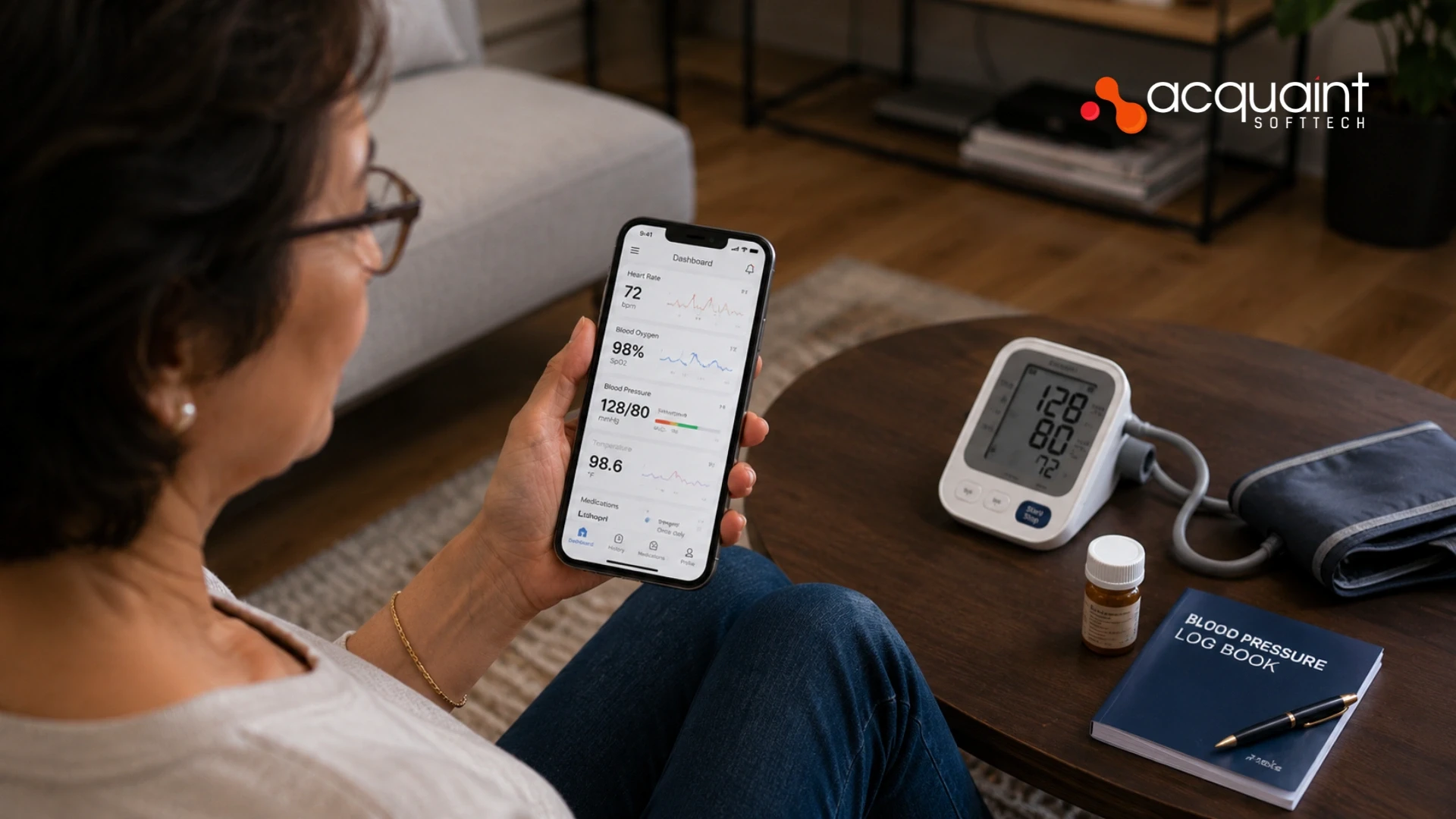
Remote Patient Monitoring App Development: From Wearable to Dashboard
Remote patient monitoring (RPM) app development connects wearable and medical devices to a clinical dashboard using IoT data pipelines, real-time alerting, and HIPAA-compliant cloud infrastructure. A production RPM system collects biometric data via Bluetooth or cellular, transmits it through an encrypted MQTT or HTTPS pipeline, stores it in a time-series database, and surfaces it in a clinical dashboard with threshold-based alerts, trend visualisation, and EHR write-back via HL7 FHIR.

Ahmed Ginani
June 9, 2026
Hospital Management System Development: Modules, Architecture, and Integration Map
A hospital management system (HMS) is integrated software that connects every operational and clinical function in a hospital: patient registration, appointment scheduling, EHR and EMR, pharmacy, laboratory, radiology, billing, and inventory, in a single platform with role-based access. Modern HMS builds in 2026 use microservices architecture, HL7 FHIR for integration, HIPAA-compliant cloud infrastructure, and role-based access control as the baseline.

Manish Patel
June 24, 2026.webp "Health Insurance Platform Development: Payer Systems, Member Portals, and Telehealth Integration")
Health Insurance Platform Development: Payer Systems, Member Portals, and Telehealth Integration
Health insurance platform development is the building of the technology a health payer needs to enrol members, adjudicate claims, manage benefits, and connect care. It spans three pillars: a payer core system for eligibility, claims, and benefits; a member portal and app for self-service; and FHIR-based integration with telehealth, EHRs, and pharmacy systems. A custom payer platform typically costs $300,000 to $1.5M and must be HIPAA-compliant and CMS interoperability-ready from day one.
Manish Patel
June 23, 2026India (Head Office)
203/204, Shapath-II, Near Silver Leaf Hotel, Opp. Rajpath Club, SG Highway, Ahmedabad-380054, Gujarat
USA
7838 Camino Cielo St, Highland, CA 92346
UK
The Powerhouse, 21 Woodthorpe Road, Ashford, England, TW15 2RP
New Zealand
42 Exler Place, Avondale, Auckland 0600, New Zealand
Canada
141 Skyview Bay NE , Calgary, Alberta, T3N 2K6