Develop a custom solution for your business to gain an upper edge by incorporating the perfect set of features for your website

Learn how image optimization transforms web design. If your website's sluggish with images, discover how image optimization boosts speed and user experience.
The best business website designs in 2026 get ten things right: a clear message, fast load speed, a mobile-first layout, an obvious call to action, easy navigation, strong trust signals, accessibility, a focused homepage, well-built key pages, and a design proven by results. What they share is not a look but a job done well, guiding a visitor to act without friction. Judge a design by these ten, not by whether it looks impressive in a screenshot.
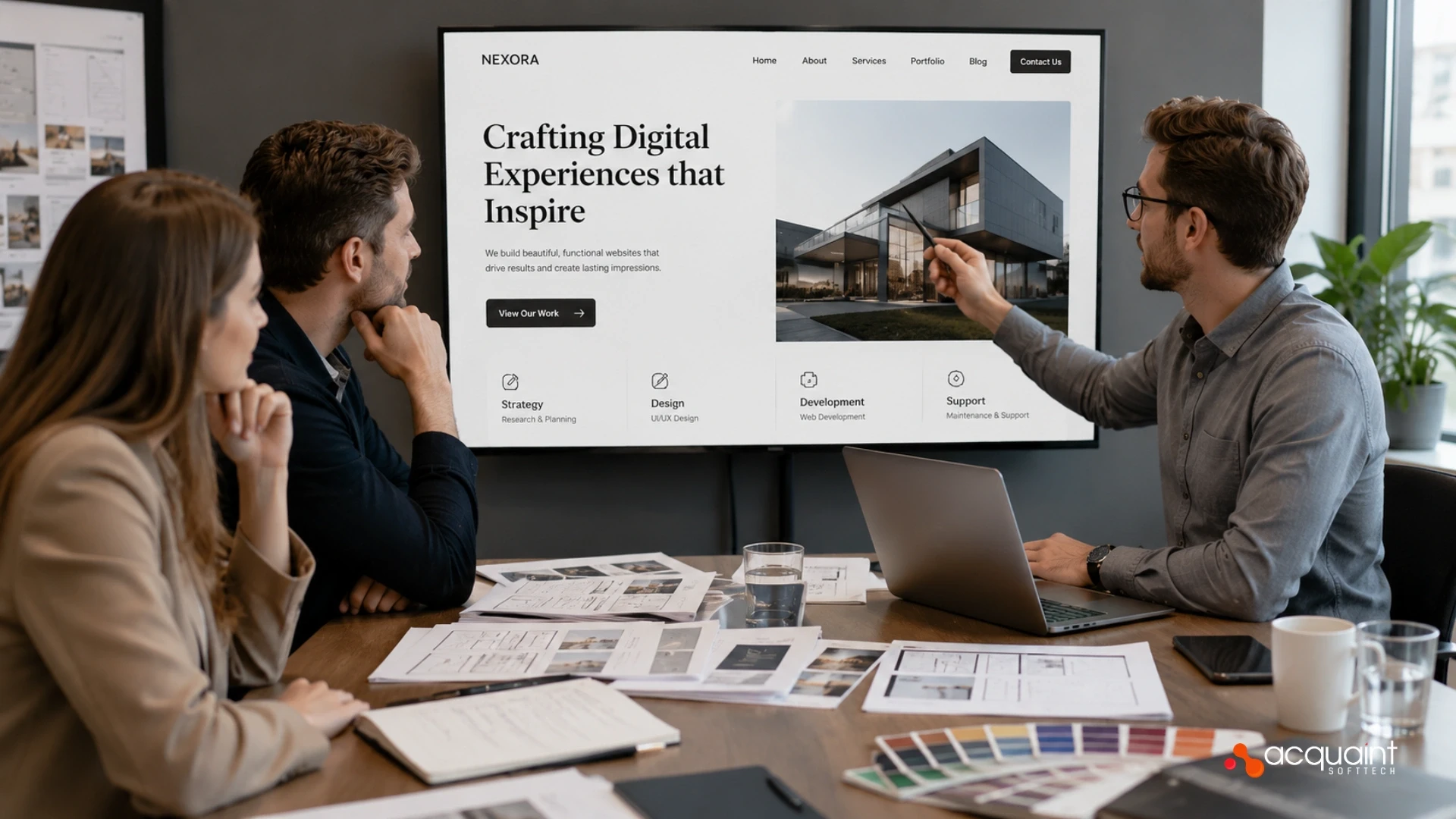
The best way to present web design to a client in 2026 is a shared, live design link they can comment on directly, backed by a short recorded walkthrough for clients in other time zones and a live call for the big decisions. Static images and emailed PDFs still have a place for sign-off, but they go stale the moment you edit. What matters more than the method is the framing: explain the reasoning before the visuals, and you will get better feedback and far fewer revision rounds.
Store passwords with Argon2id, offer passkeys as the strongest sign-in option, separate a user's identity from their account record, and rate-limit every authentication endpoint. Do not impose composition rules or forced password changes, as NIST advises against both. The weakest part of most systems is not the login screen but account recovery, so treat the reset flow with the same rigour as sign-in.
The forces shaping UX design in 2026 are legal and technical rather than aesthetic. Accessibility is now enforceable law in the EU and UK, deceptive interface patterns are explicitly prohibited under the EU Digital Services Act, and AI features have introduced new design problems around trust, correction and consent. Gradients, illustrations and full-screen video are visual design choices, not user experience decisions, and confusing the two is the most common mistake in this field.
A website redesign is worth doing when the site misrepresents your business, fails accessibility rules, cannot meet Core Web Vitals thresholds, or blocks your team from publishing. It is not worth doing simply because the site looks dated or a new marketing lead dislikes it. Measure conversion, speed and top-page traffic before you start, then rebuild in phases so you can prove the new version is better rather than hope it is.
No, UX and CX are not the same. User experience is how someone feels using one product, website, or app; customer experience is how they feel about your company across every interaction, including sales, billing, support, and delivery. UX is one part of CX, which is why a company can ship an excellent interface and still lose customers, and why the gap between the two is usually caused by systems rather than by design.


-(1).webp "4 Benefits of Redesigning Your Website (And When Not To)")