

Top food delivery app development companies for 2026.
A curated list for founders, restaurateurs, and product leaders hiring expert teams to build real-time, logistics-ready delivery platforms, from multi-restaurant marketplaces and cloud kitchens to grocery and quick-commerce apps. The global online food delivery market is projected to reach US$1.65 trillion by 2027, with mobile apps now driving most orders.
Building a food delivery app that survives real traffic is harder than shipping a menu and a cart. Few agencies can engineer real-time dispatch, surge-proof order flows, live tracking, and multi-vendor payouts that keep drivers, restaurants, and customers in sync. We ranked the top firms on verified Clutch data, pricing, and client outcomes.
Marketing Head








How we picked the top food delivery app development companies.
Not by rate, and not by who pays for placement. We ranked on what actually holds up when real orders start flowing.
We reviewed dozens of food delivery and on-demand app development companies across three types, template and clone providers, general app agencies, and specialist product engineering teams. Each was scored on five criteria that decide a delivery build: verified Clutch review depth, real on-demand and marketplace experience, technical depth in real-time systems, transparent pricing, and ideal use-case fit. Only companies with a minimum of 50 verified Clutch reviews made the shortlist. The five below are what remained.
The 6-point checklist for hiring a food delivery app developer.
Most agencies sound the same in a sales call. These are the six things to actually verify before you sign, each one is where delivery apps quietly break.
Can they handle peak load?
Ask how they engineer for 3 to 5 times order surges at lunch and dinner. If the answer is not about queue-based, surge-proof architecture, the app will slow exactly when revenue peaks.
Do they build all three apps?
A delivery platform needs a customer app, a restaurant dashboard, and a driver app, synced in real time. Confirm they build the full ecosystem, not just the customer-facing screen.
How real is their live tracking?
Live GPS tracking and accurate ETAs are easy to fake in a demo. Ask to see real-time location and driver-to-order matching working under real conditions, not a mockup.
Can they handle multi-vendor payments?
Multi-vendor payouts, refunds, and split payments are where money movement breaks trust. Verify they have shipped commission logic and payouts that reconcile cleanly.
Will the architecture scale?
Clone scripts hard-code one scenario. Ask whether the build can grow into new cities, vendors, and commission models without a rebuild you pay for twice.
What happens after launch?
Delivery apps need constant tuning as orders grow. Confirm ongoing maintenance, monitoring, and scaling support, so the team does not vanish the day you go live.
The 5 best food delivery app development companies, compared.
Here is how the five compare on verified Clutch reviews, minimum project size, real hourly cost, experience, and ideal use case.
Review counts, project sizes, and rates are compiled from each company's public Clutch profile and pricing pages as of [month/year], and are subject to change. Always confirm current figures directly on each provider's Clutch profile. This ranking reflects overall fit for building food delivery and on-demand apps, not a single dimension such as lowest rate.
The 5 best food delivery app development companies, profiled.
What each company is genuinely best at for food delivery, and where it fits your budget and stage, so you can match a team to your build rather than picking by rate alone.
Acquaint Softtech
Ahmedabad, India · Founded 2013 · 70+ developers
Acquaint Softtech ranks first on this list because it builds the part of a food delivery app that actually decides success: the full three-sided system, engineered to survive real traffic. Instead of a template locked to one scenario, you get a customer app, restaurant dashboard, and driver app built as one connected platform, with real-time dispatch, live GPS tracking, and multi-vendor payouts on Laravel, MERN, and React Native. The 70+ developer team has shipped on-demand and marketplace products across 20+ industries, with named reference clients including Lampoo, SuperFi, XOALA, and Great Colorado Homes.
What sets it apart is a combination rarely found in one provider: Official Laravel Partner and Laravel News Partner recognition, ISO 27001 certified security, a 4.9 star Clutch rating, NDA and 100% IP from day one, 48-hour developer onboarding, and a 5-day developer replacement guarantee, all at offshore pricing from $22 per hour. For founders and growth-stage brands that want senior engineering without enterprise price tags, it is the strongest overall fit here.
- ✔ Full three-sided build: customer, restaurant, and driver apps in sync
- ✔ Surge-proof, real-time dispatch and live tracking architecture
- ✔ Multi-vendor marketplace and secure payout expertise
- ✔ NDA and 100% IP from day one, 5-day replacement guarantee
- •Best value on custom and ongoing builds, not tiny one-off clone tweaks
- •Ideal for startup-to-growth stage, not only enterprise $50K+ budgets
- •Offshore hours, aligned to your overlap window
BairesDev
Mountain View, CA, USA · Founded 2009 · Nearshore delivery
BairesDev is a US-headquartered nearshore software company with 4,000+ senior engineers across Latin America, working with names like Google, Adobe, and Pinterest. For food delivery, its strength is raw capacity: it can stand up customer, restaurant, and driver apps in parallel and scale them for high-volume, enterprise-grade rollouts. The trade-off is cost and fit, its model is built for large budgets and big teams, so it is strongest when scale matters more than price. A solid choice for enterprises launching delivery at scale, less so for early-stage founders watching burn.
Cleveroad
New York, USA · Founded 2011 · R&D in Estonia
Cleveroad is a custom software and mobile app development company with offices in the USA and Estonia, and a strong track record across logistics, retail, and on-demand delivery. For food delivery, its strength is mobile-first customer and driver apps with real-time tracking and third-party integrations, making it a solid fit for products that need both native and cross-platform reach. The trade-off is entry cost: with projects typically starting at $25,000+, it fits funded builds more than lean MVPs.
Hedgehog Lab
Newcastle, UK · Founded 2007 · Offices in London & Boston
Hedgehog Lab is a UK-headquartered digital product studio with nearly two decades of app development experience across fintech, retail, and consumer products. For food delivery, its edge is design-led, premium consumer app craft, and it brings direct domain proof: it has built for Deliveroo, one of the biggest names in food delivery. It is best suited to brands where user experience is the main differentiator. The trade-off is price, with projects starting at $50,000+ and rates in the premium tier, it fits well-funded consumer brands more than early-stage builds.
Netguru
Poznań, Poland · Founded 2008 · 900+ team
Netguru is a Poland-based product design and development company trusted by major brands for scalable consumer apps. For food delivery, it brings direct domain proof: it has worked with Wolt and Delivery Hero, two of Europe's biggest delivery platforms. Its strength is design-led product engineering, building clean, scalable, customer-facing apps with strong strategy and UX support from concept to launch. The trade-off is price and focus, with projects starting at $50,000+, it fits well-funded product teams more than lean, budget-driven builds.
Clone or custom? Here is what actually decides it.
Founder & CEO, Acquaint Softtech
I will not tell you clone scripts are useless. In 13 years and 1,300+ projects, I have seen founders launch a simple ordering app on a template, validate demand, and invest in a real build only after. If you are testing an idea fast, a clone can be the right first step, and I will say so even when it sends you elsewhere.
The problem is what happens when it works. The orders that prove your idea are the same ones that break a template, a lunch rush it cannot handle, a second city, a payout model it hard-codes. That is when the low upfront price becomes the most expensive part of the project, because you are rebuilding the foundation while live customers are ordering on it.
So the real question is not "clone or custom." It is "am I testing an idea, or building the business?" Testing, start lean. Building, invest in a foundation that will not need replacing at your first real peak, that is the same advice I give on every discovery call.
Anyone can claim delivery expertise. Few can show it.
These are the marketplace and on-demand builds behind our ranking, real clients, real scale, the same engineering a food delivery platform demands.
Luxury resale demands more than just a storefront; it requires a high-performance engine capable of handling complex inventory and global traffic. We built a custom eCommerce development for Lampoo. It meant engineering a digital runway that converts browsers into loyal brand advocates.
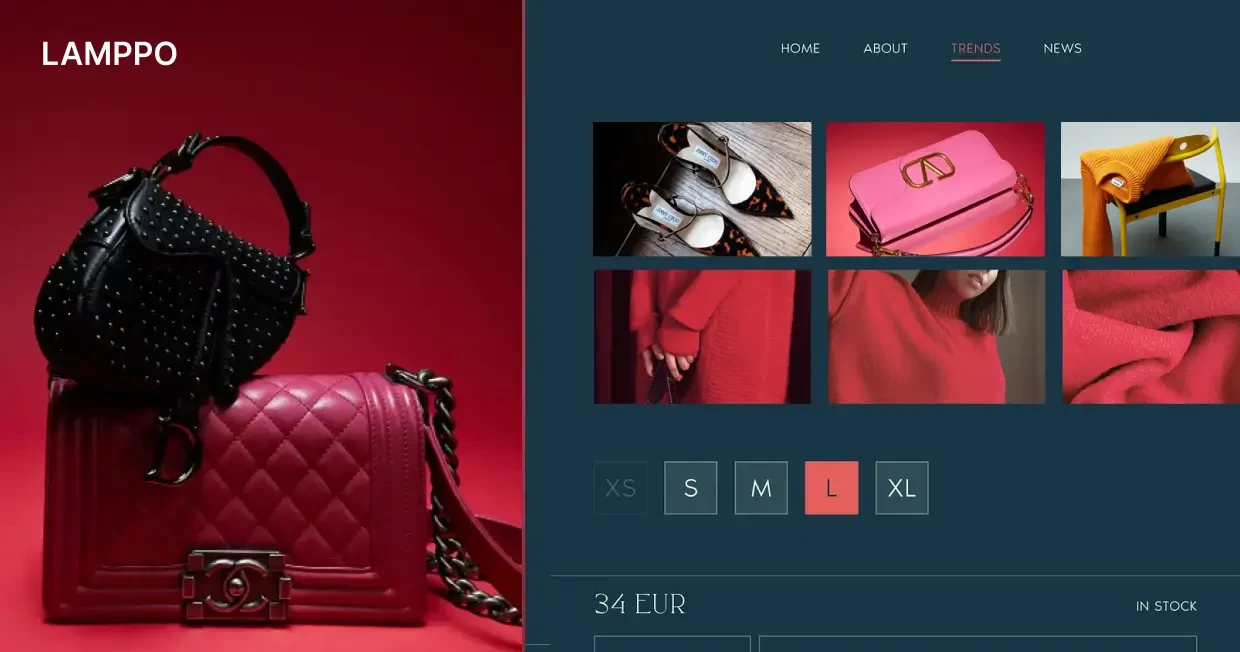
Develop a top-notch marketplace that is more than just buying & selling products. We develop the perfect solutions after extensive research and carefully choosing the best technologist suitable for your specific needs.
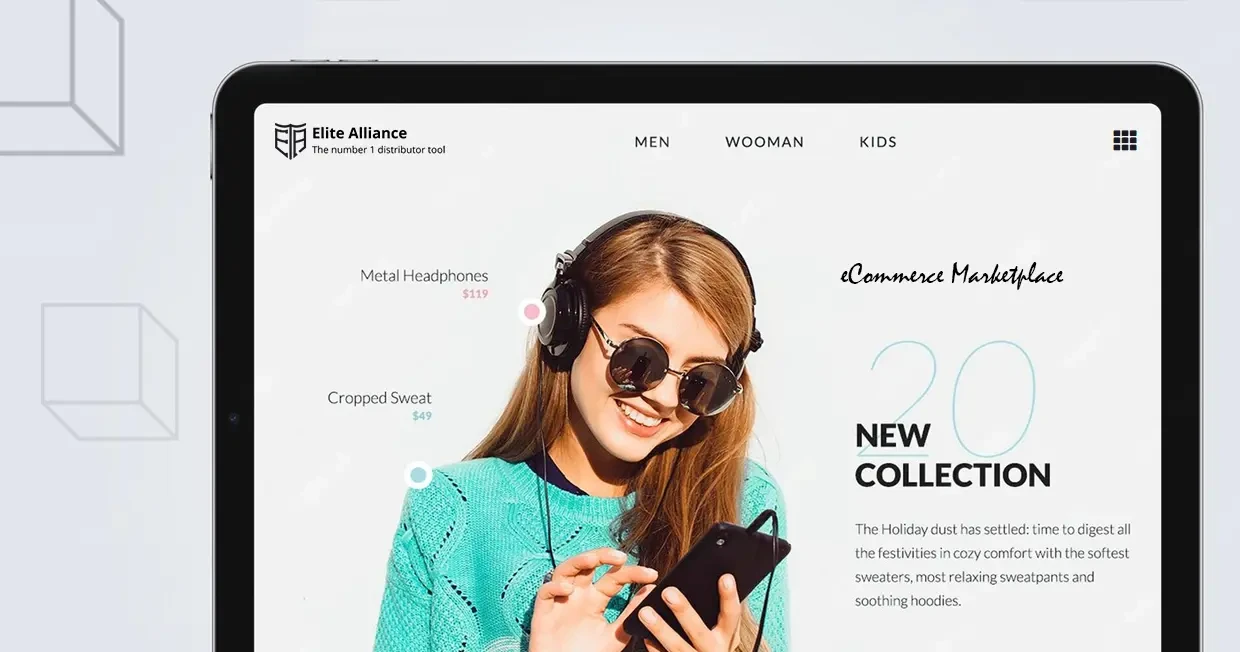
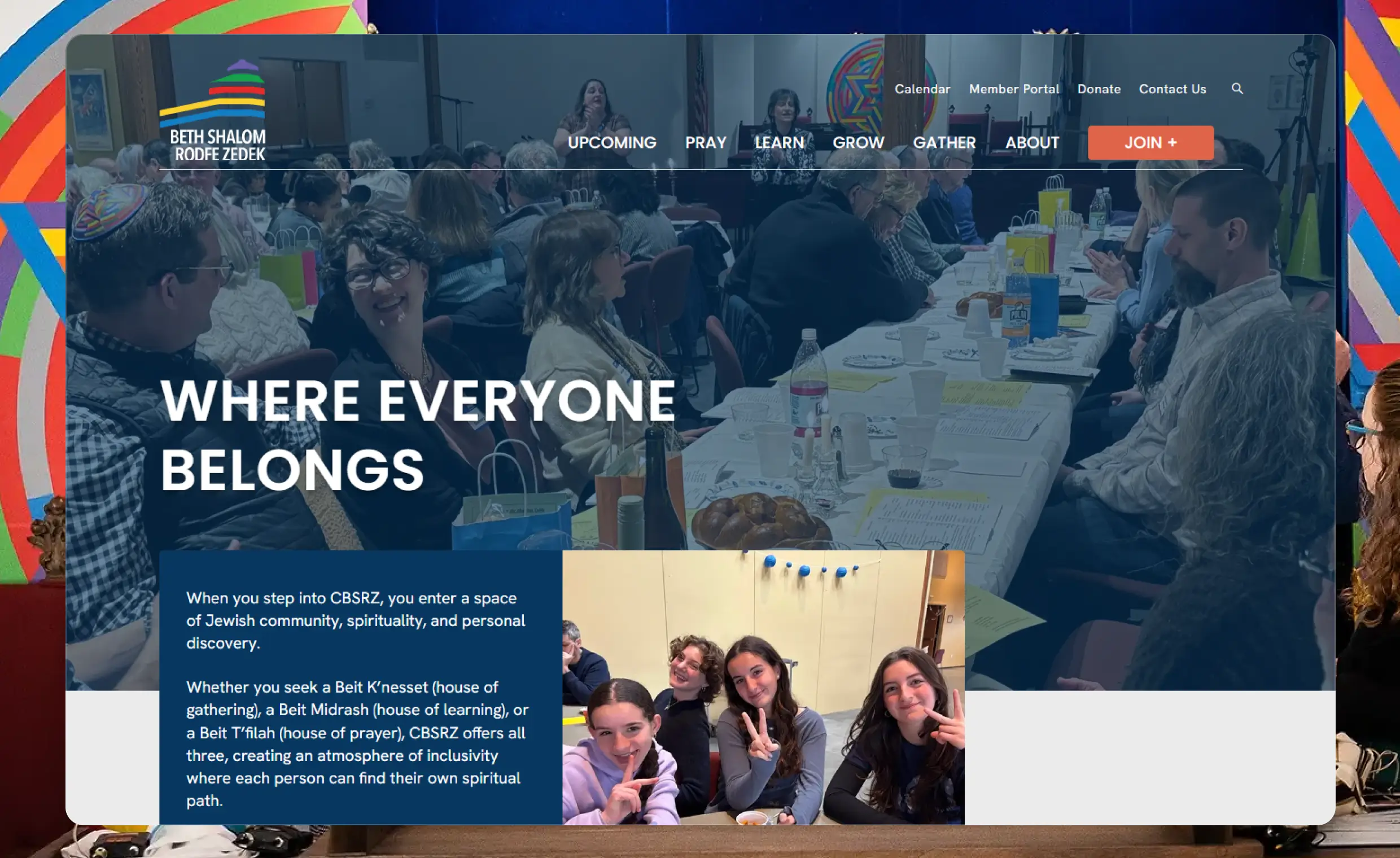
We helped Rebecca Mead and the INQ Creative team build a flexible WordPress website for Congregation Beth Shalom Rodfe Zedek (CBSRZ), with a strong focus on event management, community engagement, and registration workflows. The platform was designed to handle a wide range of event scenarios, including multi-day events, recurring programs, varied schedules, and registration-based activities, while giving visitors an easy way to discover, register for, and save events to their own calendars.
What Clients Say on Clutch & Upwork
Rated 5 stars on Clutch across 66+ reviews. Trusted by 1,293+ clients on Upwork with a 98% success rate. The proof is public.


What makes Acquaint Softtech the right food delivery app development partner.
Official Engineering Ecosystem Partner
Acquaint holds official partner status with Laravel, Statamic, Laravel News, and Bagisto, a rare combination that gives food delivery builds a certified, production-grade engineering foundation few agencies globally can match.
Full Three-Sided Platform Depth
From the customer ordering app and restaurant dashboard to the driver app and admin panel, Acquaint builds every side of the delivery ecosystem, not just one screen, all synced in real time.
Real-Time & Peak-Load Engineering
Surge-proof order flows, queue-based architecture, and live dispatch built to handle 3 to 5 times traffic spikes at lunch and dinner rush, so your app stays fast in production, not just in a demo.
Location & Logistics Ready
Live GPS tracking, driver-to-order matching, route optimization, and delivery-zone management, the location intelligence that keeps customers, restaurants, and riders in sync.
Multi-Vendor & Payments Depth
Vendor onboarding, menu management, commission logic, multi-vendor payouts, and secure payment gateway integrations, the exact marketplace mechanics a food delivery platform runs on.
Security, Compliance & IP
Secure coding, encrypted payment and personal data handling, PCI-DSS and GDPR-aware architecture, plus NDA and 100% IP ownership from day one.
Direct Engineer Access
You work directly with your delivery-app engineers, full visibility, proactive communication, no account-manager buffer slowing decisions.
Food delivery app development, answered.
-
How much does it cost to develop a food delivery app?
It depends on scope. A single-restaurant ordering app typically starts around $5,000 to $15,000, a multi-restaurant marketplace with customer, restaurant, and driver apps usually runs $30,000 to $80,000, and enterprise-grade platforms with advanced logistics can exceed $100,000. The most accurate number comes from a scoped estimate, not a template price.
-
How long does it take to build a food delivery app?
A basic MVP usually takes 3 to 4 months. A full three-sided platform with real-time dispatch and multi-vendor support takes 6 to 9 months, depending on feature scope, integrations, and whether you start with a discovery phase to lock requirements before development.
-
Should I use a ready-made clone or build a custom food delivery app?
A clone is cheaper and faster to launch and works for validating a simple idea. A custom build costs more upfront but handles peak load, custom commission and payout logic, and scaling into new cities, things a clone hard-codes and cannot grow past. Test an idea with a clone; build a business with custom.
-
What features does a food delivery app need?
Three connected apps: a customer app (browse, order, pay, track), a restaurant dashboard (menu, orders, earnings), and a driver app (accept, navigate, update status), plus an admin panel. Core features include real-time GPS tracking, secure payments, push notifications, and live dispatch; advanced builds add multi-vendor payouts, commission logic, and route optimization.
-
Can you build an app like Uber Eats, DoorDash, or Zomato?
Yes. These are three-sided marketplaces built on real-time dispatch, GPS tracking, dynamic matching, and payment orchestration. The key is architecture that handles the 3 to 5 times order surge at lunch and dinner rush without slowing or crashing.
-
How do I choose the right food delivery app development company?
Check verifiable signals, not pitches: genuine Clutch reviews you can read, real on-demand or marketplace experience, transparent pricing, and proof the team can handle real-time dispatch and peak load. Every company on this list was vetted for a minimum of 50 verified Clutch reviews.
-
How much does it cost to maintain a food delivery app after launch?
Ongoing maintenance typically runs 15 to 20 percent of the initial build cost per year, covering bug fixes, performance monitoring, security updates, and scaling as order volume grows. Delivery apps need continuous tuning, so budget for support from day one, not just the build.
-
Do you provide post-launch support and scaling?
Yes. A food delivery app needs constant tuning as orders grow, and Acquaint provides ongoing maintenance, performance monitoring, and scaling support, backed by a 95 percent client retention rate on long-term projects.
Marketing Head
Related Blog
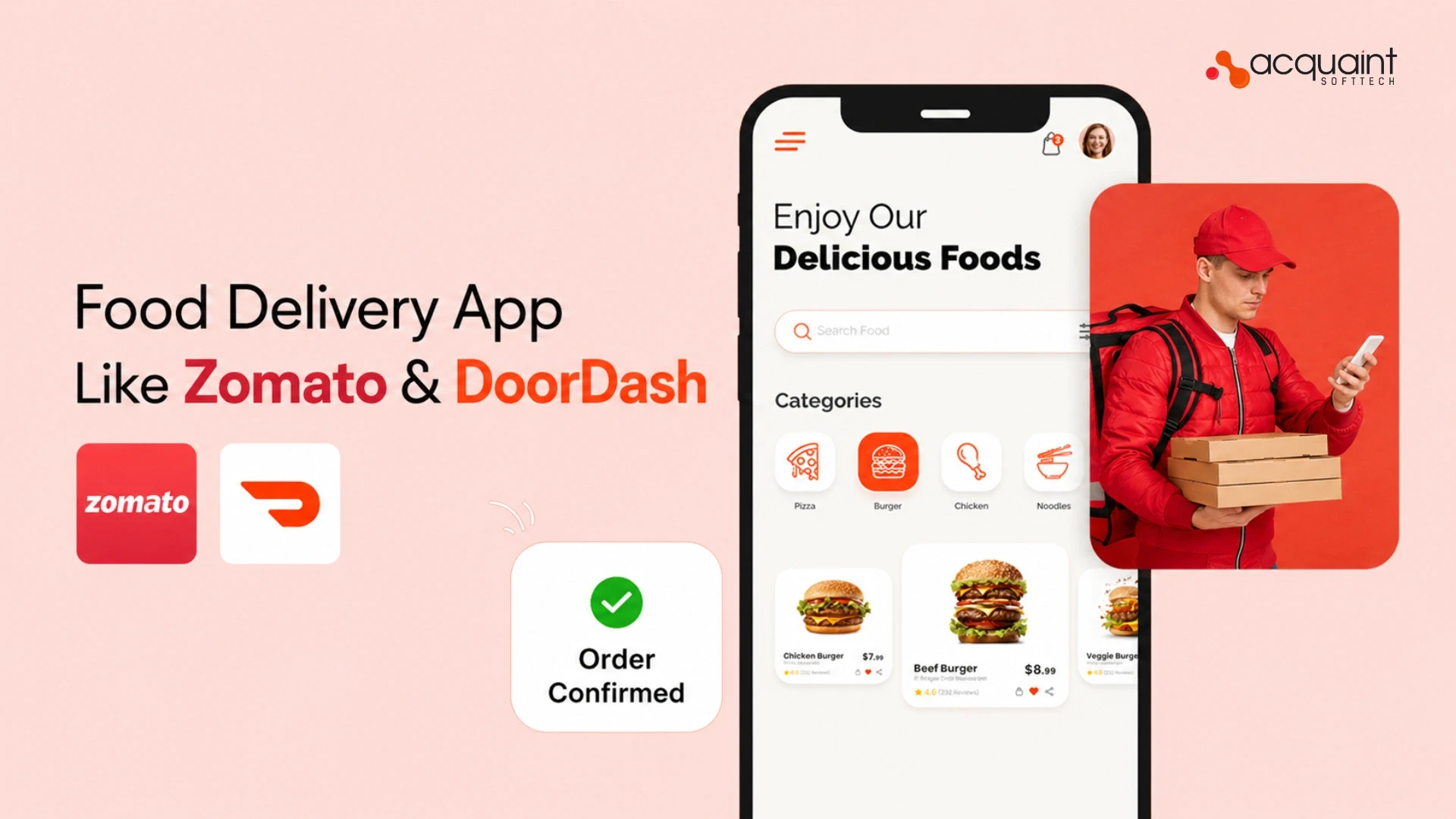
Food Delivery App Like Zomato & DoorDash: Architecture, Features, and Scale
Zomato and DoorDash are not apps. They are data platforms. Every feature you see in the consumer interface is the output of a precisely designed data model, a set of platform entities with defined relationships, and a state machine with explicit transition rules. This guide walks through the data architecture, the platform design decisions, and the six scaling triggers that tell you when the platform needs to grow.

Manish Patel
May 21, 2026.webp "How To Create an On-Demand Food Delivery App Like Uber Eats (2026 USA Guide)")
How To Create an On-Demand Food Delivery App Like Uber Eats (2026 USA Guide)
Building an app like Uber Eats means creating a multi-sided ecosystem of four interfaces: a customer app, a delivery driver app, a restaurant dashboard, and a central admin panel. A custom-coded MVP typically costs $75,000 to $120,000 (much less with no-code tools), and success depends on smart market positioning, core feature implementation, and US legal compliance. The proven path is to pick a niche, handle legal requirements, choose your build approach, ship a focused MVP, then test rigorously.

Mukesh Ram
October 16, 2019.webp "How To Hire a Top On-Demand App Development Company (2026 Guide)")
How To Hire a Top On-Demand App Development Company (2026 Guide)
An on-demand app development company builds custom software that connects users with instant services, goods, or transport through real-time digital platforms. These agencies handle the multi-sided architecture behind customer apps, service-provider dashboards, and admin panels. To hire the right one, research the market, set your priorities, make inquiries, check credentials, and choose the apt partner. Core features include real-time GPS tracking, secure payments, push notifications, and admin dashboards.
Mukesh Ram
October 24, 2019India (Head Office)
203/204, Shapath-II, Near Silver Leaf Hotel, Opp. Rajpath Club, SG Highway, Ahmedabad-380054, Gujarat
USA
7838 Camino Cielo St, Highland, CA 92346
UK
The Powerhouse, 21 Woodthorpe Road, Ashford, England, TW15 2RP
New Zealand
42 Exler Place, Avondale, Auckland 0600, New Zealand
Canada
141 Skyview Bay NE , Calgary, Alberta, T3N 2K6