

Building a Payment Split and Marketplace Payout System
Building a payment split and marketplace payout system means taking one customer payment and dividing it across multiple sellers while automatically deducting platform commission, handling compliance, and scheduling disbursements. A marketplace payment system needs four main parts: a payment gateway, seller KYC, a fee-splitting engine, and a ledger to track transactions. The payment is captured, the platform fee is deducted, funds are held for refunds or disputes, and the remaining amount is paid to sellers through ACH or SEPA.

Sanjay Prajapati
Introduction
As Head of Business at Acquaint Softtech, and a developer before that, I have watched more marketplaces stall on payouts than on any front-end feature. The money layer is where hire Laravel development earns its keep, because a split that is a cent off, or a payout that runs twice, is not a bug you can ship past.
Marketplace payout system explained in one line: it is the software that takes a single buyer payment and divides it across sellers, deducts your commission, holds funds against risk, and pays sellers out on a schedule. Marketplace payment split development is the engineering behind that, and it is mostly a ledger problem, not a checkout problem.

- A founder or CEO building a multi-vendor marketplace or platform.
- A CTO scoping the split engine, ledger, and payout rails.
- A product owner defining commissions, escrow, and payout schedules.
- A team weighing whether to build in-house or hire developers for a marketplace payout system.
If you want the wider picture first, our guide on how payment gateways work maps the authorization, capture, and settlement flow that a split system sits on top of.
This is a build guide, not a vendor brochure. It covers the four components, the payout lifecycle, the ledger design that keeps the arithmetic closed, provider choices, features, tech stack, compliance, 2026 trends, and honest cost.
What is a marketplace payout system?
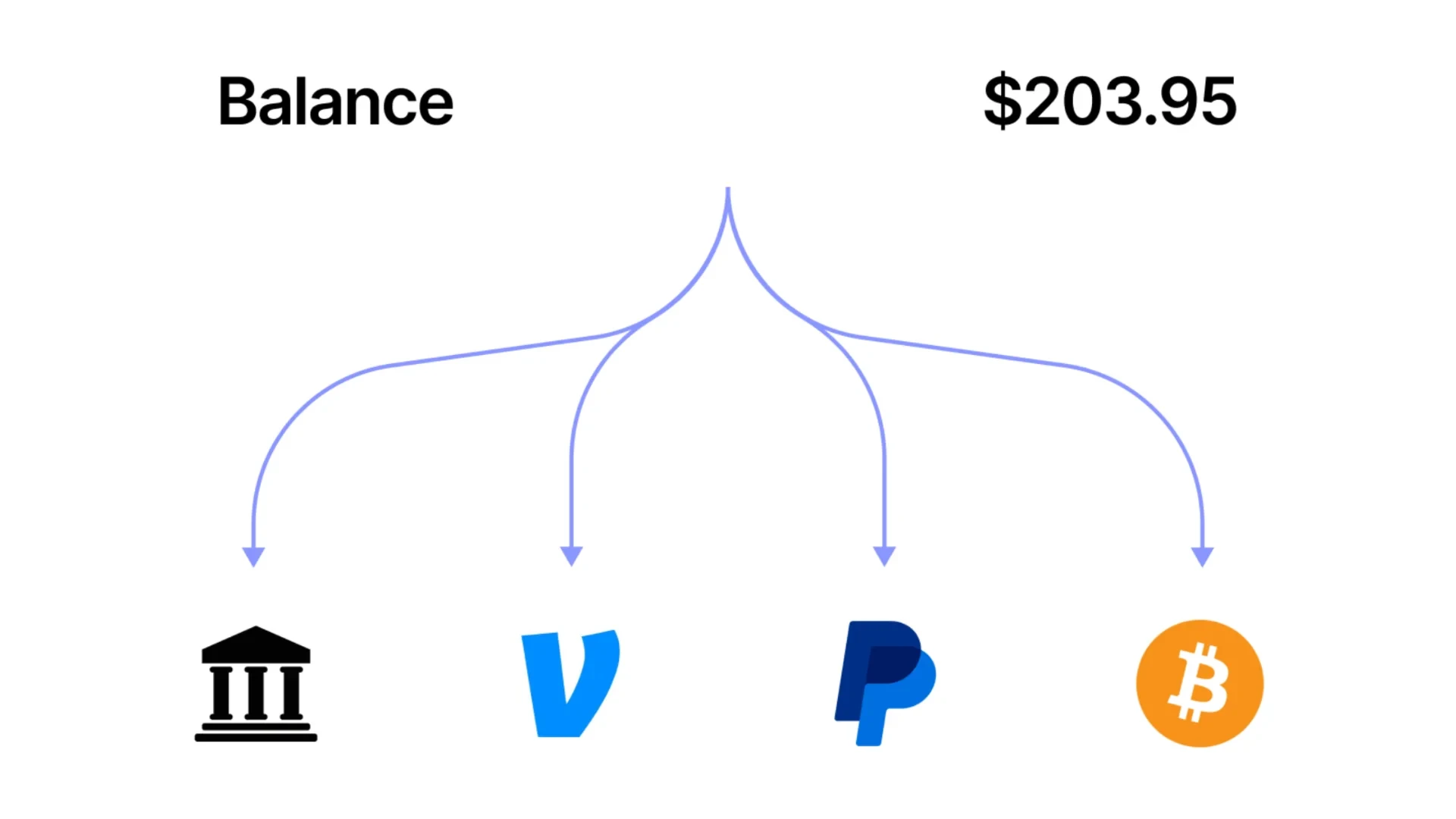
A marketplace payout system is the software that splits one customer payment among multiple sellers, deducts the platform’s commission, and disburses each seller’s share to their bank account. It replaces the manual reconciliation that becomes impossible and non-compliant once you pass a handful of sellers.
At small scale, you might pay sellers by hand. Past a couple of hundred sellers, you cannot, and regulators do not allow a platform to sit on other people’s money without the right structure. That is why marketplaces from ride-hailing to ticketing to resale run automated split and payout engines.
Is a marketplace payout the same as a BNPL split payment?
No, and this is a common mix-up. If you searched split payment online expecting a buyer-side installment option, like a split payment TikTok pay-later plan, that is Buy Now Pay Later: the buyer pays in parts over time. A marketplace payout system is the opposite side of the coin: the buyer pays once, and the platform splits that single payment out to many sellers. This guide is about the second one. Getting either right is a core software product development problem rather than a plugin.
The four core components
Every marketplace payout system has four moving parts: a payment gateway or merchant-of-record provider, seller onboarding with KYC, a split engine, and a ledger with a state machine. Get these four right and everything else is configuration.
Gateway or merchant of record. An infrastructure provider such as Stripe Connect handles card data, tokenization, and legal liability.
Seller onboarding and KYC. Collect identity, tax, and banking details through hosted or embedded verification before any payout.
Split engine. Compute and allocate exact percentages or fixed fees in real time during checkout authorization.
Ledger and state machine. Track balances, pending funds, and in-transit transfers idempotently so nothing double-pays.
The ledger and split engine are the parts that must never drift, so teams hire MERN stack developers who have built financial-grade data models. Seller onboarding is its own subsystem, and the identity checks behind it are covered in our KYC automation guide.
The transaction and payout lifecycle
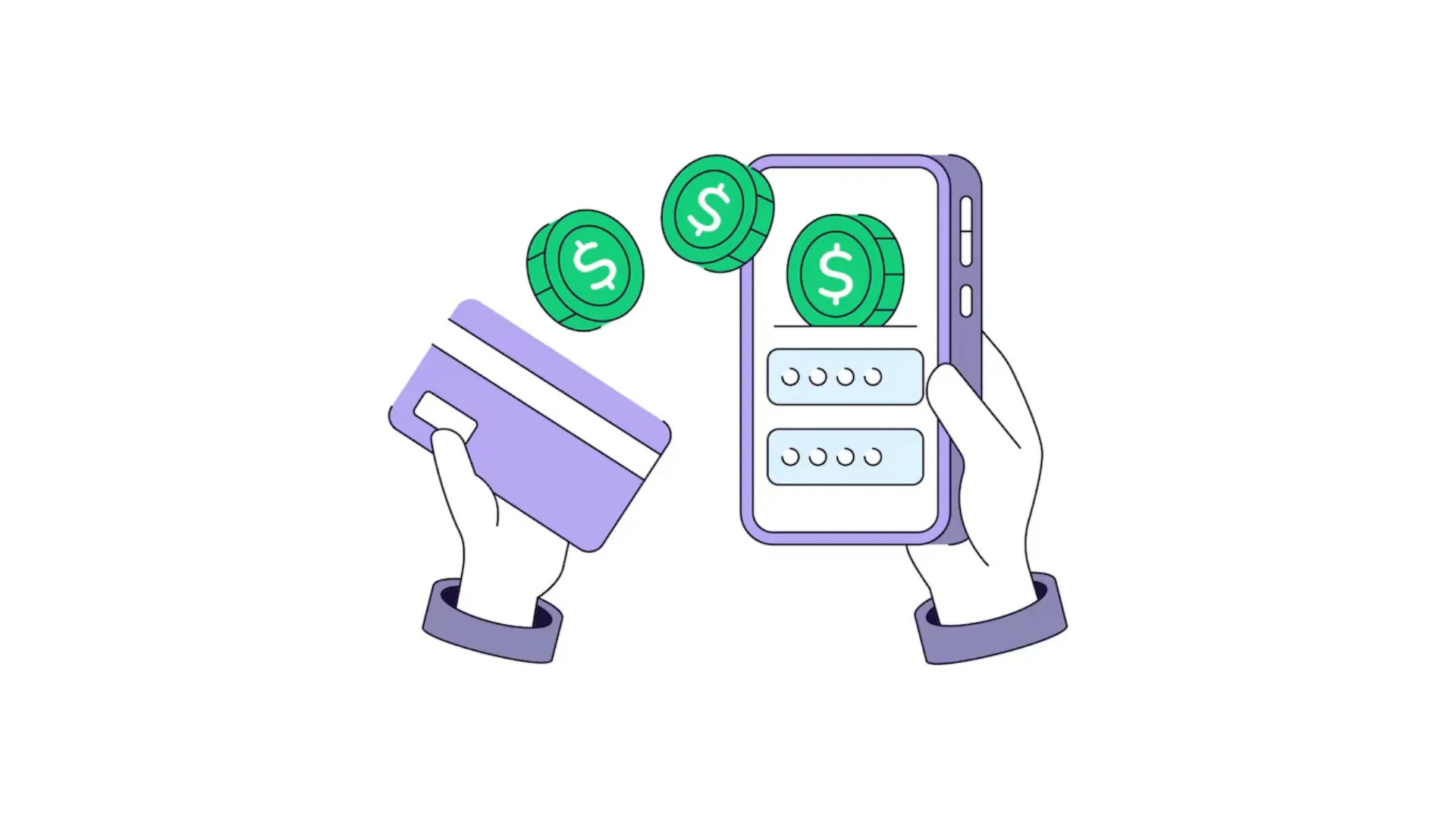
A marketplace payment moves through four stages: capture, fee deduction, an escrow or holding window, and disbursement. Understanding this lifecycle is the difference between a system that reconciles and one that leaks money.
Checkout and capture. The buyer pays one total; the gateway authorizes and captures it into a platform-controlled account, not the seller’s.
Fee deduction. The split logic separates the marketplace commission from the net vendor amount.
Escrow or holding window. Funds stay restricted for a defined period to cover chargebacks, refunds, and fulfilment disputes.
Disbursement. Scheduled or on-demand jobs push funds to sellers over local rails such as ACH, SEPA, or instant payouts.
Cross-border sellers add currency conversion and rail differences at disbursement, which our cross-border payment platform guide covers. Making the scheduled payout jobs run reliably is a good reason to hire DevOps engineers early.
The ledger: balance planes and states
The heart of the system is a double-entry ledger with two balance planes and three balance states. This is the layer most guides skip, and the one that decides whether your marketplace can scale without losing a cent.
Two balance planes
The platform balance is your own settlement account, because the acquirer settles every buyer charge to you, not to the seller. The connected-account balances are per-seller sub-ledgers you maintain, and each one is a liability: money you hold and owe a seller. The invariant you defend is simple. The sum of all seller balances plus your retained revenue must always equal the real bank balance minus payouts already in flight.
Three balance states
Model each seller balance as pending (captured but inside the refund window), available (cleared and payable), and reserved (held back for rolling reserve or disputes). Collapsing these into one number is the classic early mistake, because you lose the ability to explain why a balance cannot be paid yet. A discovery workshop is the right place to nail this model before code.
When a charge succeeds, the split posts as balanced journal entries that sum exactly to the captured amount. Compute the split before the charge, freeze the fee version onto the order, and make the seller’s net the residual after fee and tax so rounding never leaks a cent.
How to build a marketplace payout system, step by step

To build a marketplace payout system: choose your legal model, pick a provider, build onboarding and KYC, write the split engine, design the ledger and state machine, add the payout scheduler and escrow, then reconcile and test. Here is the development guide in eight steps.
Choose the legal model. Decide merchant of record versus payment facilitator; it sets your tax, dispute, and KYC duties.
Pick a provider. Select a marketplace gateway that matches your regions, rails, and volume.
Build onboarding and KYC. Verify identity, tax, and banking details before a seller can receive money.
Write the split engine. Compute commission and net per order, frozen to the fee version, summing to the exact total.
Design the ledger and states. Model platform and connected balances with pending, available, and reserved states.
Add the payout scheduler. Sweep available balances on a schedule, idempotently, through a payout state machine.
Set escrow and reserves. Hold funds through the risk window and keep a rolling reserve for late refunds.
Reconcile and test. Match ledger entries to bank settlements daily, and simulate refunds, retries, and failures.
How do you prevent double payouts?
Make every payout idempotent per seller and period, keyed on a deterministic identifier, so a crashed job that re-runs cannot pay twice. A payout is a state machine, created to submitted to paid, or failed and retryable, and money only leaves the connected balance when it reaches paid. Because these paths are tedious to prove on every release, it pays to hire automation engineers who keep the payout and refund cases covered.
Keeping this multi-part build on schedule is a job in itself, so many teams hire a project manager to track the workstreams to a plan.
Want the money layer built right the first time?
Our engineers have shipped split engines, connected-account ledgers, and idempotent payout schedulers for platform clients. Tell us your model, and we will map a custom marketplace payout system solution, with a fixed scope and clear milestones.
Negative balances, refunds, and chargebacks
The hard case is a refund that arrives after a seller has been paid. The seller balance goes negative, and the platform is out of pocket until it recovers the funds. You cannot prevent this entirely, so you engineer for recovery.
Rolling reserve. Hold back a percentage of each payout for a set period as a buffer against late refunds.
Debit-first ordering. Deduct refunds and chargebacks from available before reserved, and net new sales against a negative balance.
Payout gating. A seller with a negative balance is ineligible for payout until new sales or a top-up cures it.
Recovery workflow. If the balance stays negative, debit a linked bank account or write it off against reserves.
A negative balance is a receivable the platform holds against the seller, and it must appear that way in reconciliation, not as a hole. Predicting which sellers may go negative is a natural place to hire AI/ML engineers for risk scoring.
Choosing a provider
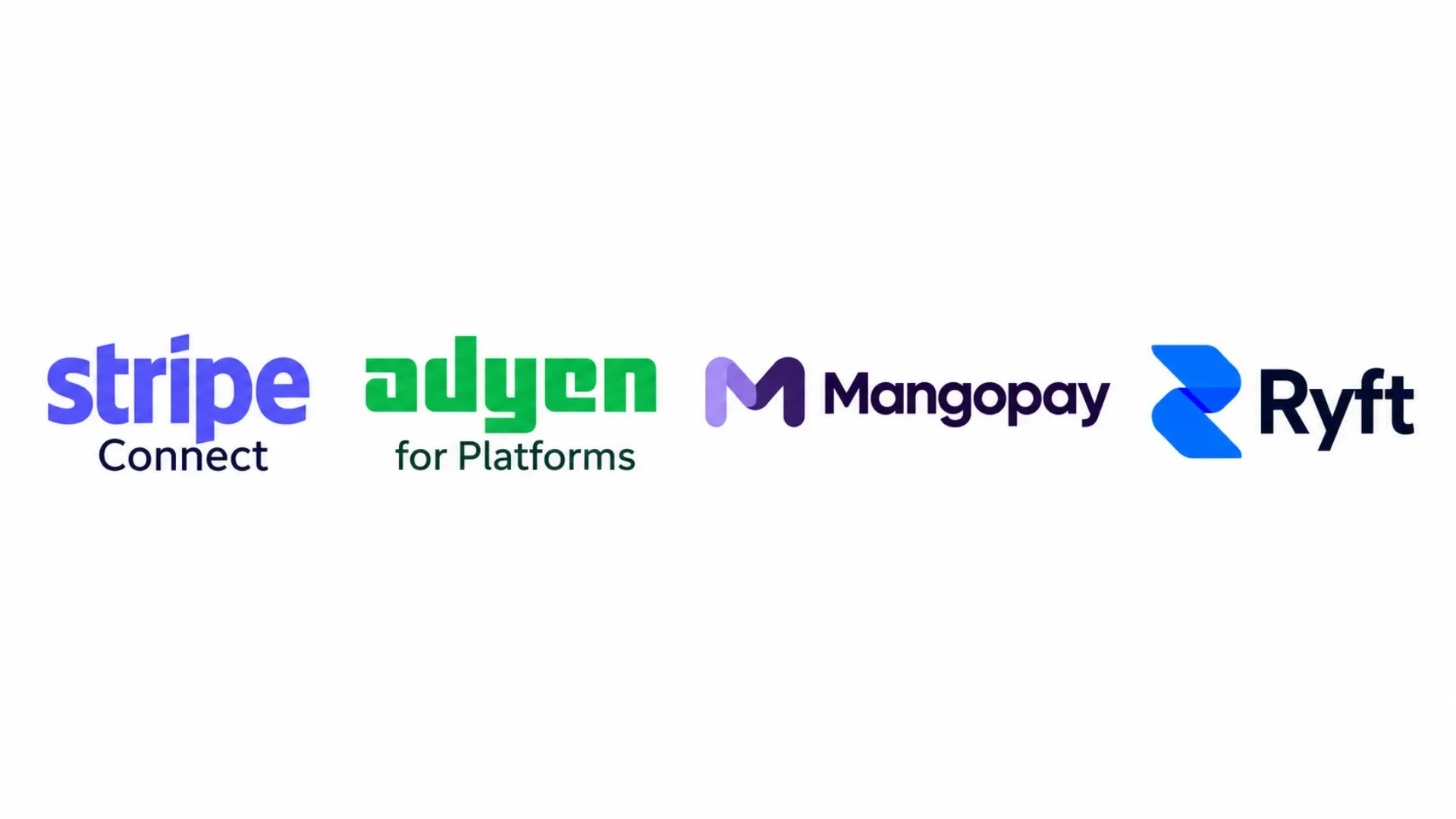
Most marketplaces build on a licensed provider rather than becoming a processor. The right choice depends on your regions, your rails, and whether you need escrow and unlimited connected accounts.
Provider | Best for | Note |
Stripe Connect | Developer-built platforms | 40+ payout methods, wide docs |
Adyen for Platforms | Large enterprise marketplaces | High volume, unified settlement |
Mangopay | European marketplaces | Native split, unlimited escrow |
Ryft | UK marketplaces | Ryft payments with volume-based fees |
Fees are the detail founders underestimate. Ryft pay fees, for example, are volume-based rather than flat, which suits growing UK platforms, while enterprise providers trade higher minimums for unified reporting.
Whichever you pick, our Stripe Connect integration guide shows how connected accounts and payouts wire together. For a senior payments architect on call, virtual CTO services set the provider and model before build.
Marketplace payout system features list
A production-grade marketplace payout system features list spans onboarding, splitting, payouts, and reporting. The items below decide whether the system survives real seller volume.
Seller onboarding with KYC, tax forms, and bank verification.
Configurable commissions: percentage, flat, tiered, or hybrid.
Real-time split engine with a frozen-fee version per order.
Connected-account ledger with pending, available, and reserved states.
Escrow, rolling reserve, refunds, and partial refunds.
Scheduled and on-demand payouts over ACH, SEPA, and instant rails.
That is a wide surface to build alone, so many founders use software development outsourcing to ship the core first. As rails and rules change, version upgrade services keep the system current without breaking live payouts.
Marketplace payout system tech stack
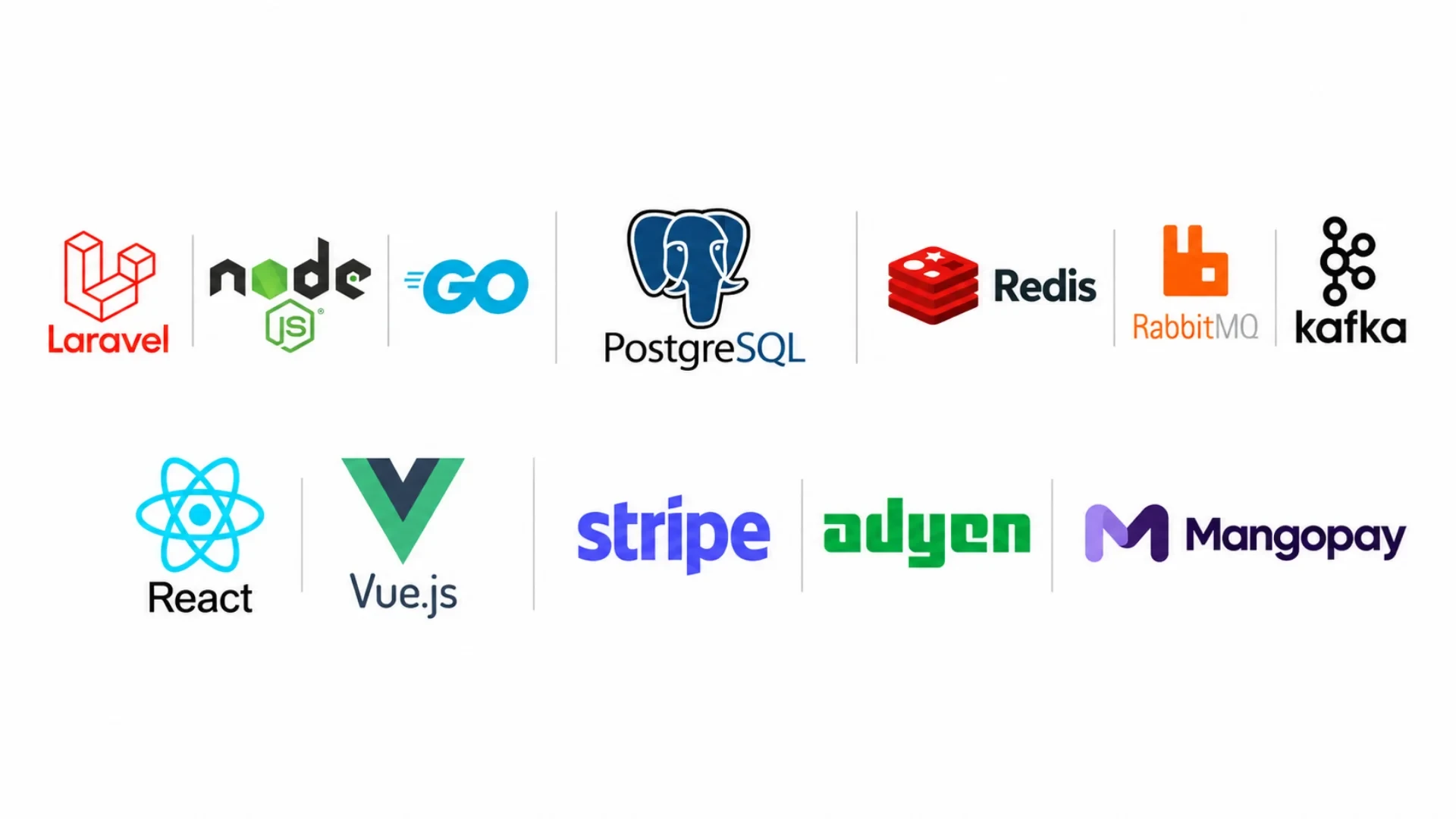
The best tech stack for a marketplace payout system pairs a strong transactional backend with a durable database, a queue for asynchronous payout jobs, and a clean dashboard. Correctness matters more than novelty here.
Layer | Common choice | Why |
Backend | Laravel, Node.js, or Go | Reliable split and ledger logic |
Database | PostgreSQL | ACID-safe financial records |
Queue | Redis or a message queue | Idempotent payout jobs |
Frontend | React or Vue | Seller and admin dashboards |
Provider | Stripe, Adyen, Mangopay | Rails, KYC, and payouts |
What is the best tech stack for a marketplace payout system?
Laravel or Node.js with PostgreSQL is the dependable default, with Go where payout throughput is extreme. Acquaint Softtech builds on this stack for payout work, and the ledger and idempotency patterns that make it safe are the same ones in our guide to building a fintech app with Laravel.
For extra hands on the split-engine and reconciliation work, IT staff augmentation adds payment-experienced engineers fast.
Compliance and the merchant-of-record question
Compliance starts with one architectural choice: are you the merchant of record, or a payment facilitator? As merchant of record, you own the transaction, tax, and disputes. As a facilitator, you are a conduit, with lighter tax but stricter onboarding duties on each seller.
Either way, you must handle KYC and anti-money-laundering checks, and in Europe, PSD2 rules on strong customer authentication. Card data handling is governed by the standards from the PCI Security Standards Council, and anti-money-laundering expectations trace back to the Financial Action Task Force (FATF).
Design tax remittance and dispute ownership from the start, because retrofitting them onto a pass-through ledger is a painful migration.
For the compliance and audit layer, dedicated software development teams that own it end to end beat stitching it together later.
Marketplace payout system benefits for businesses
The marketplace payout system benefits for businesses are direct: you scale sellers without a finance army, sellers get paid fast and trust the platform, and every cent reconciles. Automation turns payouts from a liability into a growth lever.
Benefit | What it means |
Scale without headcount | Thousands of payouts run automatically |
Seller trust | Fast, accurate, transparent payouts |
Commission control | Fees deducted correctly every time |
Clean reconciliation | Ledger always matches the bank |
New revenue | Escrow, financing, and FX margin |
Agencies and platforms that want to launch payouts under their own brand can use white label development services to move faster. Acquaint Softtech builds custom and white-label payout systems with the ledger and reserve logic solid from day one.
Marketplace payout system trends 2026
The main marketplace payout system trends in 2026 are instant payouts, embedded finance, AI-driven fraud and risk, and cheaper cross-border settlement. Building with these in mind future-proofs the platform.
Instant payouts. Sellers increasingly expect same-day or real-time access to earnings.
Embedded finance. Platforms add seller financing, cards, and insurance on top of payouts.
AI fraud and risk. Models score sellers and transactions to cut refunds and collusion.
Cheaper cross-border. Better FX and local rails, and early stablecoin settlement, cut payout costs.
Smarter risk and instant-payout decisions lean on AI development services once the core engine is live. Disbursement borrows from lending flows, covered in our digital lending platform guide.
Marketplace payout system development cost by market
Marketplace payout system development cost depends on scope and where your team sits. A split-and-payout MVP is far cheaper than a full platform with escrow, multi-currency payouts, reserves, and a seller dashboard.
Target market | MVP split and payout | Full platform |
|---|---|---|
United States / New York | $35,000 to $80,000 | $120,000 to $320,000+ |
United Kingdom | GBP 28,000 to 64,000 | GBP 95,000 to 255,000+ |
Europe (EU) | EUR 32,000 to 72,000 | EUR 110,000 to 290,000+ |
Australia | AUD 52,000 to 120,000 | AUD 180,000 to 480,000+ |
New Zealand | NZD 55,000 to 128,000 | NZD 190,000 to 510,000+ |
The biggest lever is engineering rate, not the feature list. That is why many founders hire remote developers from a marketplace payout system development company in India, where the same build costs a fraction of local rates. The drivers are broken down in our FinTech app development cost guide.
Real case study: a fashion resale marketplace
Here is a real, verified project from our public Clutch profile that maps directly to marketplace payouts: a two-sided fashion platform where sellers needed to upload items and see their payouts clearly.
Proof of work: Lampoo (Luxury fashion resale marketplace, Milan) • 5.0 on Clutch, Verified
“Their attention to detail helped us avoid problems later.” Enrico Trombini, Founder and CEO, Lampoo
The brief
Lampoo runs a two-sided marketplace for second-hand luxury fashion. Buyers and sellers shared one platform, and sellers needed a clear dashboard to upload items, track approval, and view their payouts, all while the site stayed fast and stable during high-traffic sales.
What Acquaint Softtech shipped
A team of six to ten engineers built a new seller dashboard for uploads, approval status, and payout visibility, rebuilt the checkout into a clear step-by-step flow, cleaned the legacy backend, connected the platform to the warehouse tool, and added low-stock and order alerts, testing each part before launch.
The outcome
As the client reported, the platform felt faster right after launch, buyers stayed longer on product pages, dropped carts fell, sellers found uploads much easier, support fielded fewer questions about missing updates, and the system handled a major sale without slowing down.
Seller-facing payout visibility is exactly the surface a split system exposes, and the discipline behind it, a clean ledger and a dashboard sellers trust, is what this whole guide is about. You can browse more work on our case studies page and read verified reviews on our Clutch profile.
Why teams struggle, and what to check before you hire
Most marketplace payout systems do not fail at the split. They fail at reconciliation, negative balances, and idempotent payouts, the parts sellers never see until money goes missing.
If you are deciding whether to build in-house or hire developers for a marketplace payout system, check for these before you commit:
Do they model platform and connected balances with explicit states?
Are their payouts idempotent, with a proper state machine?
Can they handle negative balances, rolling reserves, and recovery?
Do they have verifiable marketplace and fintech delivery?
That last point is where track record matters. Acquaint Softtech has delivered 1,300 or more projects over 13 or more years with 70 or more in-house engineers, 48 or more Clutch reviews, more than 1,290 Upwork jobs, and can deploy vetted developers within 48 hours. When the payout engine is the core product, that reliability is a good reason to hire Python developers for the split and reconciliation logic.
After launch, the money layer needs care as rails and rules change, which is where ongoing support and maintenance services keep reconciliation, reserves, and payouts healthy.
Get a free marketplace payout consultation
Share your marketplace model or a short brief. We will review your split logic, ledger, escrow, and payout rails, then hand back a prioritised plan and a scope you can act on. This is the last step before you commit engineering time.
Frequently Asked Questions
-
Can you build your own payment processing system?
You can, but full payment processing needs acquiring licences, bank and card-network relationships, and PCI certification. Most marketplaces build their split and payout logic on top of a licensed provider instead, which is faster, cheaper, and lower risk.
-
How to make a split payment?
Compute the split before charging, capture the buyer’s full amount into a platform account, deduct your commission, credit the seller’s net to a connected-account balance, hold it through the risk window, then disburse on a schedule via ACH, SEPA, or an instant rail.
-
How much does it cost to develop a payment gateway?
A full payment gateway that authorizes and settles funds usually costs well into the high six figures or more, driven by licensing, bank integrations, and certification. A split and payout system built on an existing gateway costs far less.
-
What are the three types of payment systems?
Broadly, cash-based, card and bank-transfer (account-based), and digital or e-money systems such as wallets. In processing terms, the three roles you deal with are the payment gateway, the payment processor, and the payment facilitator.
-
How much does a marketplace payout system cost to build?
A split-and-payout MVP typically runs from the mid-tens of thousands into six figures at local agency rates, while a full platform with escrow, reserves, and multi-currency payouts costs more. Offshore delivery from India is materially cheaper.
-
What features does a marketplace payout system need?
Seller onboarding with KYC, configurable commissions, a real-time split engine, a connected-account ledger with pending, available, and reserved states, escrow and rolling reserves, refunds, scheduled and on-demand payouts, and a seller dashboard with reconciliation exports.
-
How long does marketplace payout system development take?
A focused MVP usually takes about three to five months, while a full platform with escrow, multi-currency payouts, and compliance work can run six to twelve months depending on scope.
-
What is the best tech stack for a marketplace payout system?
Laravel or Node.js for the backend, PostgreSQL for ACID-safe records, Redis or a queue for idempotent payout jobs, React or Vue for dashboards, and a provider such as Stripe Connect, Adyen, or Mangopay for rails, KYC, and payouts.
I am Sanjay Parjapati, a developer at heart and a Head of business by work. My journey started with coding and helped me grow towards becoming a head of business which led me to focus on dual skills, i.e. technical know-hows and the business know-hows. My journey of 10+ years has helped me grow immensely from a professional viewpoint.
Table of Contents
Get Started with Acquaint Softtech
- 13+ Years Delivering Software Excellence
- 1300+ Projects Delivered With Precision
- Official Laravel & Laravel News Partner
- Official Statamic Partner
Related Reading
How Payment Gateways Work: Transaction Flow, APIs, and Settlement Explained
A payment gateway is not a checkout button. It is a 7-step transaction pipeline that authenticates, routes, scores, and settles every card payment in under 2 seconds. Here is exactly how it works.

Ahmed Ginani
May 11, 2026
How to Build a Cross-Border Payment Platform: Corridors, FX, and Settlement
A cross-border payment platform enables international money transfers through routing, currency conversion, and settlement. It uses multiple payment rails and compliance checks to deliver fast and secure transactions.
Ahmed Ginani
August 3, 2026
How to Add Payments to Your SaaS Platform With Stripe Connect
Stripe Connect for SaaS payments lets users connect their Stripe accounts so you can process payments and take a platform fee. It includes onboarding connected accounts, routing payments, handling webhooks, and ensuring accounts are verified. Most SaaS platforms use Standard or Express accounts for faster, compliant setup.
Sanjay Prajapati
August 10, 2026India (Head Office)
203/204, Shapath-II, Near Silver Leaf Hotel, Opp. Rajpath Club, SG Highway, Ahmedabad-380054, Gujarat
USA
7838 Camino Cielo St, Highland, CA 92346
UK
The Powerhouse, 21 Woodthorpe Road, Ashford, England, TW15 2RP
New Zealand
42 Exler Place, Avondale, Auckland 0600, New Zealand
Canada
141 Skyview Bay NE , Calgary, Alberta, T3N 2K6