

Building a Multi-Vendor Marketplace: Architecture for Amazon-Style Multi-Seller Platforms
Multi-vendor marketplace development is the process of building an online platform where independent sellers list and manage their own products or services while a central administrator handles the infrastructure, transactions, and overall user experience.

Manish Patel
As the person who leads technology and client success at Acquaint Softtech, I have watched more than one founder try to bolt a second seller onto a single-store setup and discover the hard way that a marketplace is a different animal. Building an Amazon-style platform is serious software product development, because the moment money flows to more than one party the architecture, the payouts, and the trust model all change at once.
A multi-vendor marketplace platform in one line: it is the software that lets many independent sellers run their own storefronts inside one branded destination, while you own the catalog, the checkout, the payouts, and the rules.

- A founder planning to build a marketplace like Amazon, Etsy, or a niche B2B version.
- A CTO scoping the seller onboarding module, catalog, and commission split payment engine.
- A COO or product owner mapping vendor workflows, disputes, and payout logic.
- A team weighing whether to buy a builder or build a custom multi-seller e-commerce platform.
The demand is real. Marketplaces made up nearly 30 percent of global online purchases in 2024, and third-party sales through marketplaces are projected to reach 59 percent of all global e-commerce by 2027. That is the shift founders are trying to catch when they ask how a multi-seller platform works.
If you want the wider picture first, our guide on how custom e-commerce platforms work maps the modules every commerce engine sits on, and this article zooms into the multi-vendor layer on top of it.
This is a marketplace architecture guide, not a builder review. It covers the four core components, the payout engine, gateways skip, seller KYC, the catalog data model, unified checkout, a step-by-step build, tech stack, honest cost, and a real project.
What is a multi-vendor marketplace?

A multi-vendor marketplace is a digital platform where multiple independent sellers list and sell to buyers, while one operator owns the infrastructure, payments, and experience. Well-known examples include Amazon, Etsy, eBay, and Alibaba.
Under the hood, the operator supplies the technology and the sellers supply the products. The marketplace does not own inventory the way a normal store does; it earns a commission on each transaction instead of a product margin. That single economic fact is why the build looks so different, and it is the heart of how a multi-seller platform works.
This structure scales in a way single stores cannot. More sellers mean more products, more products pull in more buyers, and more buyers attract more sellers. Getting that loop turning is the founder's real job; giving it a stable technical foundation is ours. Teams often hire developers for marketplace work precisely because that loop breaks the moment the platform stutters under load.
Multi-vendor marketplace vs single-seller store
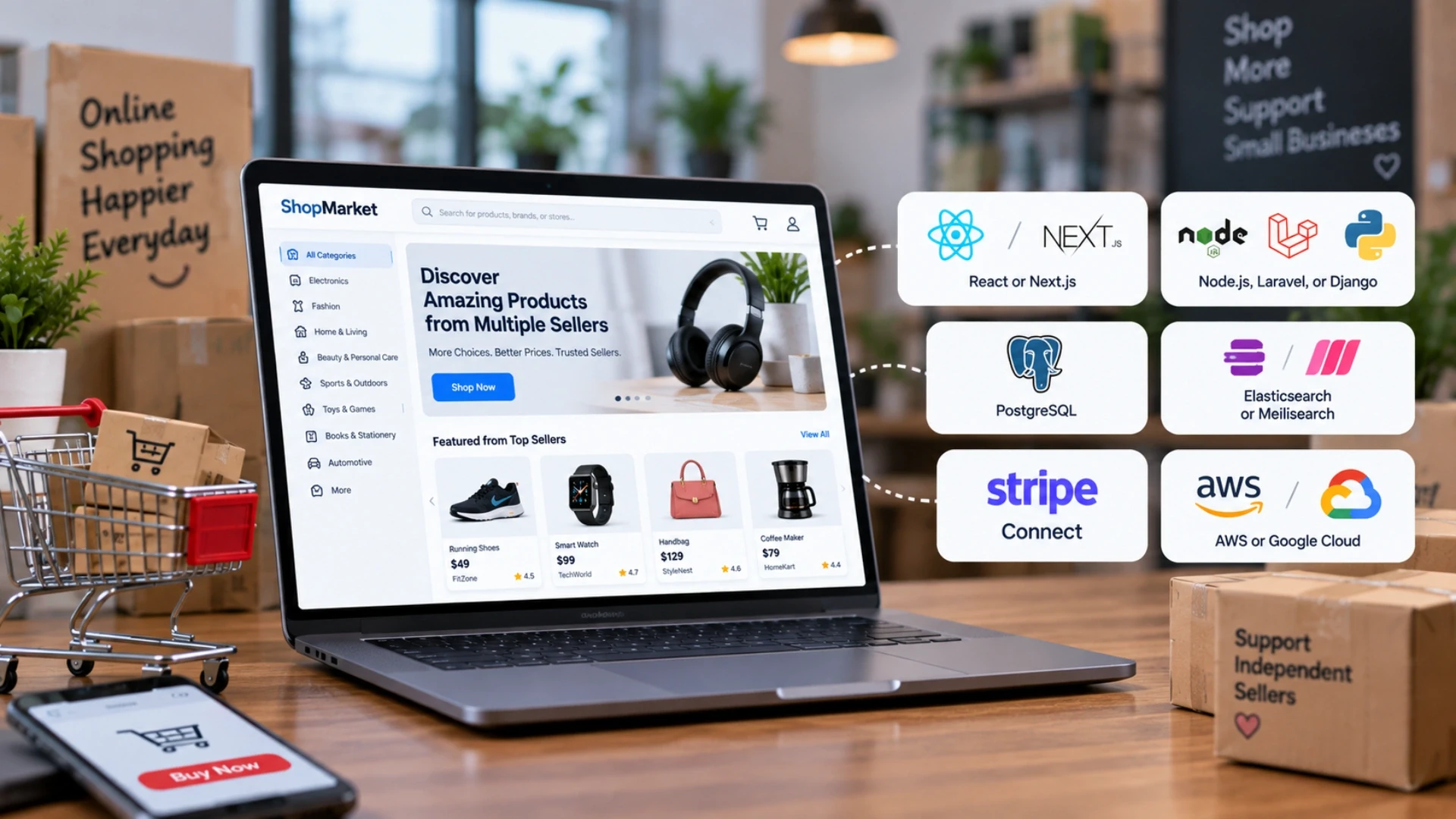
The core difference is sides. A single-seller store serves one audience, the buyer. A marketplace serves two, buyers and sellers, and must keep both happy at once. That doubles the feature surface and changes the money flow.
Dimension | Single-seller store | Multi-vendor marketplace |
Sellers | One (you) | Many independent vendors |
Inventory | You own and stock it | Each vendor owns theirs |
Revenue | Product margin | Commission per transaction |
Payments | One payout account | Split payouts to every seller |
Admin | One dashboard | Vendor dashboards plus a super-admin center |
Because Shopify, WooCommerce, and Magento are built for one seller, marketplace features such as vendor isolation, split payouts, and per-seller reviews are not there out of the box. That gap is exactly why founders move toward a custom or purpose-built stack, and why our headless commerce guide matters when the storefront and seller apps have to share one commerce engine.
The four core components of the marketplace architecture

Every multi-vendor marketplace architecture has four moving parts: vendor dashboards, an admin control center, a split-payment and commission engine, and a unified checkout. Get these four right and the rest is refinement.
Vendor dashboards. Dedicated panels where each seller uploads catalogs, manages inventory, tracks shipping, and reads sales data.
Admin control center. A super-admin interface to approve vendors, monitor platform activity, resolve disputes, and configure commission rules.
Split payments and commission engine. Automated financial routing that deducts a platform fee before transferring the balance to the vendor through tools such as Stripe Connect.
Unified checkout. A consolidated cart that lets a buyer purchase items from several sellers in one transaction and splits the order routing automatically.
These four are the marketplace-specific layer that sits on top of an ordinary commerce engine. The engine parts, catalog, cart, and order records, must stay exact, so this work goes to engineers who have built two-sided data models before. The same two-sided thinking drives our on-demand app development guide, where marketplace, buyer, and provider sides all have to stay in sync.
The commission-split payment engine, in detail

This is where most marketplace builds go wrong. A payment gateway moves money and records the transaction, but it does not know your commission rules, your payout schedule, or which seller earned what. That logic is yours to build on top of the gateway.
A commission split payment engine does three jobs on every order: it calculates the platform fee per line item, it holds funds where the model calls for escrow or delayed release, and it routes each seller's share to their connected account. Stripe Connect is the common foundation because it handles KYC on the seller, holds balances, and pushes payouts, but the fee math, the hold windows, and the reconciliation ledger are custom to your business.
How split payments actually flow
Capture. The buyer pays once at unified checkout; the full amount lands in the platform account.
Split. The engine reads each line item, applies the per-seller or per-category commission rule, and computes every payout.
Hold. Funds sit until the release condition is met, on delivery, after a return window, or on a schedule.
Route. Each seller's share transfers to their Stripe Connect account and the platform fee stays behind.
Reconcile. Every fee, payout, refund, and chargeback is logged to a ledger so any dispute has a clean answer.
Because this ledger is where compliance and payouts meet, it is the module we treat as a day-one requirement, not an afterthought. Teams frequently hire Laravel developers to build the webhook and payout layer, and hire Python developers for the fee-calculation and reporting logic that off-the-shelf builders leave out. Acquaint Softtech has shipped this exact routing on marketplace projects where the money had to reach dozens of vendors correctly, every time.
Worried your payouts will not add up at scale?
Our engineers have built commission-split engines, Stripe Connect routing, escrow holds, and reconciliation ledgers for multi-seller platforms. Tell us your commission model and we will map a payout architecture with a fixed scope and clear milestones.
Seller onboarding and KYC workflow

The seller onboarding module decides how fast good vendors get live and how well you keep bad ones out. A weak onboarding flow is the fastest way to lose supply, and supply is half your marketplace.
A production seller onboarding workflow moves a vendor from signup to first sale through clear gates: register, verify identity and business details, connect a payout account, agree to commission terms, then list products against your catalog rules. Identity and payout verification, the KYC step, is not optional; it is what keeps fraud and payout failures off your platform. Stripe Connect can carry much of this, but the approval queue and the standards live in your admin control center.
The onboarding gates in order
Signup and profile. Vendor creates an account and store profile.
KYC and business verification. Identity, business registration, and tax details are checked before approval.
Payout connection. The seller links a Stripe Connect account so payouts can route automatically.
Terms and commission. The vendor accepts the commission rate and marketplace policies.
Catalog listing. Products are added against shared categories and go live after review.
Keeping this queue moving without letting quality slip is a real operational load, so many teams use IT staff augmentation to add experienced hands during the build, and set up a dedicated software development team to own the vendor side from MVP through scale.
A senior architect can lock the approach up front through virtual CTO services before the first sprint.
The marketplace product catalog and data model
The marketplace product catalog must do something a normal catalog never does: keep every seller's listings, inventory, and pricing isolated, while still letting buyers search across all of them as one store. Vendor isolation is the design goal.
In practice that means every product, variant, and stock count carries a vendor ID, so one seller can never edit another's listing, yet search, filters, and category pages read across the whole set. Shared categories and attributes keep the buyer experience consistent; per-vendor ownership keeps the data clean. This is the layer where a custom build earns its cost, because plugin-based marketplaces tend to blur vendor boundaries as they grow. Fast discovery across a large, multi-seller catalog also needs a real search layer rather than plain database queries.
The patterns are the same ones in our D2C platform development guide, and when the catalog and search have to scale, teams often hire Django developers for the backend data model or hire React Native developers when sellers need a mobile app to manage listings on the go.
Unified checkout and order splitting
Unified checkout is the feature buyers notice and single-store platforms cannot fake. A shopper fills one cart with items from three sellers, pays once, and the system quietly splits that order into three, one per vendor, for fulfillment and payout.
Behind that single Pay button, the platform creates a parent order and child orders per seller, applies each vendor's shipping and commission, and tracks fulfillment separately while showing the buyer one clean status. Get this wrong and either the buyer sees three checkouts or a seller gets paid for items they did not ship. It is the multi-vendor shopping cart problem that generic e-commerce builders were never designed to solve.
The order-splitting logic ties directly back into the commission engine from section four, which is why we design them together. Founders who want the storefront and seller apps to share one order pipeline often hire MEAN stack developers for the real-time layer, and lean on software development outsourcing to ship the core order flow first and expand from a proven base. Acquaint Softtech designs the checkout, order-splitting, and payout paths as one connected pipeline, not three features stitched together late.
How to build a multi-vendor marketplace, step by step
To build a multi-vendor marketplace: validate a niche, choose a commission model, build the vendor and admin core, wire the split-payment engine, then launch a focused MVP and grow. Here is the build in six steps.
Validate a niche. Pick a specific category or region where buyers and sellers struggle to connect today, and confirm demand before you build.
Choose a commission model. Commission per transaction is the default, often 10 to 25 percent by category; you can add listing fees or subscriptions later.
Build vendor dashboards and the admin center. Give sellers catalog, inventory, and sales tools, and give the operator approvals, disputes, and commission config.
Wire the split-payment engine and KYC. Connect Stripe Connect, build the fee, hold, and payout logic, and gate sellers behind identity verification.
Ship a focused MVP. Launch the core transaction with a small seller cohort in one niche before adding every feature.
Launch, learn, and scale. Onboard anchor sellers, seed the catalog, fix drop-off, and expand into adjacent categories once liquidity holds.
Keeping a two-sided build on track is easier when you hire a project manager to own the plan, and easier still with automated payout and webhook tests in place, which is why teams hire automation engineers early.
Development approaches: SaaS, CMS, or custom
There are three ways to build a marketplace like Amazon, and the right one depends on how much control and scale you need. Speed and control pull in opposite directions.
No-code and ready-made SaaS
Purpose-built solutions, let you launch a platform quickly without writing code. They are ideal for validating an idea, but the functionality is bounded by what the builder supports.
CMS and plugins
Extending a content management system, such as pairing WordPress and WooCommerce with the Dokan plugin, is a cost-effective route for standard retail needs. Teams that outgrow this stage often hire WordPress developers or hire WooCommerce developers to stretch it before a rebuild.
Custom development
Building from scratch on modern frameworks such as Next.js or React gives complete flexibility over vendor isolation, custom workflows, and advanced scaling. It is the right call once volume, commission logic, or vendor rules exceed what a builder can carry. Agencies that want to offer marketplaces under their own brand can use white label development services to move faster.
Multi-vendor marketplace tech stack
The best tech stack for a multi-vendor marketplace pairs a scalable backend, a fast frontend, a search layer, and a payment engine built for split payouts. Correctness and scale matter more than novelty.
Layer | Common choice | Why |
Frontend | React or Next.js | Fast storefront and seller dashboards |
Backend | Node.js, Laravel, or Django | Vendor logic and payout routing |
Database | PostgreSQL | Vendor-isolated catalog and orders |
Search | Elasticsearch or Meilisearch | Discovery across every seller |
Payments | Stripe Connect | Split payouts and seller KYC |
Cloud | AWS or Google Cloud | Auto-scaling as traffic grows |
Node.js or Laravel with PostgreSQL and Stripe Connect is the dependable default, with Elasticsearch for catalog search. When the machine-learning side, recommendations and fraud scoring, becomes a priority, it is a natural fit for AI development services, and teams hire AI/ML engineers once the core transaction flow is live and generating data. Acquaint Softtech builds on this stack for multi-seller platforms so the catalog, payouts, and search scale together rather than one at a time.
Multi-vendor marketplace development cost by market
Multi-vendor marketplace cost depends on scope and where your team sits. An MVP with vendor dashboards and split payments is far cheaper than a full platform with KYC, dispute handling, search at scale, and mobile apps.
The ranges below are 2026 planning estimates at local agency rates. They are starting points to confirm against a real scope, not fixed quotes. Offshore delivery of a custom Amazon-style platform from India typically lands well below these numbers.
Target market | MVP marketplace | Full multi-vendor platform |
United States / New York City | $25,000 to $60,000 | $90,000 to $250,000+ |
United Kingdom | $24,000 to $58,000 | $85,000 to $230,000+ |
Europe (EU) | $26,000 to $60,000 | $90,000 to $240,000+ |
Australia | $28,000 to $65,000 | $95,000 to $260,000+ |
New Zealand | $28,000 to $66,000 | $95,000 to $265,000+ |
The biggest lever is engineering rate, not the feature list. That is why many founders hire DevOps engineers and full delivery teams to build a custom Amazon-style platform in India, where the same scope costs a fraction of local rates. As gateway APIs and framework versions change, version upgrade services keep the platform current without breaking live selling.
Real case study: a B2B and B2C multi-vendor marketplace
No two builds are identical, but the closest documented parallel from our own work is a custom marketplace, very similar to Amazon, that let multiple vendors set up their own stores for both B2B and B2C sales, with data supplied over an API and a feature-rich admin dashboard to manage products, users, and individual stores.
Question | Detail |
Client | A multi-vendor commerce operator who needed independent sellers running their own stores under one platform |
Issue faced | Off-the-shelf tools could not give each vendor an isolated storefront, custom UI control, and a single admin view across all stores |
How we solved it | Built a custom Amazon-style marketplace where vendors set up shop for B2B and B2C sales, with product data served over an API |
Challenge | Keeping vendor catalogs isolated while giving one super-admin control over products, users, and every individual store |
How it helps | Vendors choose their own store UI, buyers shop one secure marketplace, and the operator manages the whole platform from one dashboard |
Result | A secure, feature-rich multi-vendor marketplace with a custom product page and per-vendor store design, delivered with weekend support when it mattered |
Why Acquaint Softtech | 13+ years, 1,300+ projects, and 50+ verified Clutch reviews, with vetted developers deployable within 48 hours |
You can read the full write-up on our B2B e-commerce marketplace case study and verified client reviews on our Clutch profile. The relevance is direct: vendor isolation, an API-driven catalog, and a single admin control center are the same building blocks every Amazon-style platform needs.
Why teams struggle, and what to check before you hire
.webp "Why teams struggle, and what to check before you hire")
Most marketplaces do not fail at the storefront. They fail at payouts and vendor management, where a wrong commission split or an unverified seller quietly breaks trust with buyers and sellers at the same time.
If you are deciding whether to build in house or hire a partner for a custom multi-seller e-commerce platform, check for these before you commit:
Do they build a real commission-split engine, not just a payment form?
Is seller KYC and payout verification handled properly before a vendor goes live?
Does the catalog keep vendor data isolated while search still reads across all sellers?
Do they have verifiable marketplace delivery, not just single-store stores?
That last point is where track record matters. Acquaint Softtech has delivered 1,300+ projects over 13+ years with 50+ Clutch reviews and can deploy vetted developers within 48 hours. After launch, a marketplace needs care as gateway rules and seller volumes change, which is where ongoing support and maintenance services keep payouts, listings, and reconciliation healthy. Founders who want to pressure-test the plan first can start with a discovery workshop before any code is written.
Two compliance points are worth building in from day one. Card handling on your checkout must meet the standard published by the PCI Security Standards Council, and in the United States, marketplaces that route payouts to many sellers have third-party reporting duties described by the Internal Revenue Service. A gateway helps, but the reporting and record-keeping logic lives in your platform.
Get a free multi-vendor marketplace consultation
Share your marketplace idea, your seller model, or a short brief. We will review your vendor onboarding, catalog, commission-split payments, and checkout, then hand back a prioritized plan and a scope you can act on. This is the last step before you commit engineering time.
Frequently Asked Questions
-
How do I build a multi-vendor marketplace?
Validate a niche, choose a commission model, then build the four core parts: vendor dashboards, an admin control center, a split-payment and commission engine on Stripe Connect, and a unified checkout that splits orders per seller. Add seller KYC, launch a focused MVP with a small vendor cohort, then scale into adjacent categories once liquidity holds.
-
What is a commission model for a marketplace?
The commission model is how the platform earns. The most common is a percentage of each transaction, often 10 to 25 percent by category, deducted before the seller is paid. Alternatives or add-ons include listing fees, seller subscriptions, and featured placements. Most marketplaces start with commission because it aligns platform revenue with seller success.
-
What is the seller onboarding workflow?
Seller onboarding moves a vendor from signup to first sale through gates: create a store profile, pass KYC and business verification, connect a Stripe Connect payout account, accept commission terms, then list products against shared catalog rules. Identity and payout checks keep fraud and payout failures off the platform, and the operator approves each vendor from the admin control center.
-
How much does it cost to build a multi-vendor marketplace?
Multi-vendor marketplace cost depends on scope. An MVP with vendor dashboards and split payments runs from the mid-tens of thousands of dollars at local agency rates, while a full platform with KYC, disputes, search at scale, and mobile apps costs six figures. Offshore delivery from India is materially cheaper for the same scope.
-
What is a multi-vendor marketplace?
A multi-vendor marketplace is a platform where many independent sellers list and sell to buyers while one operator owns the infrastructure, payments, and experience. Amazon, Etsy, and eBay are examples. The operator earns a commission per transaction rather than a product margin, which is what makes the model scale through network effects.
-
What is a multi-vendor marketplace platform?
A multi-vendor marketplace platform is the software that runs this model: vendor dashboards for sellers, an admin center for the operator, a commission-split payment engine for payouts, and a unified checkout for buyers. You can build one with a SaaS builder such as Sharetribe, a CMS plus plugin such as WordPress and Dokan, or a custom stack on Next.js and React.
I lead technology and client success at Acquaint Softtech with one goal in mind. Deliver work that feels personal, reliable, and worthy of long term trust. I stay close to both our clients and our developers to make sure every project moves with clarity, quality, and accountability.
Table of Contents
Get Started with Acquaint Softtech
- 13+ Years Delivering Software Excellence
- 1300+ Projects Delivered With Precision
- Official Laravel & Laravel News Partner
- Official Statamic Partner
Related Blog
How Custom E-Commerce Platforms Work: Architecture, Modules, and When to Build One
A custom e-commerce platform is not a bigger Shopify plan. It is a purpose-built commerce engine where every module answers to your business logic, not a vendor's roadmap. This article explains exactly how one is architected, what it contains, and the 5 operational signals that tell you when building your own beats, staying on SaaS.
Manish Patel
May 12, 2026.webp "Headless Commerce Explained: Decoupled Architecture for Modern E-Commerce Development")
Headless Commerce Explained: Decoupled Architecture for Modern E-Commerce Development
Headless commerce is not a technology upgrade. It is a structural decision that separates the commerce engine from the storefront entirely. Done right, it gives you deployment freedom, channel flexibility, and a performance ceiling that no monolithic SaaS platform can match. Done wrong, it creates distributed systems complexity that your team is not ready for. This article tells you exactly which situation you are in.
Manish Patel
May 19, 2026.webp "Building a Freelance Marketplace Like Upwork or Fiverr: Two-Sided Platform Architecture")
Building a Freelance Marketplace Like Upwork or Fiverr: Two-Sided Platform Architecture
A freelance marketplace like Upwork or Fiverr is a two-sided platform that connects clients who need work done with freelancers who provide services. It works by letting clients post jobs or browse gigs, matching them with freelancers, holding payment in escrow against milestones, and releasing funds when work is approved, taking a commission on each transaction.
Manish Patel
June 30, 2026India (Head Office)
203/204, Shapath-II, Near Silver Leaf Hotel, Opp. Rajpath Club, SG Highway, Ahmedabad-380054, Gujarat
USA
7838 Camino Cielo St, Highland, CA 92346
UK
The Powerhouse, 21 Woodthorpe Road, Ashford, England, TW15 2RP
New Zealand
42 Exler Place, Avondale, Auckland 0600, New Zealand
Canada
141 Skyview Bay NE , Calgary, Alberta, T3N 2K6