

LMS Performance Optimization: Handling 100,000+ Concurrent Learners During Live Exams
Managing a live exam with high concurrent learners is the ultimate stress test for any Learning Management System. Unlike normal course navigation where users pull static pages, a live exam forces heavy, write-intensive database traffic at the same millisecond, such as saving quiz answers, autosaving progress, and validating timers.

Sanjay Prajapati
As a developer and Head of Business at Acquaint Softtech, I have watched more than one learning platform sail through a demo and then fall over the first time 40,000 students hit submit at once. That gap is why serious LMS performance work belongs to experienced, hired DevOps Engineers and cloud engineers from the first architecture meeting, not the week before an exam.
Here is the core problem in one line. Searches for LMS performance optimization, concurrent learners live exam online all describe the same thing: a write-heavy distributed-systems challenge, not a hosting upgrade. During an exam, thousands of learners autosave answers, extend timers, and submit within the same seconds, and every one of those actions is a database write. Because these platforms also hold sensitive student records, they must stay within privacy rules such as the U.S. Department of Education FERPA guidance even under peak load.

- You run high-stakes online exams and cannot afford a crash at peak.
- You need a platform that holds up at 100,000-plus concurrent learners.
- You are a CTO, COO, or founder responsible for exam-day reliability.
- You want real architecture, numbers and cost, not vague hosting advice.
This technical guide breaks performance into the three layers above, gives concrete tactics for each, and then covers how to build, test and budget for it. It sits inside our wider EdTech software development guide, so you can branch into any related engineering topic from here.
Everything below is grounded in delivery experience. Acquaint Softtech has built and hardened education platforms with real data architecture, integrations, and load testing, and this guide distils what actually keeps an LMS upright when the whole cohort logs in at nine o'clock sharp.
Why live exams are the ultimate LMS stress test

A live exam is the hardest thing an LMS ever does because it turns a read-heavy system into a write-heavy one in an instant. Normal browsing pulls mostly static, cacheable pages. An exam forces constant database writes as every learner autosaves answers, and those writes cannot be cached away. That is LMS performance explained at its sharpest: performance is decided by how your system handles simultaneous writes, not page views.
Concurrency is the number of learners hitting the platform in the same window, and during an exam that number spikes to its absolute maximum at the start time. If ten thousand candidates begin a timed test at nine o'clock, you get a wall of authentication, question loading, and autosave traffic in the same minute. Handling that well is the heart of serious custom software product development for assessment platforms.
Read-heavy versus write-heavy, and why it matters
The distinction changes the whole architecture. Read-heavy load is solved with caching and content delivery networks. Write-heavy exam load is solved with database scaling, queues, and careful write design, because you cannot cache a student's in-progress answer. Getting this right is real education software development, not a server size you pick from a dropdown.
This is also where generic advice fails. Most guidance optimizes for video streaming and course browsing, which are read problems. Exam concurrency is a different beast, and our overview of software product engineering companies explains the deeper ownership that a platform this demanding requires.
Layer 1: infrastructure architecture for 100,000+ learners
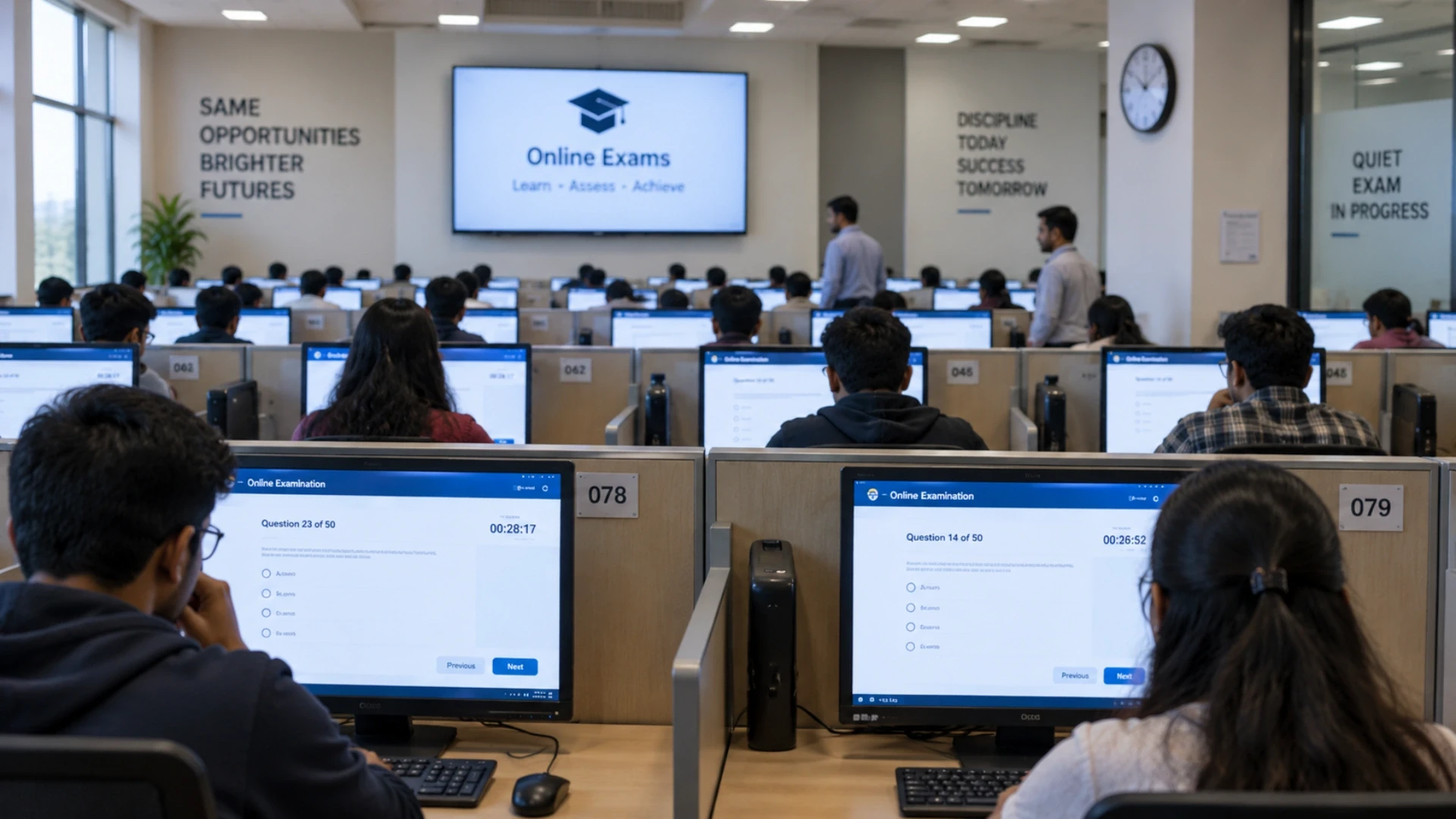
Infrastructure is the foundation, and at 100,000-plus concurrent learners it has to scale horizontally, not just run on a bigger box. That means stateless application servers behind a load balancer, database read replicas, a content delivery network for static assets, and autoscaling that adds capacity before the exam starts, not after it stalls.
Component | What it does at scale | Exam-day priority |
Load balancer | Spreads traffic across many servers | Even write distribution |
App server pool | Stateless, autoscaled instances | Add capacity before peak |
Read replicas | Serve reads off the primary | Protect the write primary |
CDN | Delivers static assets and media | Keep origin free for writes |
Scale for the peak, not the average
The single most common mistake is provisioning for daily traffic and hoping the exam behaves. It will not. You pre-scale the app pool and database connections ahead of the start window, then scale down after. A dedicated software development team that owns the platform can automate this scaling around your exam calendar so it happens reliably every time.
Isolate the exam workload
High-stakes exams deserve their own isolated capacity so a spike cannot drag down the rest of the platform. Separating the exam service, its database, and its queues from general course traffic is a proven pattern. Teams often reach this design through software development outsourcing when they need senior infrastructure skills quickly.
Our guide to Python development architecture and frameworks shows how to structure these services cleanly from the start.
Layer 2: software and application configuration
Infrastructure gives you capacity; application configuration decides whether you actually use it well. The biggest wins are caching every read you safely can, pooling database connections so thousands of learners do not each open their own, and moving non-urgent work off the request path into background queues. Done right, this is where a platform quietly absorbs a peak instead of buckling under it.
Caching, connection pooling and queues
Cache aggressively with a layer such as Redis so question banks, user sessions and static config never hit the primary database during an exam. Use connection pooling so a fixed set of database connections is shared, preventing connection exhaustion at peak. Push autosave writes, grading, and notifications through an asynchronous queue with workers, so a burst is smoothed over seconds rather than slamming the database in one instant. This work rewards hiring Python developers who have tuned high-throughput systems before.
Moodle performance optimization, specifically
If you run Moodle, the same principles apply through Moodle's own tools. Moodle performance optimization means enabling the Moodle Universal Cache with Redis, tuning PHP OPcache and worker counts, offloading sessions, and scheduling cron and heavy reports away from exam windows.
Specialist Moodle partners such as Eummena and dedicated Moodle hosting providers scale single instances toward 100,000 users using exactly these levers. When the platform is custom, experienced Django developers apply the equivalent caching and query tuning at the code level. Our guide to hiring Python developers covers what to look for in engineers who can do this well.
Layer 3: exam delivery strategies that protect the write path

The third layer is often skipped, and it is where high-stakes exams are truly won. Exam delivery strategy means shaping learner behaviour and the write path so the peak is survivable: stagger start windows, preload questions, make autosave idempotent, validate timers server-side, and degrade gracefully if a component slows. These choices cut the peak write rate without changing a single server.
Stagger, preload, and buffer
Staggering start times across a few minutes flattens the login and first-save spike dramatically. Preloading the full question set to the browser at launch means the learner reads and answers locally, so the server sees periodic autosaves rather than constant traffic. Client-side buffering with server reconciliation lets a brief network blip resolve without losing an answer.
This kind of edtech module design is what separates a platform that merely functions from one that stays calm under fire, and it pairs naturally with hire automation and QA engineers who can prove it under simulated load.
Idempotent autosave and honest timers
Autosave must be idempotent, meaning the same answer saved twice does not create duplicates or corrupt state, because retries are inevitable at scale. Timers must be validated on the server so a slow client or a refresh cannot grant or steal time.
When mobile matters, a hire MERN stack team can deliver a resilient offline-tolerant exam client on one JavaScript stack. This is education tech implementation at its most demanding, and our Laravel SaaS architecture blueprint shows the same resilience thinking applied to a full platform.
How to build LMS performance: the engineering playbook

Building for scale is a repeatable process, not a one-time heroic effort. The playbook for how to build LMS performance is: model the true peak, load test against it early, remove the first bottleneck you find, then repeat until the system holds the target with headroom. Performance you have not load tested is a guess, and exam day is a bad time to discover the number was wrong.
Load test to the real number
Simulate the actual scenario, not a gentle ramp: tens of thousands of virtual learners logging in within the same minute, autosaving on the real interval, and submitting near the end. Watch database write latency, connection pool saturation, and queue depth, because those break before CPU does. Sound learning platform engineering treats these tests as a standing part of delivery.
Need to prove your LMS survives 100,000 concurrent users?
Guessing at capacity is how exam days go wrong. Realistic load testing turns your peak into a number you can engineer against with confidence.
LMS performance optimization cost and who builds it

Performance work is best budgeted as a range tied to scale. Hardening an existing platform toward tens of thousands of concurrent learners typically runs from about $25,000 to $70,000, depending on how much re-architecture the write path needs. Building a high-concurrency exam platform from scratch usually falls between $80,000 and $180,000 in year one, plus scalable hosting. That is the honest shape of LMS performance optimization cost in 2026.
Scope | What it includes | Indicative year-1 |
Optimize existing | Caching, queues, DB tuning, load tests | $25,000 to $70,000 |
Build for scale | Exam platform engineered for 100k peak | $80,000 to $180,000 |
Scalable hosting | Autoscaling, replicas, CDN, monitoring | $4,000 to $12,000 / mo |
Where location changes the maths
Edtech development cost in India, and the wider option to hire developers for LMS performance work offshore, can cut engineering spend by up to 40 percent versus Western agencies without lowering quality. Many teams keep senior oversight through a virtual CTO service so the right scaling trade-offs get made during the hardening sprint.
A custom learning platform, India-built or globally built, still needs senior technical direction to make the right scaling trade-offs. Long-term support and maintenance services keep that performance intact as traffic grows and exams get larger. Our cost-saving software development tips show how to build education software economically without piling up technical debt.
How Acquaint Softtech builds high-concurrency platforms

Reliability at scale starts with getting the fundamentals right, and this verified project shows that discipline. A Singapore-based e-learning company hired Acquaint Softtech to build its online education portal from the ground up, and the engagement holds a 5.0 out of 5 rating on Clutch across quality, schedule, and cost. The same data architecture and testing rigour are exactly what a high-concurrency exam platform is built on.
Project focus | What Acquaint Softtech engineered | Why it holds under load |
Data architecture | A structured PostgreSQL schema and CMS on Django and Python | A clean schema is the base for write scaling |
Course engine | Course configuration, browsing and registration flows | Predictable queries stay fast at volume |
Integrations | Zoom for live sessions, Stripe for payments, Accredible for credentials | Isolated services do not block core writes |
Quality assurance | Full testing, bug fixing, and configuration before launch | Bottlenecks found before real users hit them |
Outcome | Delivered on time with clear, timely communication | 5.0 / 5 verified rating on Clutch |
The client, a Singapore e-learning company teaching business skills, needed a portal where students could browse courses, register, and pay, backed by an admin console to manage courses and users. The stack was Django, Python, and PostgreSQL, with Zoom, Stripe, and Accredible integrated as first-class parts of the product. Those same foundations, a clean data model and isolated integrations, are precisely what a platform must have before it can absorb an exam-day peak.
Delivery discipline is what makes performance targets land on schedule. Assigning a dedicated hire project manager for your learning platform is how Acquaint Softtech sustains a 95 percent on-time sprint record across more than 1,300 projects, including data-sensitive education builds.
For teams that want to de-risk a high-concurrency build before committing budget, a short product discovery workshop turns your peak-load requirements into a scoped architecture and test plan. Our roundup of MVP development companies is a useful reference if you are still choosing a delivery partner.
Ready to engineer an exam platform that never blinks at peak?
Exam-day reliability is won months earlier, in architecture and load testing. A short scoping call turns your concurrency target into a concrete plan, timeline and budget.
Frequently Asked Questions
-
What are the top 5 LMS systems?
Five of the most widely used LMS platforms are Moodle, Canvas, Blackboard, TalentLMS and Docebo. Moodle and Canvas dominate education, while TalentLMS and Docebo are popular for corporate training and Blackboard remains common in higher education. For high-stakes exams at very large scale, many organisations move beyond off-the-shelf tools to a custom platform engineered specifically for concurrency.
-
What are some LMS examples?
Common LMS examples include Moodle, Canvas, Blackboard, Brightspace, TalentLMS, Docebo, Totara and Open edX. Each targets a different mix of education, corporate training, and compliance needs. When a platform must handle 100,000-plus concurrent learners in live exams, a custom-built LMS is often chosen because generic examples are tuned for course browsing rather than write-heavy assessment load.
-
What does LMS mean?
LMS stands for Learning Management System, software used to create, deliver, track, and manage learning and training. It hosts courses, enrols learners, runs assessments, and generates progress reports. In this article, the focus is on LMS performance, which is how well that system holds up when huge numbers of learners use it at the same moment, such as during a timed live exam.
-
What is LMS implementation?
LMS implementation is the process of setting up, configuring, and launching a learning platform for real use. It covers infrastructure, data migration, integrations, security, testing, and user training. For exam-heavy platforms, implementation must include capacity planning and realistic load testing, because a platform that works for a pilot can still fail when the full cohort logs in at once.
-
How does LMS performance work in EdTech?
LMS performance in EdTech is about handling concurrent learners without slowdowns or data loss, especially during write-heavy events like exams. It works across three layers: infrastructure that scales horizontally, application configuration such as caching, connection pooling, and queues, and exam delivery tactics like staggered starts and idempotent autosave. Together, these keep the platform fast and reliable at peak.
-
What is the best implementation approach?
Model your true peak first, then engineer the write path around it: horizontal infrastructure, aggressive caching, connection pooling and asynchronous queues, plus exam tactics like staggered starts and server-side timers. Load test against a realistic worst-second scenario, remove the top bottleneck, and repeat. Isolate the exam workload so a spike cannot affect the rest of the platform.
-
What are the best practices for learning platforms?
Scale for the peak rather than the average, cache every safe read, pool database connections, and move autosave and grading into background queues. Make autosave idempotent, validate timers on the server, and stagger exam start times to flatten the spike. Load test continuously, isolate the exam service, and build graceful degradation so one slow component never fails the whole exam.
-
How much does LMS performance optimization cost?
Hardening an existing LMS toward tens of thousands of concurrent learners typically costs about $25,000 to $70,000, depending on how much the write path must be re-architected. Building a high-concurrency exam platform from scratch usually runs $80,000 to $180,000 in year one, plus scalable hosting of roughly $4,000 to $12,000 per month. Offshore delivery can reduce these figures by up to 40 percent.
I am Sanjay Parjapati, a developer at heart and a Head of business by work. My journey started with coding and helped me grow towards becoming a head of business which led me to focus on dual skills, i.e. technical know-hows and the business know-hows. My journey of 10+ years has helped me grow immensely from a professional viewpoint.
Table of Contents
Get Started with Acquaint Softtech
- 13+ Years Delivering Software Excellence
- 1300+ Projects Delivered With Precision
- Official Laravel & Laravel News Partner
- Official Statamic Partner
Related Blog
.webp "EdTech App Development for Students, Teachers & Enterprises")
EdTech App Development for Students, Teachers & Enterprises
EdTech app development builds mobile learning apps for students, teachers, and professionals. Modern apps support offline learning, personalized experiences, and secure user data.

Manish Patel
July 20, 2026.webp "How to Build an EdTech Startup: From Idea Validation to MVP and Scale")
How to Build an EdTech Startup: From Idea Validation to MVP and Scale
To build an EdTech startup, validate the learning problem, build a focused MVP, and scale after achieving product-market fit. Successful startups test demand before investing in full development.

Chirag Daxini
July 24, 2026
Why Acquaint Softtech Is the Right Partner for Your EdTech Development Project
Acquaint Softtech is an EdTech development company with 13+ years of experience and 1,300+ projects delivered. It builds scalable learning platforms using Laravel, MERN, React Native, and AI.

Acquaint Softtech
August 3, 2026India (Head Office)
203/204, Shapath-II, Near Silver Leaf Hotel, Opp. Rajpath Club, SG Highway, Ahmedabad-380054, Gujarat
USA
7838 Camino Cielo St, Highland, CA 92346
UK
The Powerhouse, 21 Woodthorpe Road, Ashford, England, TW15 2RP
New Zealand
42 Exler Place, Avondale, Auckland 0600, New Zealand
Canada
141 Skyview Bay NE , Calgary, Alberta, T3N 2K6