

E-Commerce Inventory Management: Real-Time Stock, Multi-Warehouse Sync, and Low-Stock Alerts
Real-time e-commerce inventory management automatically tracks and syncs stock levels across all sales channels as sales, returns, and restocks occur. It uses event-driven updates, checkout reservations, multi-warehouse allocation, and low-stock alerts to prevent overselling, reduce errors, improve forecasting, and provide accurate inventory and financial visibility.

Chirag Daxini
As the COO at Acquaint Softtech, I have watched more than one growing brand hit the same wall: orders arrive from Shopify, Amazon, and a physical store at the same second, and the stock count cannot keep up. The last unit sells three times, three customers get an apology, and trust takes the hit. Fixing that is real software product development, because e-commerce inventory management stops being a spreadsheet task the moment stock moves in real time across channels.
Real-time inventory meaning, in one line: the stock number updates the instant a sale, return, or restock happens, not overnight. That single shift is what separates a store that oversells from one that does not. This guide is a build guide for that system, not a tool roundup.

- A COO or operations lead tired of overselling and manual stock reconciliation across channels.
- A CTO or architect scoping real-time inventory architecture, reservation, and multi-warehouse sync.
- A founder moving off spreadsheets and deciding whether to buy a tool or build a custom module.
- A product owner mapping low-stock alerts, reorder points, and allocation rules.\
If you want the wider picture first, our guide on how custom e-commerce platforms work maps every module a store runs on. This article zooms into the inventory engine underneath it: the real-time core, reservation, multi-warehouse sync, and the low stock alert system.
What is real-time inventory management?

Real-time inventory management is technology that tracks, views, and adjusts stock levels the instant each sale, return, or restock happens, across every online and physical channel. It replaces batch updates with an always-current single source of truth.
The difference is timing. A traditional system reconciles stock on a schedule, so the number on the storefront lags reality by hours. A real-time system adjusts the master count the moment an event fires, then pushes that number to every channel. That is the whole point of real-time stock tracking: the figure a shopper sees is the figure in the warehouse, right now.
This matters most when you sell in more than one place. When orders can arrive from Shopify, Amazon, and a store counter at once, only a shared, live count keeps them honest. Acquaint Softtech builds this shared count as the spine of every commerce platform, not as a report bolted on later.
Real-time vs spreadsheet inventory (and why Excel breaks)
Real time inventory management in Excel works until you sell on more than one channel. A spreadsheet has no locking, no live sync, and no reservation, so two orders at once both see the same stock and both go through. That is how overselling starts.
Spreadsheet inventory | Real-time inventory system |
Updated manually or nightly | Updated the instant an event fires |
One person editing at a time | Concurrent orders handled safely |
No stock reservation | Stock reserved at checkout |
No cross-channel sync | Synced to every storefront and marketplace |
Errors found after the fact | Overselling blocked before it happens |
A spreadsheet is fine for a single channel and a slow week. The moment volume rises or a second sales channel goes live, the manual model quietly falls behind and the apologies begin. Moving off it is usually the first thing we scope when a brand asks us to hire developers for stock tracking.
The key benefits
Real-time inventory management delivers four benefits that go straight to the bottom line: it prevents overselling, eliminates manual errors, improves forecasting, and gives real-time financial clarity.
Prevents overselling. It instantly syncs stock counts across multiple platforms such as Shopify, Amazon, or a brick-and-mortar POS, so customers never buy an item that is out of stock.
Eliminates manual errors. It replaces slow spreadsheets and paper logs with automated updates, so shrinkage and mispicks stop slipping through.
Improves forecasting. It uses live data and historical trends to predict demand and plan reorders before stock runs low.
Real-time financial clarity. It connects daily sales and cost of goods sold instantly for accurate profit tracking.
None of these are soft benefits. Overselling costs refunds and reviews; manual errors cost margin; weak forecasting costs either stockouts or dead capital. The recurring and event-driven patterns behind these gains are the same ones in our D2C platform development guide.
Real-time inventory architecture
A real-time inventory architecture has one rule: a single source of truth for stock, updated by events, then synced outward. Every sale, return, and restock is an event that adjusts the master count, and every channel reads from it rather than keeping its own copy.
In practice that means the inventory service owns the number. A sale on any channel fires an event; the service decrements the master count atomically; a sync layer pushes the new figure to every storefront and marketplace, often through webhooks. Because the count lives in one place and changes through events, there is no drift between what the warehouse holds and what the store shows.
The four moving parts
Event-driven core. Records every stock change as it happens, so the master count is always current.
Reservation step. Locks units at checkout so two buyers cannot claim the last item.
Multi-warehouse allocation. Decides which location fulfills each order.
Low-stock notification engine. Fires reorder alerts before a SKU runs out.
That event-driven core is why real-time systems beat batch ones: nothing waits for a nightly job. Teams building this often hire Laravel developers for the service and queue layer, and lean on our headless commerce architecture guide when the storefront and inventory service have to stay decoupled.
Want a real-time inventory core designed for your channels?
Your channel mix and warehouse count decide how the event core, reservation, and sync layer should be built. Tell us your setup and we will map the exact architecture, from the master count to the webhook sync, as a build-ready plan.
Stock reservation at checkout: how overselling is prevented
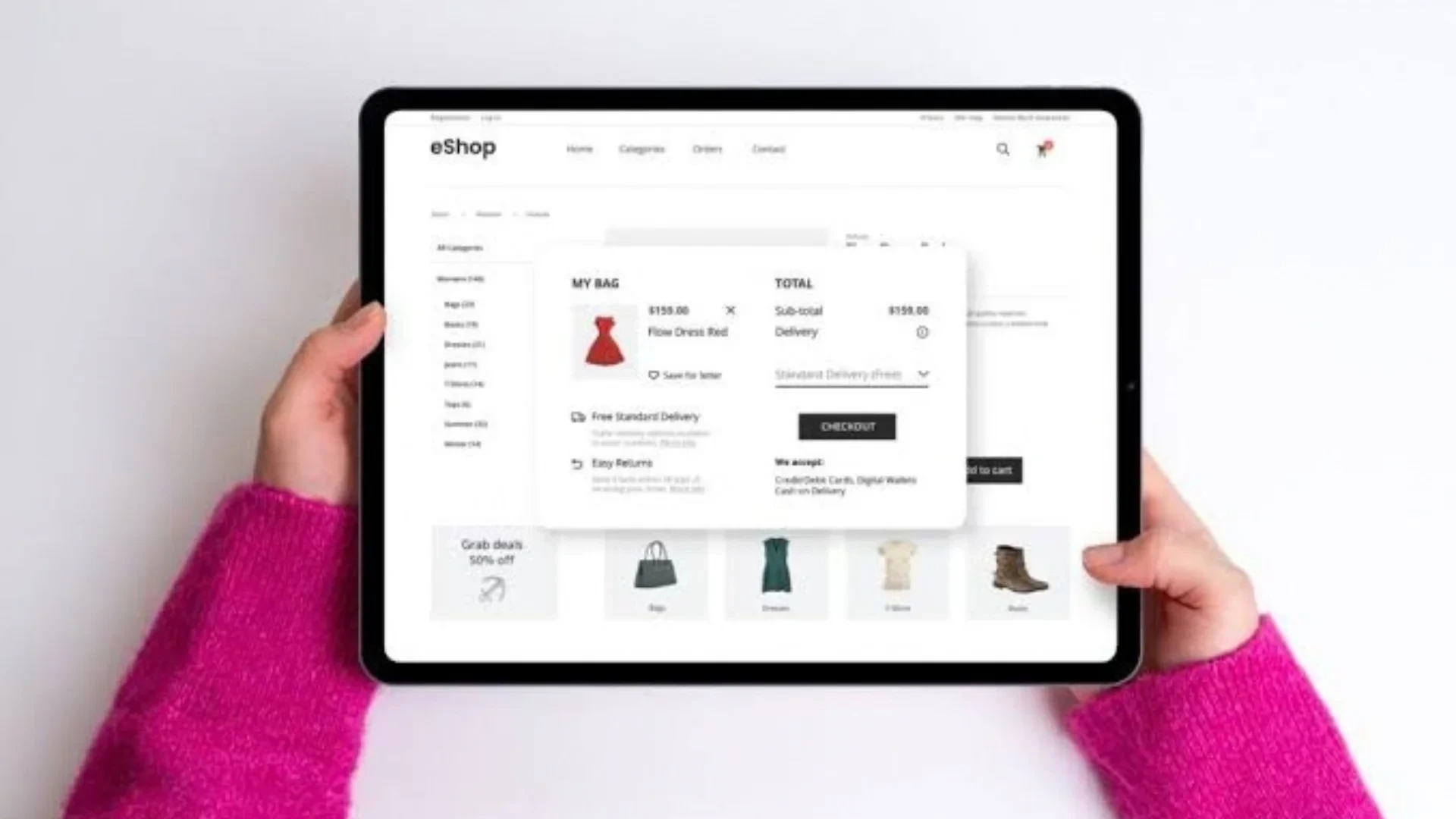
Stock reservation at checkout is the mechanic that actually stops overselling. When a buyer begins checkout, the system reserves the units rather than waiting for payment to decrement them. Reserved stock is unavailable to everyone else, so the last item cannot be sold twice.
The pattern is two-phase. Available stock equals on-hand minus reserved. At checkout, units move from available to reserved; on payment, the reservation converts to a sale and on-hand drops; if checkout is abandoned, the reservation expires and the units return to available. This is the same safety-buffer idea a threshold setting gives you on a channel, but enforced at the transaction level where the race condition actually lives.
Without reservation, two concurrent orders both read the same available count and both succeed, and one customer gets an apology. With it, the second order sees zero available and is stopped cleanly. Getting this write path atomic under load is where teams hire Python developers who have shipped high-traffic checkouts, so the reservation holds even during a flash sale.
Multi-warehouse sync and allocation
Multi-warehouse sync keeps one live count per SKU per location, and multi-warehouse allocation decides which location fulfills each order. Together they let you hold stock in several depots and still show one accurate number to the shopper.
Sync is the read side: total available for a SKU is the sum across its warehouse rows, so a sale in one depot lowers the global number everywhere instantly. Allocation is the decision side: when an order lands, the system picks a warehouse by rule, usually nearest to the customer, or the one that can ship the whole order, or a split across two. This is what lets a brand fulfill from three locations without three separate stock silos.
The allocation rules are where real operational savings hide: choosing the closest depot cuts shipping cost and transit time. Building a reliable multi-warehouse module is a common reason founders set up a dedicated software development team, and the routing logic overlaps with the real-time state work in our on-demand app development guide.
The low-stock notification engine
A low-stock notification engine fires an alert when a SKU crosses a reorder point, so you restock before you run out. It watches the live count, compares it to a per-SKU threshold, and notifies the right people through the right channel.
The engine has three parts: a reorder point per SKU, set from sales velocity and supplier lead time; a trigger that fires the moment the available count drops to that point; and a delivery path that sends the alert by email, dashboard, or an auto-generated purchase order. Because it reads the same live count as the storefront, the alert is never stale.
The reorder point is the number that matters. Set it too low and you stock out during the lead time; too high and capital sits idle. A good low-stock notification engine lets each SKU carry its own threshold and updates it as velocity changes. Wiring these triggers and purchase-order automations reliably is why teams hire automation engineers to keep the alert paths tested.
How to manage e-commerce inventory, step by step
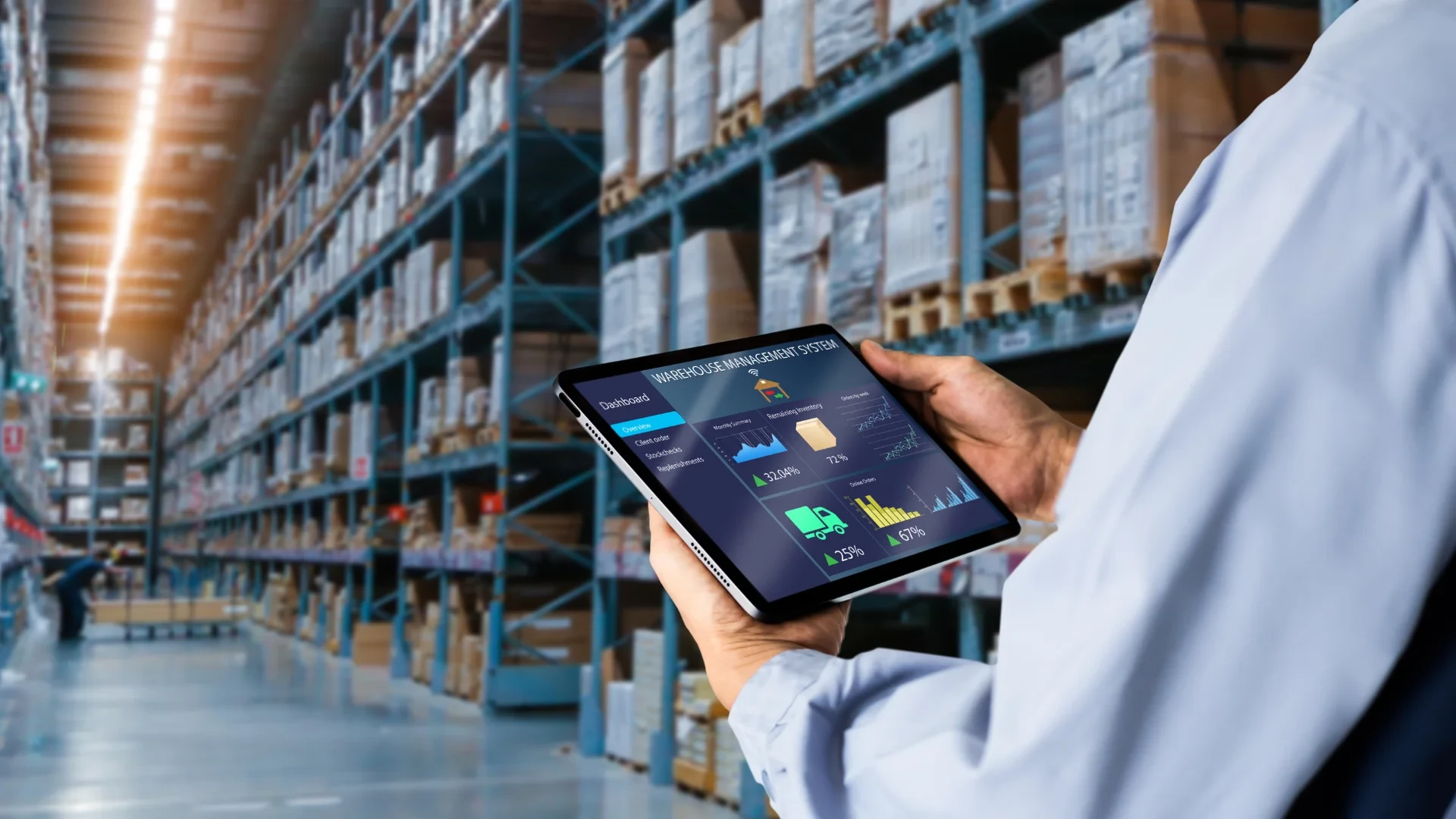
To manage e-commerce inventory in real time: centralize the count, connect every channel, reserve at checkout, allocate across warehouses, and automate reorder alerts. Here is the build in six steps.
Centralize the count. Make one inventory service the single source of truth; no channel keeps its own copy.
Connect every channel. Sync each storefront, marketplace, and POS to the master count through webhooks or APIs.
Reserve at checkout. Lock units when checkout starts so concurrent orders cannot oversell.
Allocate across warehouses. Route each order to the best location by nearest-stock or whole-order rules.
Automate reorder alerts. Set a per-SKU reorder point and fire low-stock notifications before stockout.
Reconcile and audit. Run cycle counts against the live figure to catch shrinkage early.
Keeping a multi-channel build on track is easier when you hire a project manager to own the plan. When search and catalog also need to scale alongside inventory, the patterns in our freelance marketplace build guide carry over.
Best practices: safety stock, ABC, FIFO, EOQ and JIT
Four practices keep a real-time system healthy: hold safety stock as a buffer, prioritize with ABC analysis, rotate with FIFO, and use EOQ and JIT to time reorders. Real-time data is what makes each of them accurate.
Safety stock. A buffer that covers demand spikes and supplier delays so orders are not delayed.
ABC analysis. Segment SKUs into A (high value, low quantity), B (moderate), and C (low value, high quantity) and focus control on the A items.
FIFO. First in, first out, so older stock sells first and perishable or dated goods do not expire.
EOQ and JIT. Economic order quantity finds the reorder amount that minimizes total ordering and holding cost; just in time keeps stock low by receiving goods only as needed.
The 80/20 rule sits underneath all of this: roughly 20 percent of SKUs drive about 80 percent of sales, so those are the ones that most need accurate real-time counts and tight reorder points. Founders often use IT staff augmentation to add operations-savvy engineers who bake these rules into the system rather than leaving them to manual judgment.
Popular tools and when to build custom
Off-the-shelf tools are the fast start for real-time inventory; a custom build wins when your channels, warehouses, or allocation rules exceed what a tool allows. Most brands begin with a tool and move to custom when the edges start to bind.
hipBob. Combines fulfillment services with real-time inventory tracking and multi-channel syncing.
Zoho Inventory. Affordable software offering automated purchase orders and multi-channel syncing.
Veeqo. Cloud-based tool that updates stock levels across channels instantly to prevent discrepancies.
These tools are excellent until you need a rule they do not support: a bespoke allocation strategy, a reservation window tuned to your checkout, or a sync to an ERP the tool does not integrate with. That is the point to build a multi-warehouse module on your own terms, and where agencies offering inventory tools under their own brand use white label development services to move faster.
Real-time inventory tech stack
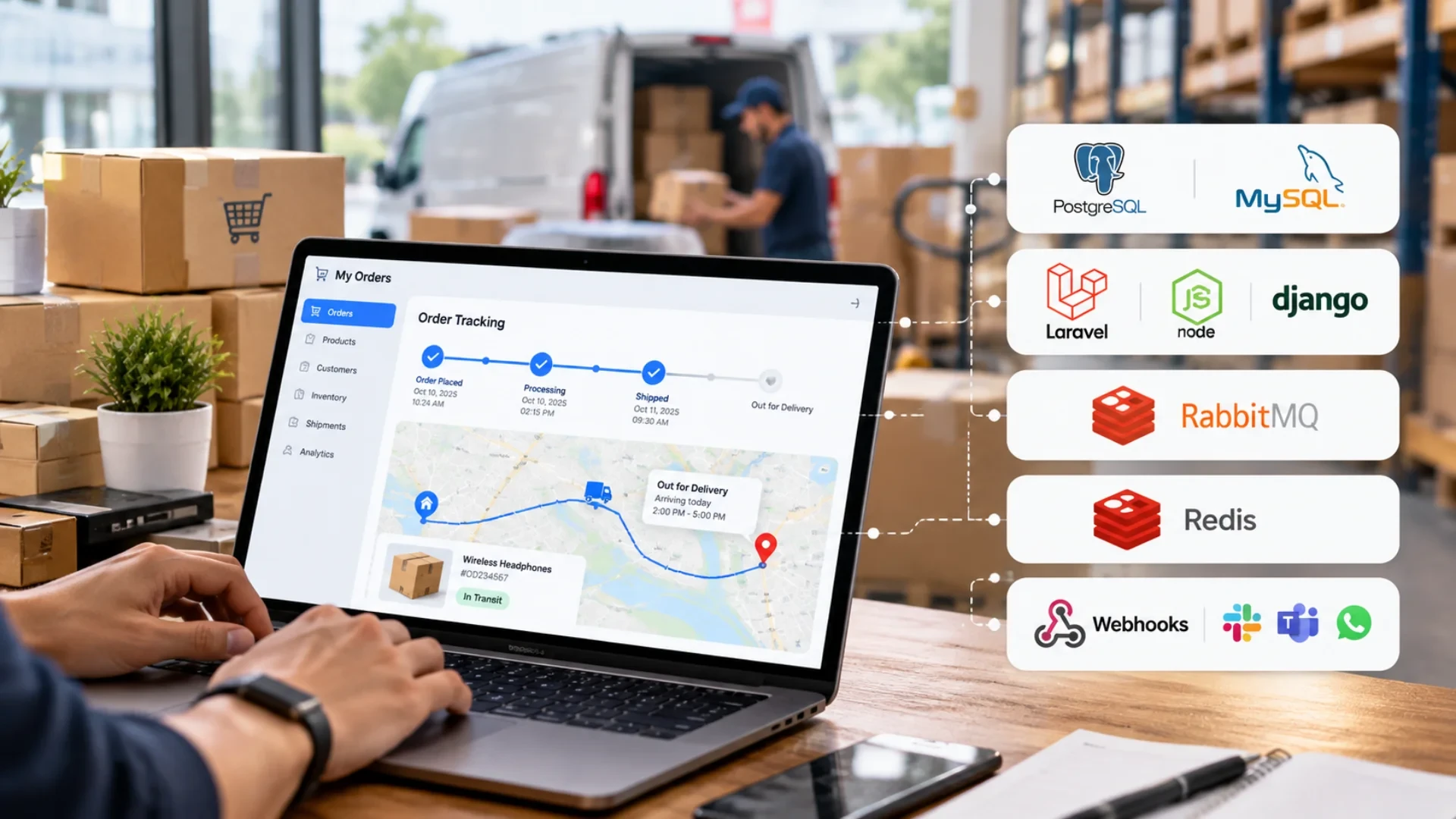
The best stack for real-time inventory pairs a reliable transactional database, a message queue for events, a cache for hot reads, and webhooks for channel sync. Correctness under concurrency matters more than novelty.
Layer | Common choice | Why |
Database | PostgreSQL (or MySQL) | Atomic stock writes and constraints |
Backend | Laravel, Node.js, or Django | Event handling and reservation logic |
Queue | Redis or a message queue | Idempotent event and webhook processing |
Cache | Redis | Fast live count reads |
Sync | Webhooks and channel APIs | Push updates to every storefront |
Laravel or Node.js with PostgreSQL and a Redis-backed queue is the dependable default, with webhooks for sync. Acquaint Softtech builds on this stack so the count, the reservations, and the alerts all stay consistent under load. When demand forecasting becomes a priority, it is a natural fit for AI development services once the real-time core is live and generating data.
Inventory management cost by market
Inventory management cost depends on channel count, warehouse count, and how much automation you need. A single-channel real-time module is far cheaper than a multi-warehouse system with allocation, alerts, and ERP sync.
The ranges below are 2026 planning estimates at local agency rates for a custom real-time inventory module plus backend implementation. They are starting points to confirm against a real scope. Offshore delivery of a custom inventory sync from India typically lands well below these numbers.
Target market | Real-time module (MVP) | Full multi-warehouse platform |
United States / New York City | $15,000 to $40,000 | $55,000 to $150,000+ |
United Kingdom | $14,000 to $38,000 | $52,000 to $140,000+ |
Europe (EU) | $15,000 to $40,000 | $55,000 to $145,000+ |
Australia | $16,000 to $42,000 | $58,000 to $155,000+ |
New Zealand | $16,000 to $43,000 | $58,000 to $158,000+ |
The biggest lever is engineering rate, not feature count. That is why many teams choose custom inventory sync in India to build multi-warehouse module and alert logic, where the same scope costs a fraction of local rates. As channel APIs and integrations change, version upgrade services keep the sync current without breaking live selling, and a senior architect can set the approach up front through virtual CTO services.
Real case study: a multi-vendor stock sync rebuild
No two builds are identical, but the closest documented parallel from our own work is a custom multi-vendor marketplace, similar to Amazon, where many sellers ran their own stores and stock had to stay accurate across all of them from a single admin dashboard, with product data served over an API. Inventory sync was the part that had to be right. The table below is the before-and-after sync log from that engagement.
Area | Before (the problem) | After (how we solved it) |
Stock source | Each vendor store held its own count, so numbers drifted | One live count per SKU as the single source of truth |
Overselling | Concurrent orders sold the same last unit twice | Reservation at checkout locked units before payment |
Sync speed | Counts updated on a slow, manual cycle | Event-driven updates pushed to every store instantly |
Visibility | No single view of stock across vendors | One super-admin dashboard over an API-served catalog |
Result | A secure, feature-rich marketplace with a custom product page and per-vendor store design, delivered with weekend support | Accurate stock across every seller from one dashboard |
Why Acquaint Softtech | 13+ years, 1,300+ projects, 50+ Clutch reviews | Vetted developers deployable within 48 hours |
You can read the full write-up on our B2B e-commerce marketplace case study and verified client reviews on our Clutch profile. The relevance is direct: a single live count, reservation at checkout, and event-driven sync are the same choices every real-time inventory system needs.
Why teams struggle, and what to check before you hire
Most inventory systems do not fail at the dashboard. They fail at the write path, where a missed event or an unreserved checkout quietly oversells and breaks trust with customers and sellers at once.
If you are deciding whether to build in house or hire a partner for a custom inventory sync, check for these before you commit:
Do they keep one live count as a single source of truth, not a copy per channel?
Is stock reserved at checkout so concurrent orders cannot oversell?
Does multi-warehouse allocation route orders by real rules, not a fixed default?
Are low-stock alerts event-driven, reading the same live count as the storefront?
That write path is where experience shows. Acquaint Softtech has delivered 1,300+ projects over 13+ years with 50+ Clutch reviews and can deploy vetted developers within 48 hours.
After launch, an inventory system needs care as channels and volumes change, which is where ongoing support and maintenance services keep sync, reservations, and alerts healthy. Teams that want the approach pressure-tested first can start with a product discovery workshop before any code is written.
Get a free real-time inventory consultation
Share your channels, warehouses, or a short brief. We will review your stock source, checkout reservation, multi-warehouse allocation, and low-stock alerts, then hand back a prioritized plan and a scope you can act on. This is the last step before you commit engineering time.
Frequently Asked Questions
-
How do you track inventory in real time?
Track inventory in real time by keeping one central count as a single source of truth and updating it the instant each sale, return, or restock happens, then syncing that number to every channel through webhooks or APIs. Reserve stock at checkout so concurrent orders cannot oversell, and read the same live count everywhere so the storefront figure always matches the warehouse.
-
How do you manage e-commerce inventory?
Centralize the count in one inventory service, connect every storefront, marketplace, and POS to it, reserve units at checkout, allocate orders across warehouses by rule, and automate reorder alerts at a per-SKU threshold. Run cycle counts against the live figure to catch shrinkage. The goal is one accurate number that updates instantly and drives both selling and restocking.
-
How do you sync inventory across warehouses?
Keep one live count per SKU per warehouse and treat total available as the sum across locations, so a sale in any depot lowers the global number instantly. Add allocation rules that pick which warehouse fulfills each order, usually the nearest stock or the location that can ship the whole order. Adding a warehouse means inserting rows, never rebuilding the model.
-
How do you build low-stock alerts?
Set a reorder point per SKU based on sales velocity and supplier lead time, then run an engine that watches the live count and fires the moment available stock hits that point. Deliver the alert by email, dashboard, or an auto-generated purchase order. Because it reads the same live count as the storefront, the notification is never stale and restocking starts before a stockout.
-
What is the 80/20 rule in inventory?
The 80/20 rule, or Pareto principle, holds that roughly 80 percent of sales come from about 20 percent of SKUs. In inventory management it means those high-velocity items deserve the tightest real-time counts, the most accurate reorder points, and the most safety stock, while low-value, high-quantity items can be managed more loosely. It is the basis of ABC analysis.
-
What is the best inventory management system for e-commerce?
There is no single best system; it depends on channels, warehouses, and rules. Tools such as ShipBob, Zoho Inventory, and Veeqo offer real-time tracking and multi-channel sync quickly. A custom build wins when you need bespoke allocation, a tuned reservation window, or ERP sync a tool cannot provide. Most brands start with a tool and move to custom as their edges bind.
-
What is EOQ and JIT?
EOQ, economic order quantity, is the reorder amount that minimizes total ordering and holding cost, telling you how much to buy each time. JIT, just in time, keeps stock as low as possible by receiving goods only as they are needed, cutting storage cost but demanding reliable suppliers. Real-time inventory data makes both calculations accurate rather than guesswork.
-
What is real-time inventory management, in one line?
Real-time inventory management is an automated system that tracks stock levels instantly as sales, returns, and restocks happen across all digital and physical channels, keeping one live count that every storefront reads from. It prevents overselling, removes manual errors, sharpens forecasting, and ties live sales to cost of goods sold for accurate profit tracking.
With over 11 years of experience in web application development and project management, I excel in leading cross-functional teams to deliver innovative digital solutions. My expertise spans eCommerce platforms, ERP systems, and JS & PHP-based frameworks, including WordPress, React JS, and Laravel. As a Technical Project Manager, I specialize in strategic planning, system design, and end-to-end project execution, transforming complex ideas into scalable, high-impact applications.
Table of Contents
Get Started with Acquaint Softtech
- 13+ Years Delivering Software Excellence
- 1300+ Projects Delivered With Precision
- Official Laravel & Laravel News Partner
- Official Statamic Partner
Related Blog

How Custom E-Commerce Platforms Work: Architecture, Modules, and When to Build One
A custom e-commerce platform is not a bigger Shopify plan. It is a purpose-built commerce engine where every module answers to your business logic, not a vendor's roadmap. This article explains exactly how one is architected, what it contains, and the 5 operational signals that tell you when building your own beats, staying on SaaS.

Manish Patel
May 12, 2026
Headless Commerce Explained: Decoupled Architecture for Modern E-Commerce Development
Headless commerce is not a technology upgrade. It is a structural decision that separates the commerce engine from the storefront entirely. Done right, it gives you deployment freedom, channel flexibility, and a performance ceiling that no monolithic SaaS platform can match. Done wrong, it creates distributed systems complexity that your team is not ready for. This article tells you exactly which situation you are in.
Manish Patel
May 19, 2026
Building a Freelance Marketplace Like Upwork or Fiverr: Two-Sided Platform Architecture
A freelance marketplace like Upwork or Fiverr is a two-sided platform that connects clients who need work done with freelancers who provide services. It works by letting clients post jobs or browse gigs, matching them with freelancers, holding payment in escrow against milestones, and releasing funds when work is approved, taking a commission on each transaction.
Manish Patel
June 30, 2026India (Head Office)
203/204, Shapath-II, Near Silver Leaf Hotel, Opp. Rajpath Club, SG Highway, Ahmedabad-380054, Gujarat
USA
7838 Camino Cielo St, Highland, CA 92346
UK
The Powerhouse, 21 Woodthorpe Road, Ashford, England, TW15 2RP
New Zealand
42 Exler Place, Avondale, Auckland 0600, New Zealand
Canada
141 Skyview Bay NE , Calgary, Alberta, T3N 2K6