

Home Services Subscription Plans: Building Maintenance Packages for Monthly Recurring Revenue
Home maintenance subscription packages cost between £10 and £500 or more per month in the UK, providing recurring proactive upkeep, priority emergency call-outs, and discounted repairs. Basic plans at £10 to £20 cover appliance protection and minor checks, standard plans at £50 to £150 add monthly visits and priority booking, and premium plans at £250 to £500 or more offer full property management. For the operator, the value is predictable monthly recurring revenue and higher customer retention.

Ahmed Ginani
As the Business Head at Acquaint Softtech, I watch home services founders chase new leads while a far cheaper growth lever sits unused: recurring revenue from maintenance subscriptions. Turning one-off jobs into monthly plans is a business decision, and the software that runs it is core software product development, not a light add-on.
Here is the honest framing. A home services subscription model charges a homeowner a flat monthly fee for scheduled upkeep, priority support, and repair discounts, in exchange for predictable revenue you can plan around. Members renew far more reliably than one-off customers, which is why recurring revenue home services businesses are valued more highly than job-to-job operators.

- You want to turn one-off home service jobs into monthly recurring revenue.
- You need the real build behind a subscription or AMC module and recurring billing.
- You want honest 2026 pricing tiers, package contents, and cost to build.
- You are a CEO, CTO, COO, founder, or agency owner shipping a home services platform.
This guide covers how the model works, what to put in a package, pricing tiers, the module you build, the billing engine, and cost. It sits inside our wider on-demand app development guide, so you can see where subscriptions fit next to booking, scheduling, and payments.
Everything here reflects delivery experience. Acquaint Softtech has built multi-tenant subscription logic, usage tiers, and predictable billing for real platforms, which is exactly the foundation a home services recurring-revenue product needs.
How home services subscriptions work
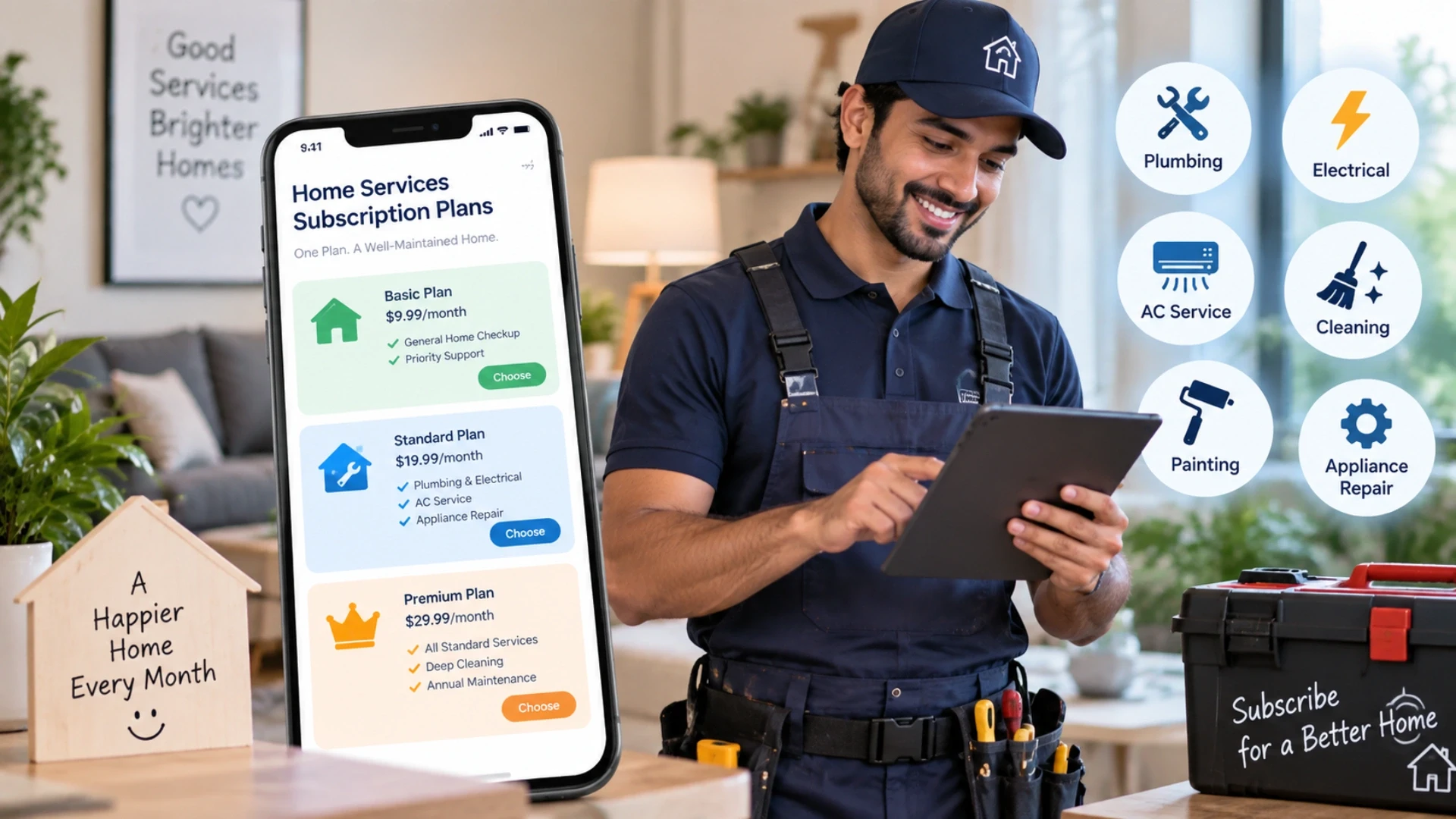
A home services subscription charges a homeowner a recurring monthly or annual fee in exchange for scheduled maintenance, priority booking, and repair discounts. The provider gains predictable monthly recurring revenue and higher retention, and the customer gains proactive upkeep instead of emergency panic. That trade is the whole model.
In practice, this is the same idea as an Annual Maintenance Contract, or AMC, a contract that bundles a year of routine service into one plan, delivered through an app. Building AMC apps and monthly maintenance packages well is why teams hire Laravel developers with real subscription and billing experience rather than generalists.
The reason operators care is retention. A one-off customer is won again every season; a member is already on the calendar. Operators who want to launch a branded plan fast often start with white label development and then extend the rules as they grow, which is how the best home services subscription maintenance package monthly recurring model usually reaches the market quickly.
The numbers explain the enthusiasm. Operators who earn a meaningful share of revenue from memberships tend to keep customers at retention rates in the mid-nineties, against a transactional-industry average nearer 65% to 70%, because a member already has the next visit booked.
That retention advantage also lifts business valuation, since buyers pay more for predictable recurring revenue than for job-to-job income. Recurring revenue is not only steadier cash; it makes the whole business structurally more valuable.
What a maintenance package should include
A strong maintenance package includes four things: routine checks, an allowance of on-demand labor, priority emergency support, and member discounts. Together, they turn an abstract monthly fee into visible, repeated value the member actually feels.
What is included
Routine checks: annual boiler services, gas safety certificates, and seasonal property inspections.
On-demand labor: fixed monthly allowances for minor handyman tasks, plumbing, or electrical repairs.
Emergency support: priority response times, often 24/7 or within 48 hours, with waived or reduced call-out fees.
Discounts: reduced rates on extra labor, materials, and specialized renovation work.
Some inclusions carry compliance weight. In the UK, an annual boiler service and gas safety work must be done by an engineer on the Gas Safe Register, so your plan logic has to track certificate expiry, not just visit dates.
For teams without that domain depth in-house, software development outsourcing brings engineers who have modelled these rules before. Our guide to building on-demand lifestyle and home apps covers the wider service model.
Pricing tiers: basic, standard, and premium
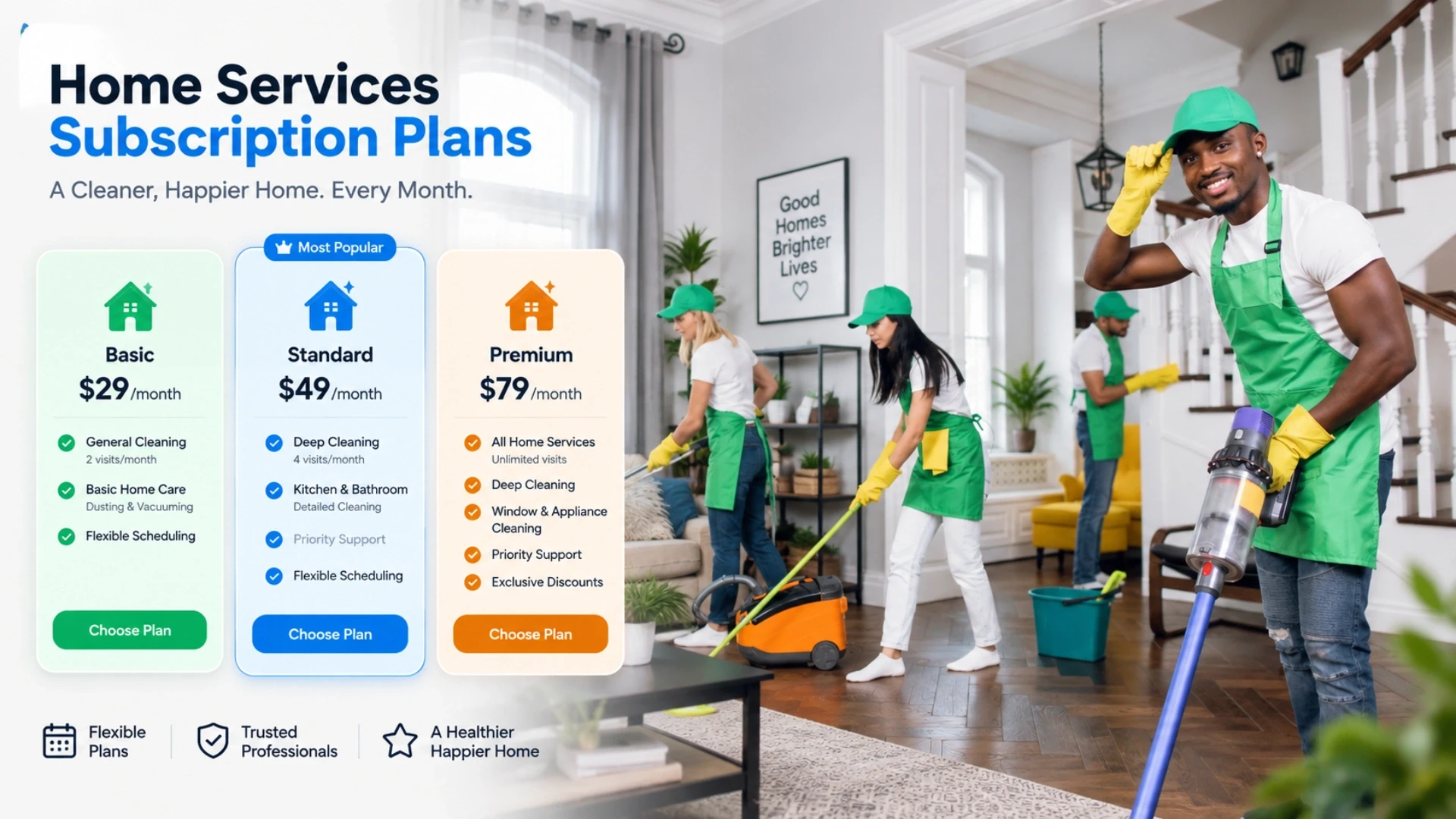
Home maintenance plans usually come in three tiers: basic, standard, and premium. The tiers scale by number of visits, size of labor allowance, and depth of coverage, and modelling them cleanly is the first real engineering decision in any subscription build.
Basic £10 to £20 / mo | Standard / Essential £50 to £150 / mo | Premium / Comprehensive £250 to £500+ / mo |
Appliance protection or network access Coordination and minor scheduled checks Member discount on repairs | Regular monthly maintenance visits Material allowances included Priority booking and response | Multiple monthly visits Full property inspections Heavy labor and renovation discounts |
The tiers are the easy part to describe and the hard part to model, because each one unlocks a different set of entitlements. Getting that structure right up front is where a dedicated software development team earns its keep, and usage-based tiers that flex with consumption pair naturally with AI development for demand and pricing insight.
Not sure how to structure your plans and pricing?
Tier design, entitlements, and billing all connect, and getting them wrong is expensive to unwind later. Tell us your services and markets, and we will map the plans, the module, and the billing engine before you build.
Building the subscription and AMC module
A subscription module is built from three core objects: a plan that defines the terms, a subscription that links a customer and payment method to that plan, and entitlements that define what each plan unlocks. Model those three cleanly, and everything else, billing, renewals, and reporting- hangs off them.
To build a home services subscription module, treat plans and entitlements as data, not code: a plan carries price, interval, and included visits, while entitlements record what a member can consume, such as two visits a quarter or a labor allowance. Sharing that logic across the customer, technician, and admin apps is cleaner when teams hire MERN stack developers for one codebase. Our guide to building a marketplace with recurring logic covers the same entitlement patterns.
The AMC package feature adds a service calendar on top: the module has to schedule the included visits, track what has been consumed, and roll unused entitlements according to your rules. That scheduling and consumption logic is data-heavy, so teams hire Python developers to own it, which is often why founders hire developers for an AMC module rather than stretch a generalist.
Model plans as data: price, interval, included visits, and effective dates per plan and tier.
Define entitlements: what each plan unlocks, from visit counts to labor allowances and discounts.
Link the service calendar: schedule included visits and track consumption against entitlements.
Enforce access: gate member-only pricing and priority booking behind an active subscription.
One detail separates a real module from a demo: mid-cycle changes. When a member upgrades from standard to premium, or pauses for a month, the module must prorate the charge, adjust entitlements from that date, and keep the service calendar in step. Handle plan changes, pauses, and cancellations as first-class events from the start, because bolting them on later is where subscription builds usually break.
Recurring billing, renewals, and failed payments
Recurring billing for home services works by storing a payment token, charging it on a schedule set by the plan, and handling renewals and failed payments automatically. The billing engine, not the checkout screen, is what makes recurring revenue actually recur.
You never store raw card numbers. The gateway vaults the card and returns a token, which keeps the system within the PCI DSS standard, and a scheduler charges that token each cycle. The same tokenized billing patterns appear in our mobile commerce development guide.
The part most teams underestimate is failed payments. Cards expire, and charges decline, so a custom subscription for home services needs dunning: automatic retries, a grace period, member reminders, and a clean pause or cancel path. Keeping those jobs correct is why teams hire automation engineers to test the billing and renewal flows continuously, so maintenance plan management stays trustworthy as plans change.
Building the subscription and billing engine yourself?
Plans, entitlements, recurring billing, renewals, and dunning all have to agree, and a gap in any one leaks revenue. Bring us your model, and we will scope the module and the billing engine so every cycle charges cleanly.
The management dashboard and cost to build

A subscription dashboard turns the billing data into decisions: it shows active members, monthly recurring revenue, churn, failed payments, and visits due. Without it, finance and operations reconstruct the numbers by hand and members slip through the cracks.
The metrics that matter are monthly recurring revenue, churn rate, average revenue per member, and failed-payment recovery. Track those four from launch, because they are the numbers a board and an eventual buyer will ask for, and they are far easier to capture by design than to reconstruct later.
The dashboard reads from the same records the billing engine writes, so every figure ties back to a subscription. Keeping those reporting and scheduling jobs fast and reliable under load is why teams hire DevOps engineers to run the pipelines behind them. Because engineering rate is the biggest cost lever, the home services subscription maintenance package monthly recurring cost drops sharply when founders hire remote developers from India, a pattern our on-demand cost guide breaks down by feature.
The ranges below are 2026 planning estimates at local agency rates for the subscription feature only, not a whole platform. Confirm against a real scope, and note that offshore delivery from India typically lands well below these numbers.
Scope | Rough build cost | Best for |
Subscription module only | 10,000 to 22,000 USD | Adding plans to an existing app |
Module plus recurring billing | 22,000 to 40,000 USD | Full self-running recurring revenue |
Billing plus dashboard and AMC calendar | 35,000 to 60,000 USD | Operators who need full visibility |
How Acquaint Softtech builds subscription systems
Here is a real example rather than a hypothetical one. Acquaint Softtech restructured the backend for Juna AI, a Berlin-based industrial AI company, to support true multi-tenancy and to make subscriptions predictable.
The engagement holds a 5.0 out of 5 rating on our Clutch profile, and its core, tiered subscription logic and clean entitlements on Laravel are exactly what a home services subscription platform runs on.
Subscription capability | Delivered for Juna AI (Laravel) | Your home-services equivalent |
Plans and usage tiers | Subscription logic for multiple users and usage tiers under one account | Basic, standard, and premium maintenance plans |
Entitlements and access | Laravel Policies and Gates for fine-grained role-based access | Gating member pricing and priority booking |
Scheduled jobs | Laravel queues for notifications, reports, and scheduling | Recurring charges and renewal reminders |
Predictable billing | Subscription handling made predictable for billing and access | Reliable monthly recurring revenue |
In the client’s own words, “project management was one of the strongest aspects of working with Acquaint Softtech,” and after the engagement, subscription handling became far more predictable for both billing and access control.
That came from Christian Hardenberg, Founder of Juna AI. Tiered plans, clean entitlements, and scheduled billing jobs are precisely what a home services subscription and AMC module needs, which is why this is an honest proof point rather than a stock demo.
Adding senior hands and keeping it healthy
When you need extra engineers on the subscription layer fast, IT staff augmentation adds vetted people to your team, and after launch, support and maintenance services keep the billing, renewal, and scheduling paths healthy as plans and prices change.
For teams that want a senior architect to set the subscription and billing approach before the first sprint, virtual CTO services provide that experienced hand. You can review projects on our case studies page and read verified feedback on our Clutch profile, where Acquaint Softtech holds a 4.9 out of 5 across 50-plus reviews. That track record is why founders trust Acquaint Softtech with the recurring-revenue layer.
Ready to build maintenance plans that pay you every month?
From plan and entitlement design to recurring billing, renewals, and a live dashboard, this is the layer that turns one-off jobs into monthly recurring revenue. Share your model and we will scope it end to end.
Frequently asked questions
-
How do home service subscriptions work?
A homeowner pays a recurring monthly or annual fee, and in return gets scheduled maintenance visits, priority booking, and discounted repairs. The provider earns predictable recurring revenue and keeps the customer on the calendar instead of winning them again each season. In software, a plan defines the terms and a subscription links the customer and payment method to it.
-
How to build an AMC feature in an app?
Model the Annual Maintenance Contract as data: a plan with price, interval, and included visits, plus entitlements for what the member can consume. Add a service calendar that schedules the included visits and tracks consumption, a billing engine that charges on schedule, and renewal logic. Keep rules configurable so operations can change plans without a code deploy.
-
What is recurring revenue in home services?
Recurring revenue is the predictable income from customers on ongoing maintenance plans, billed monthly or annually, rather than one-off job fees. It matters because members renew far more reliably than transactional customers, which raises retention, smooths cash flow across seasons, and increases what the business is worth to a buyer.
-
How much does a subscription module cost?
A subscription module alone typically runs about 10,000 to 22,000 US dollars, a module with recurring billing about 22,000 to 40,000, and a full build with a dashboard and AMC calendar roughly 35,000 to 60,000. Engineering rate is the biggest lever, so offshore delivery from India can build the same scope for a fraction of USA or Australia rates.
-
How much do home maintenance plans cost per month?
In the UK, home maintenance subscription plans run from about 10 to 500 pounds or more per month. Basic plans at 10 to 20 pounds cover appliance protection and minor checks, standard plans at 50 to 150 pounds add monthly visits and priority booking, and premium plans at 250 to 500 pounds or more offer full property management and inspections.
-
What should a maintenance package include?
A well-built package includes routine checks such as an annual boiler service, a fixed allowance of on-demand labor for minor repairs, priority emergency support with reduced or waived call-out fees, and member discounts on extra work. Tie compliance-sensitive items like gas safety certificates to expiry dates in your plan logic, not just visit counts.
-
How do you handle failed subscription payments?
Handle them with dunning: automatically retry a declined card on a schedule, notify the member, apply a short grace period, and pause access cleanly if payment still fails. Store cards as gateway tokens so retries are seamless, and keep every attempt in an audit log. Good dunning quietly recovers a meaningful share of otherwise lost recurring revenue.
-
Is recurring billing PCI compliant?
Yes, when built correctly. Never store raw card numbers; let a certified gateway vault the card and return a token, then charge that token on schedule. This keeps most of your system out of PCI scope, satisfies the PCI DSS standard, and, in the EU and UK, works within strong customer authentication rules for recurring payments.
I help agencies and founders scale their tech teams with the right developers at the right time. At Acquaint Softtech, I focus on building long term partnerships and making remote hiring simple, predictable, and results driven. My goal is straightforward to help businesses grow faster with reliable dedicated developers.
Table of Contents
Get Started with Acquaint Softtech
- 13+ Years Delivering Software Excellence
- 1300+ Projects Delivered With Precision
- Official Laravel & Laravel News Partner
- Official Statamic Partner
Related Blog

Why On-Demand Beauty Services Is the Next Big Thing?
On-demand beauty services are transforming the app development landscape by meeting the growing demand. Discover why on-demand beauty apps are the next big trend.

Mukesh Ram
December 3, 2024
Food Delivery App Like Zomato & DoorDash: Architecture, Features, and Scale
Zomato and DoorDash are not apps. They are data platforms. Every feature you see in the consumer interface is the output of a precisely designed data model, a set of platform entities with defined relationships, and a state machine with explicit transition rules. This guide walks through the data architecture, the platform design decisions, and the six scaling triggers that tell you when the platform needs to grow.

Manish Patel
May 21, 2026
Building an Uber Clone for US Carpooling Demand
Gas prices at $3.84/gal and rising? The USA carpooling market is exploding. Learn why a Laravel-powered Uber clone is the strategic move for founders in 2026.

Chirag Daxini
April 9, 2026India (Head Office)
203/204, Shapath-II, Near Silver Leaf Hotel, Opp. Rajpath Club, SG Highway, Ahmedabad-380054, Gujarat
USA
7838 Camino Cielo St, Highland, CA 92346
UK
The Powerhouse, 21 Woodthorpe Road, Ashford, England, TW15 2RP
New Zealand
42 Exler Place, Avondale, Auckland 0600, New Zealand
Canada
141 Skyview Bay NE , Calgary, Alberta, T3N 2K6