

Product Information Management (PIM): Centralizing Product Data for Multi-Channel Commerce
Product Information Management (PIM) is a centralized software system that stores, organizes, enriches, and syndicates all the data needed to market and sell products across multiple e-commerce channels. It manages product details, specifications, marketing content, digital assets, and localization while distributing optimized data to websites and marketplaces.

Manish Patel
As the person who leads technology and client success at Acquaint Softtech, I have seen the same bottleneck slow down brand after brand: the product data lives in ten places at once. A spec sheet here, a supplier file there, marketing copy in a shared doc, images in a folder, and none of it agrees. Fixing that is real software product development, because product information management PIM e-commerce is what turns that mess into one clean record every channel can pull from.
This is a build and integration guide, not a tool review. Most product information management pim e commerce tutorial and product information management pim e commerce guides stop at what a PIM is and which product to buy.

- A CTO or architect scoping a centralized product data platform and its syndication layer.
- A COO or ops lead tired of manual data entry and inconsistent listings across channels.
- A founder deciding whether to buy a PIM tool or build a custom one that fits your catalog.
- A product owner mapping enrichment workflows, DAM integration, and multi-channel product management.
This one goes further: how a PIM is architected, how data is normalized, how it syndicates to channels, and when a custom build beats an off-the-shelf platform.
If you want the wider picture first, our guide on how custom e-commerce platforms work maps every module a store runs on. This article zooms into the product-data layer that feeds all of them.
What is PIM in e-commerce?
PIM in e-commerce is a centralized system that consolidates, enriches, and distributes product data across every sales channel, acting as the single source of truth for all product content. It ensures the same accurate description, spec, and image reach your website, Amazon, and every marketplace at once.
Before PIM, product information sat in fragmented silos: spreadsheets for specs, one place for pricing, another for marketing copy, a folder for images. That scatter causes inconsistent listings, manual-entry errors, and slow launches. A PIM fixes it by letting product information be created once, enriched together, checked against quality rules, and pushed automatically to every touchpoint.
The payoff is concrete. Complete, accurate product content lifts online conversion, and centralized workflows cut the weeks teams lose compiling data per channel. Acquaint Softtech treats this single source of truth as the backbone of multi-channel product management, not a nice-to-have.
The four core functions of a PIM
A PIM does four jobs: centralization, enrichment, optimization, and distribution. Together they move product data from scattered and raw to clean, channel-ready, and syndicated automatically.
Centralization. Gathers scattered product data from spreadsheets, supplier files, and folders into a single source of truth.
Enrichment. Allows cross-functional teams to add marketing copy, technical specs, and translations to each product.
Optimization. Tailors product data for specific channels such as Amazon, Google Shopping, or your web store, and improves content for search engine optimization.
Distribution. Syndicates clean, up-to-date product feeds automatically through APIs to digital storefronts and marketplaces.
Enter data once, publish everywhere. That single loop is the reason a PIM earns its place, and the reason teams building one often hire Python developers for the data-processing and API work that enrichment and distribution depend on. The recurring patterns overlap with our D2C platform development guide.
What data does a PIM manage?
A PIM manages every attribute needed to market and sell a product: core product data, technical specifications, marketing and SEO content, digital assets, and localization. If it helps a shopper decide, it belongs in the PIM.
Core product data. SKUs, barcodes, titles, prices, and dimensions.
Technical specifications. Materials, ingredients, weight, and compliance certificates.
Marketing and SEO content. Descriptions, feature highlights, and target keywords.
Digital assets. Photos, videos, user manuals, and 360-degree views, often integrating with digital asset management.
Localization. Multilingual copy, regional sizing, and currency details.
That breadth is why the underlying data model matters so much: the schema has to hold structured specs, free-form copy, asset links, and per-locale variants without becoming a tangle. Designing that model well is where our headless commerce architecture guide and PIM work meet.
What a PIM is not: PIM vs ERP, inventory, and CMS
A PIM is not an ERP, not an inventory system, and not a CMS. It focuses strictly on sales-ready product data and feeds that data to those other systems rather than replacing them.
System | What it owns | How it relates to PIM |
PIM | Sales-ready product content | The single source of product data |
ERP | Financials and procurement | Feeds raw product data into the PIM |
Inventory system | Live stock and fulfillment | Separate; PIM does not track stock |
CMS | Website pages and layout | Consumes product data from the PIM |
DAM | Images, video, documents | Assets link into PIM product records |
Keeping these boundaries clean is the most common thing we correct on inherited systems. An ERP manages core financials and procurement; a PIM focuses on sales-ready data. An inventory system tracks live warehouse stock and order fulfillment; a PIM does not. A CMS builds and displays website pages; a PIM feeds product data into the CMS. Blur those lines and every integration afterward fights the confusion.
Not sure where the PIM ends and your ERP or CMS begins?
Drawing those boundaries is the first design decision, and the one that saves the most rework later. Tell us your stack and we will map which system owns which data and how a PIM should sit between them, as a build-ready plan.
PIM vs product catalog, and PIM vs PLM
A product catalog is a list of what you sell; a PIM is the governed system that manages and distributes all the data behind that list. PLM manages the design and engineering lifecycle upstream; a PIM enriches the finished product for selling.
A catalog on a storefront is an output. It shows titles, prices, and images to shoppers. A PIM is the layer beneath many catalogs at once: it holds the master record, enforces quality rules, and generates each channel's catalog from one source. That is the difference between a static list and a living data platform.
PLM, product lifecycle management, sits upstream of the PIM. PLM governs how a product is designed and engineered; the PIM takes the finished specs and wraps them in the marketing content, assets, and localization needed to sell. One builds the product; the other sells it. Founders who want a senior hand drawing these lines up front often use virtual CTO services before the first sprint.
How a custom PIM is architected
A custom PIM has four architectural layers: a flexible product data model, a workflow and governance engine, an ingestion layer that pulls from sources, and a syndication layer that pushes to channels. The data model is the foundation everything else stands on.
The four layers
Product data model. A flexible attribute schema holding structured specs, marketing copy, asset links, and per-locale variants, usually with a hybrid of typed columns and JSON for dynamic attributes.
Workflow and governance engine. Approval chains, role-based permissions, and validation rules that hold data to a completeness standard before it goes live.
Ingestion layer. Connectors that pull raw data from ERP, supplier feeds, and spreadsheets into the master record.
Syndication layer. Channel-specific transformers that generate and push a clean feed to each storefront and marketplace over APIs.
The workflow engine is what separates a PIM from a shared spreadsheet: nothing publishes until it passes the rules. To build PIM system capability that scales, teams often hire Laravel developers for the workflow and API layer, and set up a dedicated software development team to own the data platform end to end.
Product data normalization
Product data normalization is the work of turning messy, inconsistent source data into one clean, standardized record. It is where a PIM earns most of its value, because a channel feed is only as good as the data underneath it.
Normalization does three things: it standardizes values, so 10 in, 10-inch, and 10 inches all become one canonical value; it maps supplier fields to your master attributes, so a vendor's Colour column lands in your color field; and it de-duplicates, so the same product from two suppliers does not become two records. Without this step, syndication just spreads the mess faster.
This is the least glamorous and most important part of any PIM build. Getting it right is why teams that want a clean centralized product data foundation hire developers for product management who have done the data-cleaning work before, rather than treating it as a one-time script.
PIM to channel syndication
PIM to channel syndication is the automated distribution of clean product feeds to each storefront and marketplace, each in the format that channel requires. Update the master record once and every channel updates, on demand or on a schedule.
Each channel wants different fields, formats, and rules: Amazon expects one feed shape, Google Shopping another, your own store a third. The syndication layer transforms the master record into each of these, pushes it over an API or feed, and reports back what published and what failed. Because it reads from the single source of truth, a price change made once is correct everywhere within minutes.
The value is one-to-many: one edit, many channels, no manual reformatting. Building reliable connectors and keeping them healthy as channel APIs change is why teams hire automation engineers, and the event-driven patterns overlap with the real-time work in our on-demand app development guide.
PIM and DAM integration
PIM DAM integration, also written PIM and DAM integration, links digital assets to product records, so the right image, video, or manual travels with each product to every channel. The PIM owns the data; the DAM owns the media; the integration ties them together.
A digital asset management system stores and organizes images, videos, and documents. On its own it does not know which asset belongs to which SKU. The integration creates that link: each product record references its assets in the DAM, so when the PIM syndicates a listing, the correct media goes with it, in the resolution and format each channel needs. That is how a product page on three marketplaces all show the same approved photography.
Keeping asset links accurate as catalogs grow is real engineering, which is why agencies offering combined product and asset tools under their own brand use white label development services to ship faster.
How to build a PIM system, step by step
To build a PIM: model the product data, wire ingestion from your sources, build the enrichment workflow, add syndication to channels, then integrate the DAM. Here is the build in six steps.
Model the product data. Design a flexible attribute schema for specs, copy, assets, and locales.
Wire ingestion. Connect ERP, supplier feeds, and spreadsheets, and normalize the incoming data.
Build the enrichment workflow. Add roles, approvals, and validation rules so nothing publishes half-finished.
Add syndication. Build channel-specific transformers and push feeds over APIs.
Integrate the DAM. Link assets to product records so media travels with each listing.
Add SEO and localization. Optimize content per channel and adapt copy, sizing, and currency per market.
Keeping a data platform build on track is easier when you hire a project manager to own the plan. When catalog search has to scale alongside the PIM, the discovery patterns in our freelance marketplace build guide carry over.
Build vs buy: when custom wins
Buy a PIM when your needs are standard and speed matters; build a custom PIM when your catalog, channels, or workflows exceed what a tool allows. Most brands start with a tool and move to custom when the edges bind.
Off-the-shelf platforms such as Akeneo, Salsify, Pimcore, and Acquia PIM are excellent when your model fits theirs. A custom build wins when you have unusual attribute relationships, a channel or ERP the tool does not integrate with cleanly, a syndication rule the tool cannot express, or a cost curve that turns punishing at your SKU count. That is the point to build product data platform capability on your own terms, and where founders bring in IT staff augmentation to add data engineers fast.
Real case study: a multi-vendor product data platform
No two builds are identical, but the closest documented parallel from our own work is a custom multi-vendor marketplace, similar to Amazon, where many sellers uploaded product data that had to be cleaned and served consistently to buyers over an API, all managed from one super-admin dashboard.
That is a PIM problem at its core: many messy sources, one clean output. The table below is the source-to-channel data-flow log from that engagement.
Stage | What the client faced | How we solved it |
Source | Each vendor uploaded product data in its own format | An ingestion layer normalized every feed into one schema |
Enrich | Listings were inconsistent and often incomplete | Validation rules held data to a completeness standard before publish |
Store | No single source of truth across vendors | One master record per product, served over a clean API |
Distribute | Buyers saw mismatched product pages | Consistent, channel-ready data pushed to the storefront |
Result | A secure, feature-rich marketplace with a custom product page and per-vendor store design, delivered with weekend support | One super-admin dashboard governing all product data |
Why Acquaint Softtech | 13+ years, 1,300+ projects, 50+ Clutch reviews | Vetted developers deployable within 48 hours |
You can read the full write-up on our B2B e-commerce marketplace case study and verified client reviews on our Clutch profile. The relevance is direct: normalizing many sources into one governed record and syndicating it cleanly is exactly what a PIM does.
Why teams struggle, and what to check before you hire
Most PIM projects do not fail at the interface. They fail at normalization and governance, where messy source data and missing approval rules quietly push bad listings to every channel at once.
If you are deciding whether to build in house or hire a partner for a custom PIM, check for these before you commit:
Do they normalize source data into one clean schema, not just import it?
Is there a real governance workflow with approvals and validation before publish?
Does syndication transform per channel, not push one generic feed everywhere?
Can they integrate the DAM, ERP, and channels your stack actually uses?
That normalization-and-governance layer is where experience shows. Acquaint Softtech has delivered 1,300+ projects over 13+ years with 50+ Clutch reviews and can deploy vetted developers within 48 hours. Teams that want the approach pressure-tested first can start with a product discovery workshop before any code is written.
Get a free PIM consultation
Share your channels, sources, or a short brief. We will review your product data model, normalization, syndication, and DAM integration, then hand back a prioritized plan and a scope you can act on. This is the last step before you commit engineering time.
Frequently Asked Questions
-
What is PIM in e-commerce?
PIM in e-commerce is Product Information Management: a centralized software system that stores, enriches, organizes, and distributes all the data required to market and sell products across multiple channels. It is the single source of truth for product content, from SKUs and specs to descriptions, images, and translations, and it syndicates that data automatically to your website, marketplaces, and partners.
-
How do you build centralized product data?
Build centralized product data by modeling a flexible attribute schema, ingesting from ERP, supplier feeds, and spreadsheets, then normalizing everything into one clean master record. Add an enrichment workflow with approvals and validation so nothing publishes half-finished, then syndicate channel-specific feeds over APIs. The goal is one governed record per product that every channel reads from.
-
How does PIM help multi-channel selling?
PIM helps multi-channel selling by keeping one master record and transforming it into each channel's required format automatically. Update a price or description once and it is correct on your website, Amazon, and Google Shopping within minutes, with no manual reformatting. Consistent, complete listings across channels lift conversion and cut the errors that cause returns.
-
What is the difference between PIM and a product catalog?
A product catalog is the list of items shown to shoppers on a storefront; it is an output. A PIM is the governed system beneath many catalogs that holds the master product record, enforces quality rules, and generates each channel's catalog from one source. In short, the catalog is what customers see, while the PIM is the data platform that produces it.
-
What is PIM in e-commerce, in one line?
PIM in e-commerce is a centralized system that stores, enriches, organizes, and distributes all the data required to market and sell products across multiple channels, acting as the single source of truth. It centralizes scattered data, enriches it with copy and assets, optimizes it per channel, and syndicates clean feeds automatically through APIs.
-
Can you give me an example of PIM software?
Well-known PIM platforms include Akeneo, Salsify, Pimcore, inRiver, and Acquia PIM. These are off-the-shelf tools that centralize and syndicate product data. Brands with unusual catalogs, channels, or workflows that these tools cannot express cleanly often build a custom PIM instead, so the data model and syndication rules fit their business exactly rather than the reverse.
-
What is the difference between PIM and PLM?
PLM, product lifecycle management, governs how a product is designed and engineered upstream, managing CAD files, bills of materials, and revisions. PIM takes the finished product's specs and wraps them in marketing content, digital assets, and localization to sell it across channels. PLM builds the product; PIM sells it. They connect, with PLM feeding technical attributes into the PIM.
-
What is PIM and how does it work?
PIM, Product Information Management, is a centralized platform that manages product data. It works in four steps: it collects scattered data from ERP, suppliers, and spreadsheets into one repository; teams enrich each record with copy, specs, and assets; governance rules validate the data before publish; and a syndication layer distributes channel-specific feeds automatically over APIs, so you update once and publish everywhere.
I lead technology and client success at Acquaint Softtech with one goal in mind. Deliver work that feels personal, reliable, and worthy of long term trust. I stay close to both our clients and our developers to make sure every project moves with clarity, quality, and accountability.
Table of Contents
Get Started with Acquaint Softtech
- 13+ Years Delivering Software Excellence
- 1300+ Projects Delivered With Precision
- Official Laravel & Laravel News Partner
- Official Statamic Partner
Related Blog

How Custom E-Commerce Platforms Work: Architecture, Modules, and When to Build One
A custom e-commerce platform is not a bigger Shopify plan. It is a purpose-built commerce engine where every module answers to your business logic, not a vendor's roadmap. This article explains exactly how one is architected, what it contains, and the 5 operational signals that tell you when building your own beats, staying on SaaS.
Manish Patel
May 12, 2026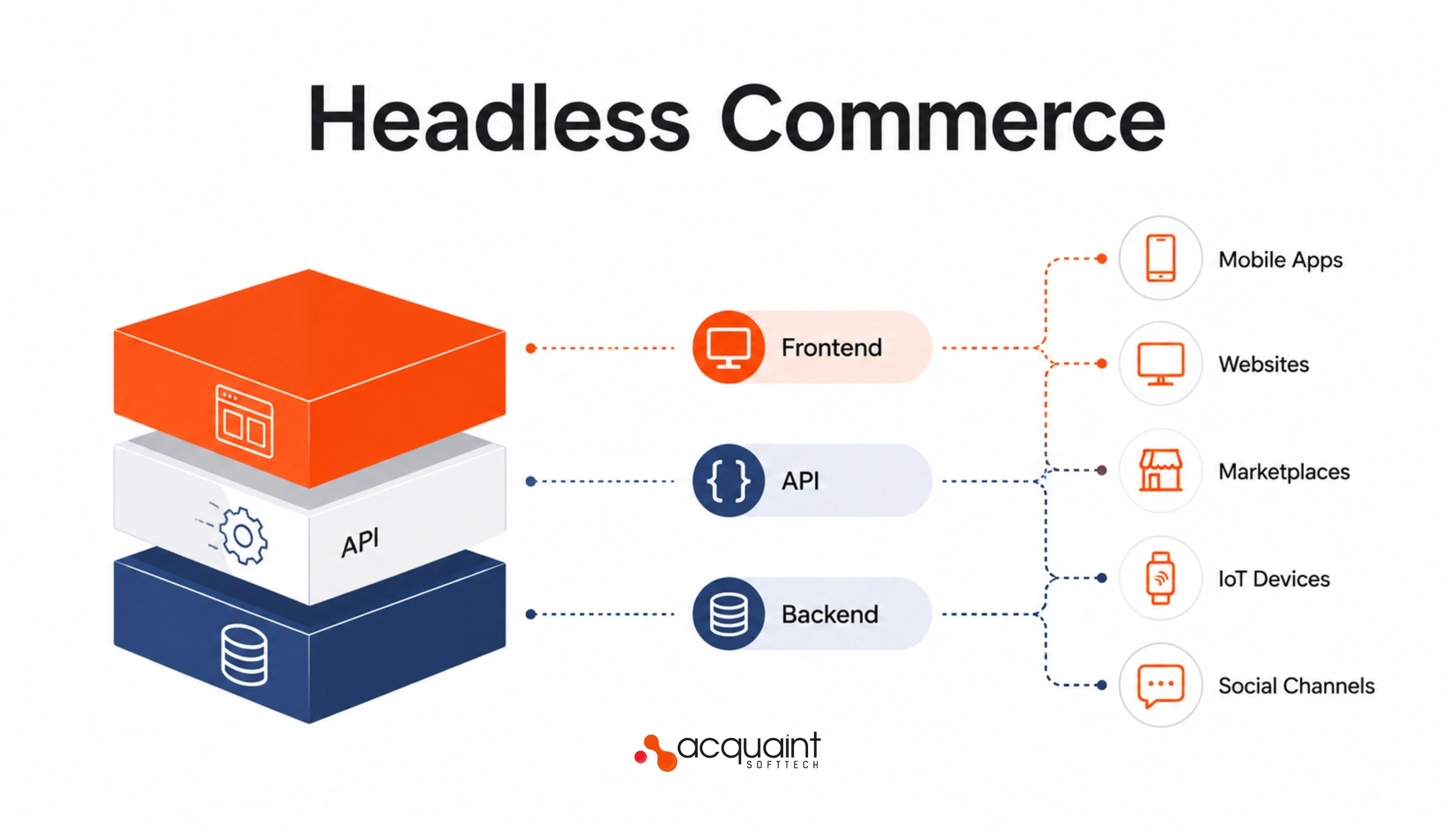
Headless Commerce Explained: Decoupled Architecture for Modern E-Commerce Development
Headless commerce is not a technology upgrade. It is a structural decision that separates the commerce engine from the storefront entirely. Done right, it gives you deployment freedom, channel flexibility, and a performance ceiling that no monolithic SaaS platform can match. Done wrong, it creates distributed systems complexity that your team is not ready for. This article tells you exactly which situation you are in.
Manish Patel
May 19, 2026
Building a Freelance Marketplace Like Upwork or Fiverr: Two-Sided Platform Architecture
A freelance marketplace like Upwork or Fiverr is a two-sided platform that connects clients who need work done with freelancers who provide services. It works by letting clients post jobs or browse gigs, matching them with freelancers, holding payment in escrow against milestones, and releasing funds when work is approved, taking a commission on each transaction.
Manish Patel
June 30, 2026India (Head Office)
203/204, Shapath-II, Near Silver Leaf Hotel, Opp. Rajpath Club, SG Highway, Ahmedabad-380054, Gujarat
USA
7838 Camino Cielo St, Highland, CA 92346
UK
The Powerhouse, 21 Woodthorpe Road, Ashford, England, TW15 2RP
New Zealand
42 Exler Place, Avondale, Auckland 0600, New Zealand
Canada
141 Skyview Bay NE , Calgary, Alberta, T3N 2K6