

Table of Contents
What Is Laravel?
Introduction
Laravel is a free, open-source PHP web framework designed to make building modern, scalable web applications easier and faster. Created by Taylor Otwell in 2011, it provides a structured foundation, following the Model-View-Controller (MVC) pattern, so developers do not have to code common features like user login systems, database connections, and security from scratch.
It is a web application development framework that uses the PHP programming language, and building on it is the core of the Laravel development services at Acquaint Softtech.
Laravel Overview
Laravel comes with a rich set of tools and features that let developers focus on creating high-quality applications rather than worrying about mundane tasks. One of its main advantages is a pre-built library of functionality, including authentication, routing, and templating, which saves developers significant time and effort.
Laravel provides a highly functional development environment with intuitive command-line interfaces and object-relational mapping (ORM) for easier data manipulation. It is known for its scalability and easy-to-maintain codebase, letting developers add new features easily; its modular packaging system and robust dependency management make it easy to integrate third-party libraries and tools into a project.
What Is Laravel Used For?
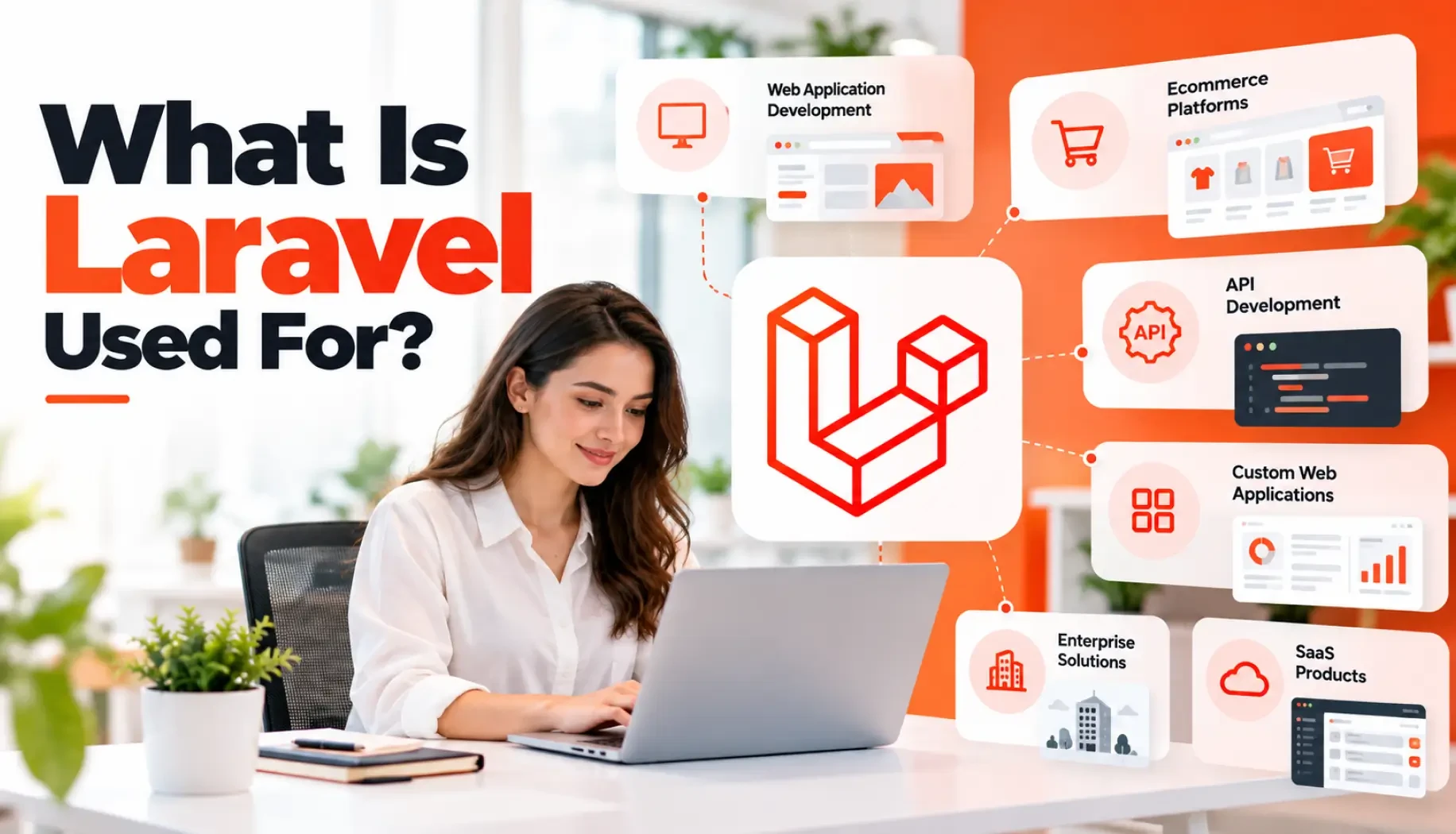
Laravel offers a suite of powerful tools that simplify and accelerate web application development. It is a widely recognized PHP framework, used by many well-known companies across industries like IT, medicine, finance, travel, sales, and entertainment, to build:
Online marketplaces and eCommerce platforms.
Social media platforms and forums.
Content management systems (CMS) for blogs, news sites, and other online publications.
Custom enterprise-level applications for businesses of all sizes.
Dynamic web applications with responsive, interactive user interfaces.
API-centric applications and web services, and much more.
Turning these into production software is the day-to-day work of Laravel web application development at Acquaint Softtech.
Core Architecture And Features
A few core building blocks define Laravel, and the official Laravel documentation details each one:
Feature | What it does |
MVC pattern | Separates data (Model), user interface (View), and logic (Controller) to keep code clean and organized |
Eloquent ORM | Lets you work with databases using readable PHP syntax instead of writing complex SQL queries |
Blade templating engine | Combines PHP and HTML into clean, reusable web page layouts |
Artisan CLI | A command-line tool that automates repetitive tasks, database migrations, and code generation |
Built-in security | Protects against common threats like SQL injection, cross-site scripting (XSS), and CSRF out of the box |
What Does Laravel Contain?
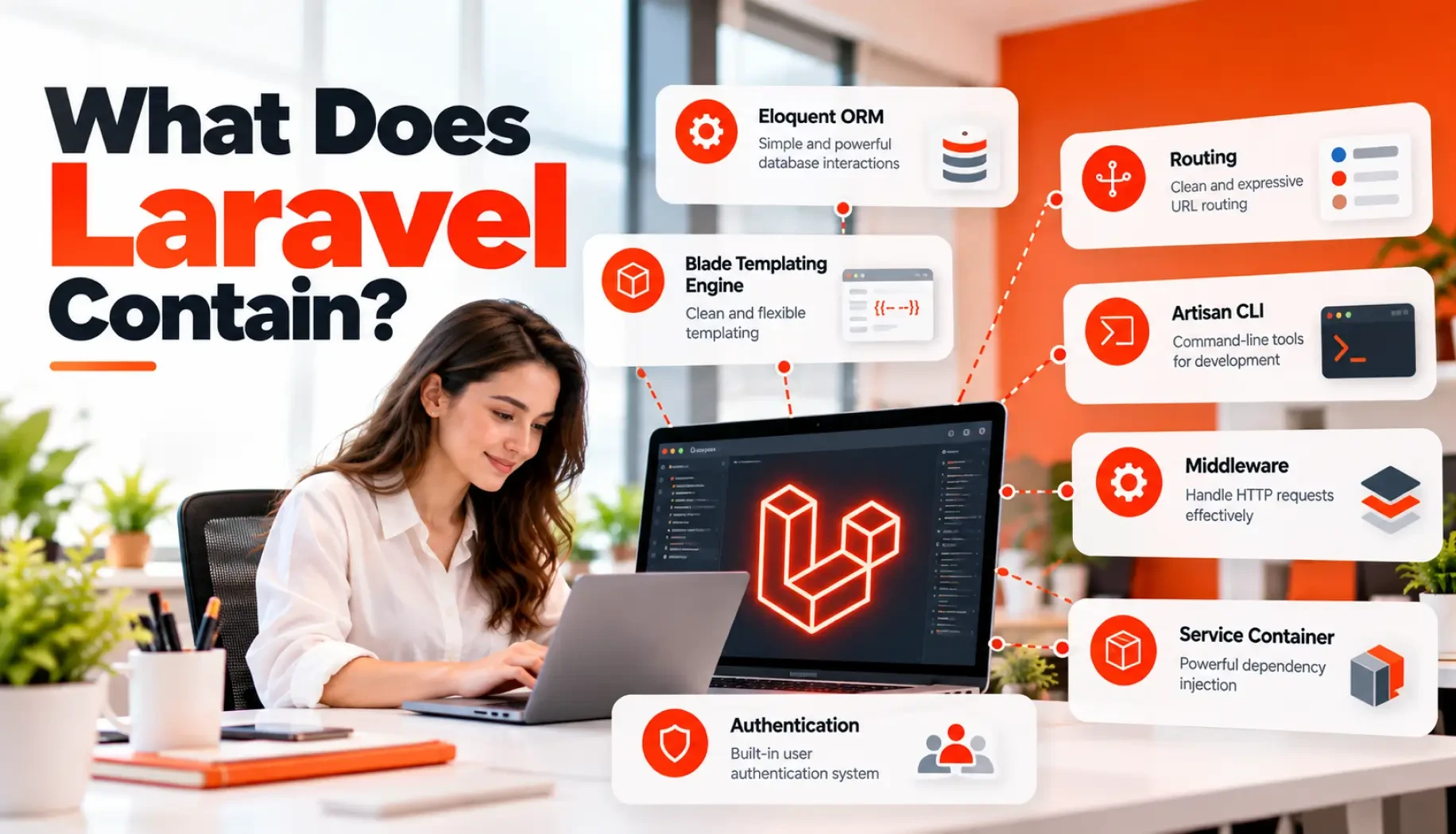
Laravel is built on object-oriented programming, and its main components are:
MVC architecture: separates code into models, views, and controllers for an organized, easy-to-maintain codebase, regardless of project size.
Artisan CLI: a command-line interface to generate boilerplate code, run database migrations, manage packages, and create custom commands.
Blade template engine: simplifies creating HTML views with reusable layouts, dynamic content, loops, conditionals, and automatic output escaping against XSS.
Eloquent ORM: lets developers interact with databases using PHP classes instead of SQL, with features like eager loading and soft deletes.
Redis: an in-memory data store used as a database, cache, and message broker, fast, scalable, and highly available.
Ecosystem: tools and services that work with Laravel, including Blade, Eloquent, Laravel Mix, Valet, Forge, and Envoyer, for building, deploying, and managing apps.
Extending these components for a specific product is the focus of custom Laravel development at Acquaint Softtech.
Why Developers Use Laravel
Beyond the features, developers choose Laravel for three big reasons:
Developer experience: clean, expressive syntax that makes coding enjoyable and efficient.
Richer ecosystem: powerful official tools and extension packages for deployment, authentication, and frontend integration with libraries like Vue or React.
Time saver: batteries-included solutions so teams can launch secure websites and APIs much faster than with raw PHP.
These reasons are explored further in why to use Laravel for web development.
Want To Build Your Project With Laravel?
Acquaint Softtech develops your website and web app from scratch with highly experienced Laravel developers. Book a free 30-minute consultation, no sales pitch, just honest advice.
Laravel Versions
Laravel was launched in June 2011 and quickly grew a large, active community that keeps improving it, which is why updates are released regularly.
At the time this answer was first written, the latest version was Laravel 9 (February 8, 2022); Laravel now ships a major version every year, and the current version is Laravel 13, released in March 2026.
You can download and install the latest version from laravel.com, and beginners often start with the official documentation or tutorial sites like W3Schools. For what the newest release adds, see 10 Laravel 13 features every developer should know.
Is Laravel A Frontend Or Backend Framework?
Laravel is a backend, server-side framework: it handles routing, business logic, databases, and APIs on the server, while the frontend (HTML, CSS, JavaScript) runs in the browser.
It can still drive the frontend through Blade, Livewire, or Inertia, but its core job is the backend, which is why it is a common choice for Laravel API development.
Are Laravel And PHP The Same?
No. PHP is the programming language; Laravel is a framework written in PHP. So Laravel vs. PHP is not really a competition; Laravel runs on PHP and adds structure, tools, and shortcuts (routing, ORM, security) on top of it, so you write less repetitive code than with plain PHP while still using the same language underneath.
Is Laravel Still Relevant In 2026?
Very much so. Laravel 13 shipped in March 2026; it follows a yearly release cycle, and it has a large, active community, so it remains a leading choice for new web apps, from SaaS to Laravel eCommerce development at Acquaint Softtech. Its tooling also keeps expanding into AI, real-time, and cloud.
Getting Started With Laravel And A Team
Laravel is beginner-friendly to learn but deep to master: the MVC structure, Eloquent, queues, testing, and the wider ecosystem each reward experience, and using them well is the difference between an app that merely works and one that scales cleanly and stays secure. For a serious product, that expertise matters from the first commit.
You can hire Laravel developers from Acquaint Softtech, an Official Laravel Partner, whose engineers build production-grade Laravel applications, APIs, and eCommerce platforms, so you get the full benefit of the framework without the learning curve slowing you down.
To Wrap Up
In short, Laravel is a robust, open-source PHP web framework that gives developers a wide range of tools, MVC, Eloquent ORM, Blade, Artisan, and built-in security, to build scalable, secure, and easy-to-maintain web applications quickly and efficiently.
Whether you are building an eCommerce store, a SaaS product, or an API, Laravel's structured foundation and rich ecosystem let you ship faster than with raw PHP, and its yearly releases keep it firmly at the front of modern web development.
India (Head Office)
203/204, Shapath-II, Near Silver Leaf Hotel, Opp. Rajpath Club, SG Highway, Ahmedabad-380054, Gujarat
USA
7838 Camino Cielo St, Highland, CA 92346
UK
The Powerhouse, 21 Woodthorpe Road, Ashford, England, TW15 2RP
New Zealand
42 Exler Place, Avondale, Auckland 0600, New Zealand
Canada
141 Skyview Bay NE , Calgary, Alberta, T3N 2K6