

Table of Contents
Who Owns Laravel?
Introduction
Laravel was created in June 2011 by Taylor Otwell. It is a free and open-source PHP framework allowing you to create websites and web apps using its huge libraries, so you don't have to write code from scratch. What this means is that Laravel isn't owned by any entity. It is a community-driven framework where anyone can contribute to take it ahead.
This is why Laravel mostly relies on its patrons to bring updates, stay relevant, and grow. Thus, so far, we have witnessed updates up to Laravel 9, with many scheduled ahead in the future. Keep in mind that, even though Laravel is free to use for anyone, other services in it need to be paid for. This helps Laravel to keep running.
Laravel ownership at a glance |
|
Creator | Taylor Otwell |
First released | June 2011 |
Company | Laravel Holdings Inc. (Little Rock, Arkansas, USA) |
Owner and CEO | Taylor Otwell |
Framework license | Open source, MIT |
Funding | $57M Series A from Accel (2024) |
Current version | Laravel 13 (March 2026) |
So who actually owns Laravel?
The statement above is true of the open-source code. The framework itself is released under the MIT license and shaped by a global community, so no single user owns it, and anyone can read, use, or contribute to it. Ownership, though, has a second layer.
There is a company behind the Laravel name: the brand, trademark, and paid products are owned by Laravel Holdings Inc., the business Taylor Otwell founded and still runs as chief executive. This became more visible in 2024, when the company raised its first outside funding, as reported by Fortune.
So the honest answer is that Laravel is free and community-driven as software, while the Laravel business, including its name and commercial tools, is owned by Taylor Otwell's company.
Both things are true at once, which is why the question can feel confusing. It is a common pattern in open source: the software is a shared, free resource, while a company builds a sustainable business around it, much as Acquaint Softtech builds Laravel Development Services on top of the free framework.
Is Laravel owned by a big tech company?
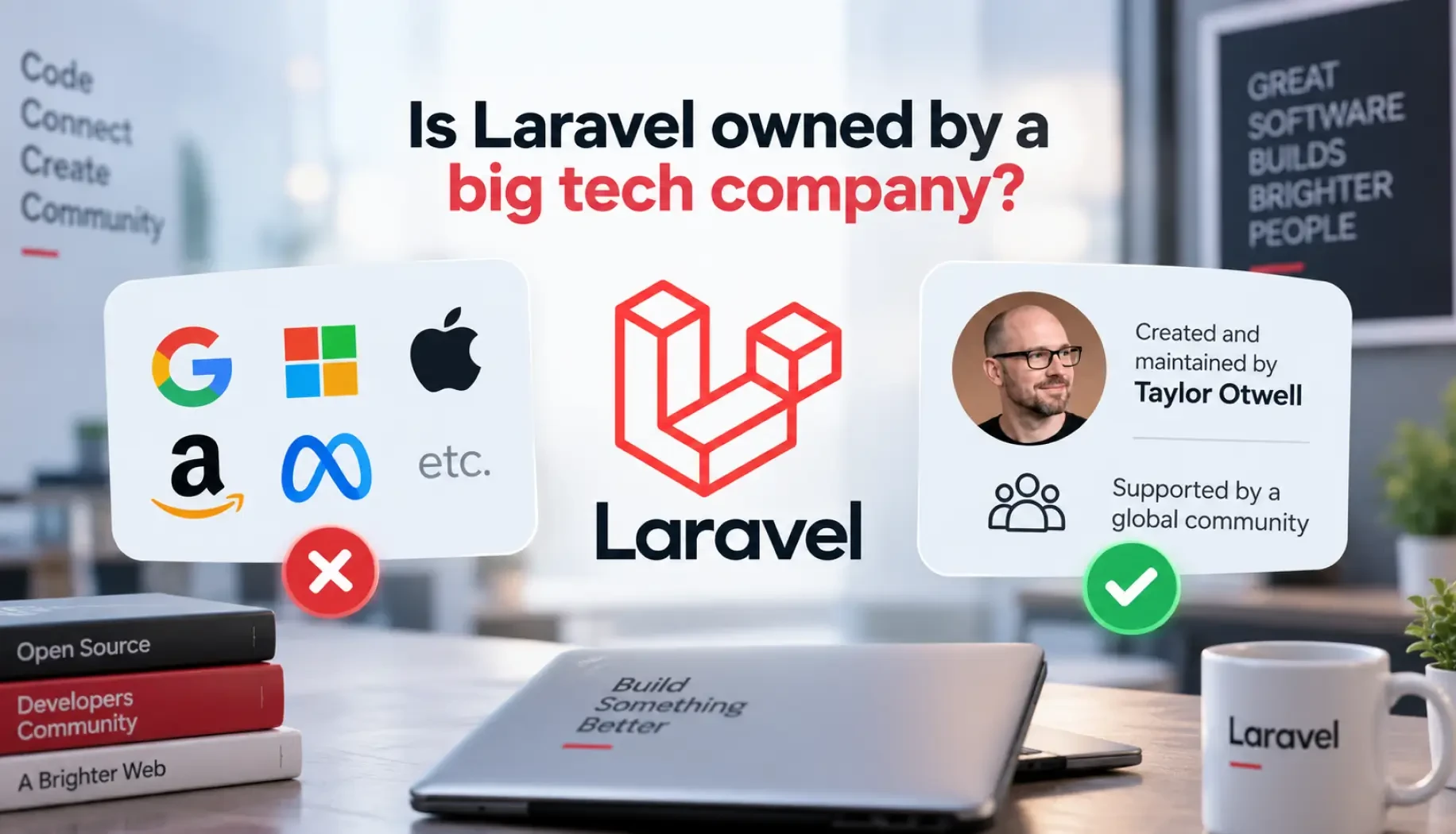
No. Despite its size and its list of well-known users, Laravel is an independent company. It is not owned by Apple, Google, Microsoft, or any larger corporation, and it did not sell itself when it raised money. The 2024 investor, Accel, is a venture capital firm that took a minority stake, not control.
Taylor Otwell remains the majority owner and CEO, and the framework itself stays open source under the MIT license. This independence is part of Laravel's appeal, because its direction is set by people who use PHP daily rather than by the priorities of a much larger parent company.
Looking for a Laravel development company?
Acquaint Softtech's Laravel team can build your website or web app of any scale and offers a free consultation to talk it through.
Background of Laravel
Taylor Otwell wanted to come up with an alternative to CodeIgniter, which didn't provide some features like built-in support for user authentication and authorization. Thus, he launched Laravel's beta version on 9th June 2011, which was followed by the release of Laravel 1 in the same month.
Taylor intended Laravel for the development of web applications using MVC or Model-View-Controller, architecture. With Laravel's development over the years, it has become a one-stop solution for building websites and web apps of any scale.
The company and products behind Laravel
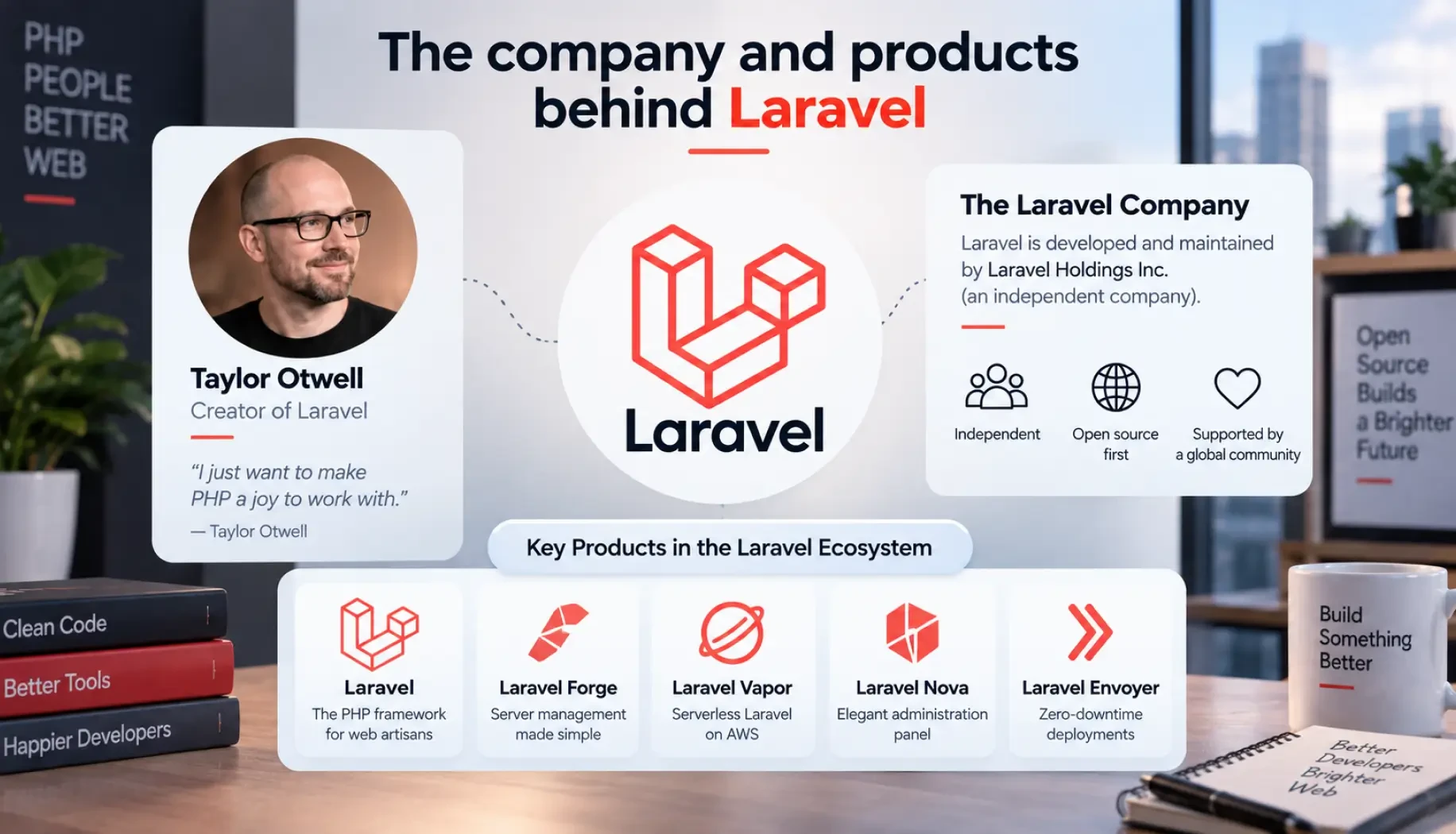
For most of its life, Laravel was a bootstrapped, profitable business, funded by its own products rather than by investors. That changed in 2024, when Laravel Holdings Inc. raised a $57 million Series A from Accel, its first major round of outside funding in more than a decade, as announced on the Laravel blog. It was an unusual deal: a profitable company based in Little Rock, Arkansas, far from the usual startup hubs, taking its first cheque only after years of persistence from the investor.
Taylor Otwell continues to lead the company as CEO, and the funding is aimed at products such as Laravel Cloud and at growing the engineering and support team. The community and core team have also kept shipping releases well beyond the Laravel 9 mentioned above; the current major version is Laravel 13, released in March 2026 and requiring PHP 8.3, so the framework remains actively maintained on a yearly cycle.
In practice, that means the free framework is now supported by full-time staff whose job is to keep it fast, secure, and compatible with the latest PHP, rather than depending only on volunteer time.
Is Laravel free to use?
Yes. A company owning the Laravel brand does not turn the framework into a paid product, and this is the part that most often confuses. You can download Laravel, build commercial applications with it, sell those applications, and ship them to customers without paying Laravel anything or asking permission.
The MIT license is permissive and cannot be revoked for versions that have already been released, so code that is open today stays open. That is a genuine guarantee for anyone building a business on the framework, because it removes the risk of a future licence change locking you out of your own stack.
As the original answer notes, some services around the framework are paid, and that revenue is what keeps development funded. The main paid products are:
Forge, for provisioning and managing servers
Vapor, for serverless deployment on AWS
Cloud, a fully managed hosting platform
Nova, an admin panel for Laravel applications
Envoyer, for zero-downtime deployment
None of these are required to build or run a Laravel application. One more nuance: while the code is open, the Laravel name and logo are trademarks owned by the company, so you can build freely on Laravel but cannot present your own product as official Laravel software. That freedom is what lets teams take on Custom Laravel Development and ship commercial products without any licence cost.
Who maintains and updates Laravel?
Ownership is one question; who does the work is another. Day-to-day development is shared between a small core team, several of whom the company now employs full-time, and a large open-source community.
Thousands of developers contribute code, report issues, and maintain packages, while Taylor Otwell and the core team set the overall direction. Contributions are reviewed openly on GitHub, so the record of who changed what stays public.
Laravel does not run through a formal foundation or committee. Otwell and the core team decide the roadmap, and the community shapes it through contributions and feedback. Since early 2022, the framework has followed a yearly major-release cycle, with roughly eighteen months of bug fixes and two years of security fixes per version, which is why teams plan regular upgrades to stay current.
What this means for your project
Laravel offers businesses an open-source, MIT-licensed framework with no licence fees or vendor lock-in. Its funded ownership and active community support regular updates, security, documentation, and packages. Even if ownership changes, Laravel remains free to use, making it a lower-risk choice for long-term projects.
The company's stewardship also created a partner ecosystem, where Laravel recognises selected agencies as official partners based on proven experience. Acquaint Softtech is an Official Laravel Partner, the kind of distinction explained in Laravel Partner vs Any Laravel Agency. For a client, that badge is a shortcut to knowing a team has real depth in the framework rather than occasional exposure to it.
With that backing, you can invest in Laravel with confidence. If you are still deciding, Laravel Consulting Services from Acquaint Softtech can help you plan the architecture and roadmap before you commit.
And when you need to add Laravel skills quickly, you can hire full-stack Laravel Developers from Acquaint Softtech to work alongside your in-house team.
To sum up
So, who owns Laravel? The open-source framework belongs to no single person. It is free under the MIT license and shaped by a global community of contributors, exactly as the original answer says. The Laravel brand, company, and paid products belong to Laravel Holdings Inc., founded and led by Taylor Otwell, who created Laravel in 2011 and still guides it as CEO, now with backing from Accel.
For a wider look at the framework's strengths, see Why Use Laravel for Web Development. And if you plan to build on it, Acquaint Softtech, as an Official Laravel Partner, can help you design, build, and maintain the product. In short, no single entity locks up the code you build on, and the company that owns the brand has every reason to keep it thriving.
India (Head Office)
203/204, Shapath-II, Near Silver Leaf Hotel, Opp. Rajpath Club, SG Highway, Ahmedabad-380054, Gujarat
USA
7838 Camino Cielo St, Highland, CA 92346
UK
The Powerhouse, 21 Woodthorpe Road, Ashford, England, TW15 2RP
New Zealand
42 Exler Place, Avondale, Auckland 0600, New Zealand
Canada
141 Skyview Bay NE , Calgary, Alberta, T3N 2K6