

Table of Contents
What Is Lumen In Laravel?
Introduction
Lumen is an open-source PHP micro-framework developed by Taylor Otwell, the creator of Laravel. It is a lightweight, faster, stripped-down alternative to the full Laravel framework, built specifically for creating microservices and API-driven applications where performance and minimal overhead are top priorities.
Though it shares many of Laravel's components and conventions, Lumen leaves out features like session management, templating engines, and extensive configuration, making it blazingly fast and optimized for stateless, request-based operations. Choosing between Lumen and Laravel for a given project is a call the team makes in the Laravel development services at Acquaint Softtech.
What Is Lumen Suitable For?
Lumen is best suited for:
RESTful APIs.
Lightweight microservices.
Internal tools.
Backend services in distributed systems.
High-performance applications where low latency is critical.
Developers often choose Lumen when they need the speed and simplicity of a micro-framework but want the option to migrate to full Laravel if the project scales, and building lean REST endpoints is exactly the focus of Laravel API development.
Key Characteristics Of Lumen
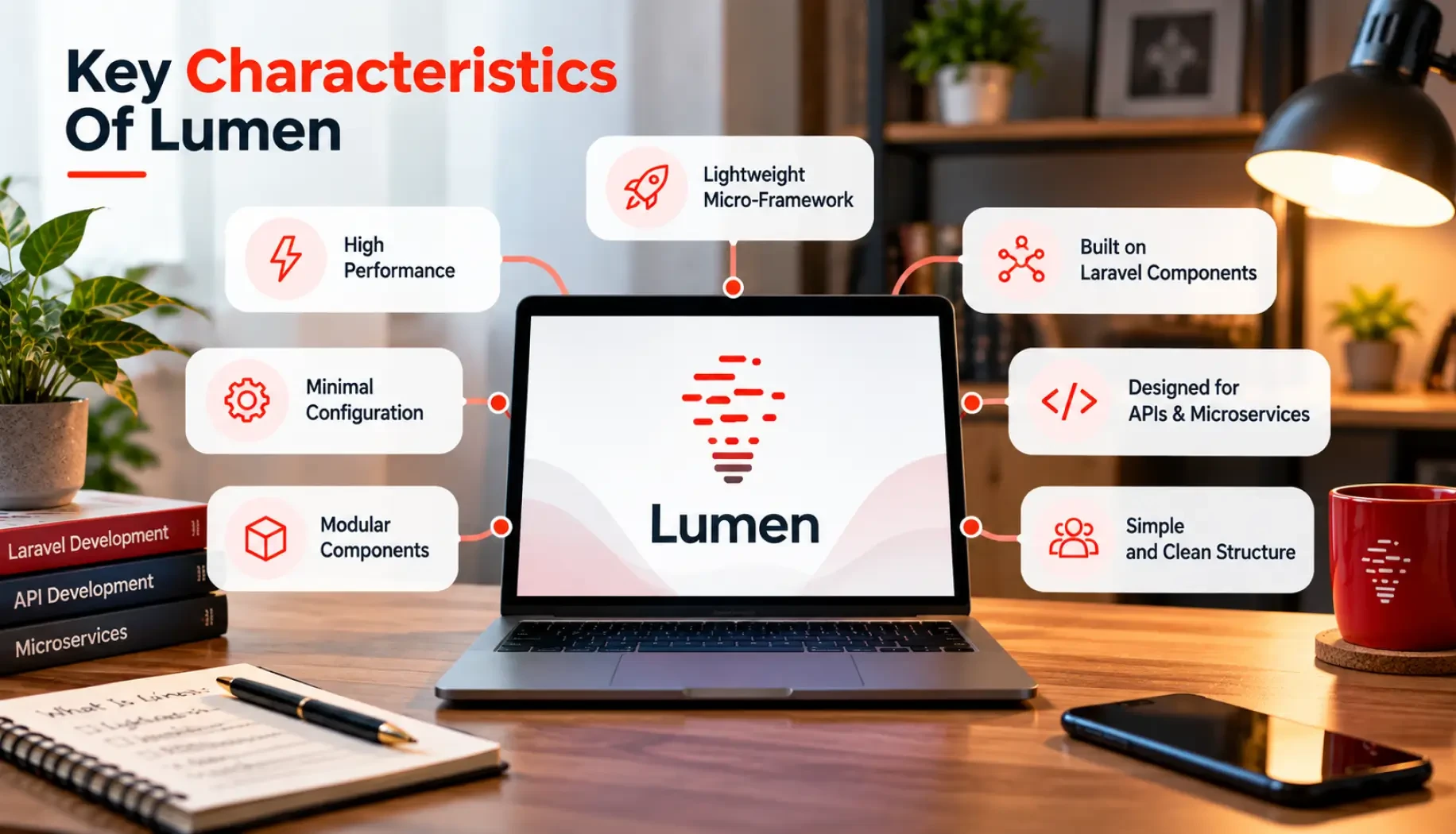
A few characteristics define Lumen, and the official Lumen documentation covers them in full:
Purpose-built for speed: designed specifically for blazing-fast REST APIs and decentralized microservices where performance and low response times are critical.
Shared ecosystem: uses many of the same core components as Laravel (Eloquent ORM, routing, database migrations, and validation), so it is highly familiar to Laravel developers.
Stripped features: to achieve maximum speed, it leaves out heavy Laravel features such as session state tracking, cookies, the Blade view engine, and extensive configuration.
Upgradability: if a project outgrows Lumen and needs the full feature set, it can be upgraded and migrated directly into the full Laravel framework.
Laravel Vs Lumen
The difference between Laravel and Lumen is a classic PHP interview question. Both are PHP, not JavaScript or Java frameworks, but they serve different jobs:
Feature | Laravel | Lumen |
Framework type | Full-stack web framework | Micro-framework |
Primary use case | Complex web apps, monoliths, full portals | REST APIs, high-performance microservices |
Speed/performance | Fast, but heavier due to the full feature set | Blazingly fast, optimized for minimal overhead |
Session and cookies | Enabled by default | Disabled by default (stateless operations) |
Frontend templating | Included (Blade, Vue/React integration) | Excluded (strictly backend data and JSON) |
Deciding which fits a given project is the kind of call Laravel consulting services from Acquaint Softtech can help you make.
Notable Features Of Lumen
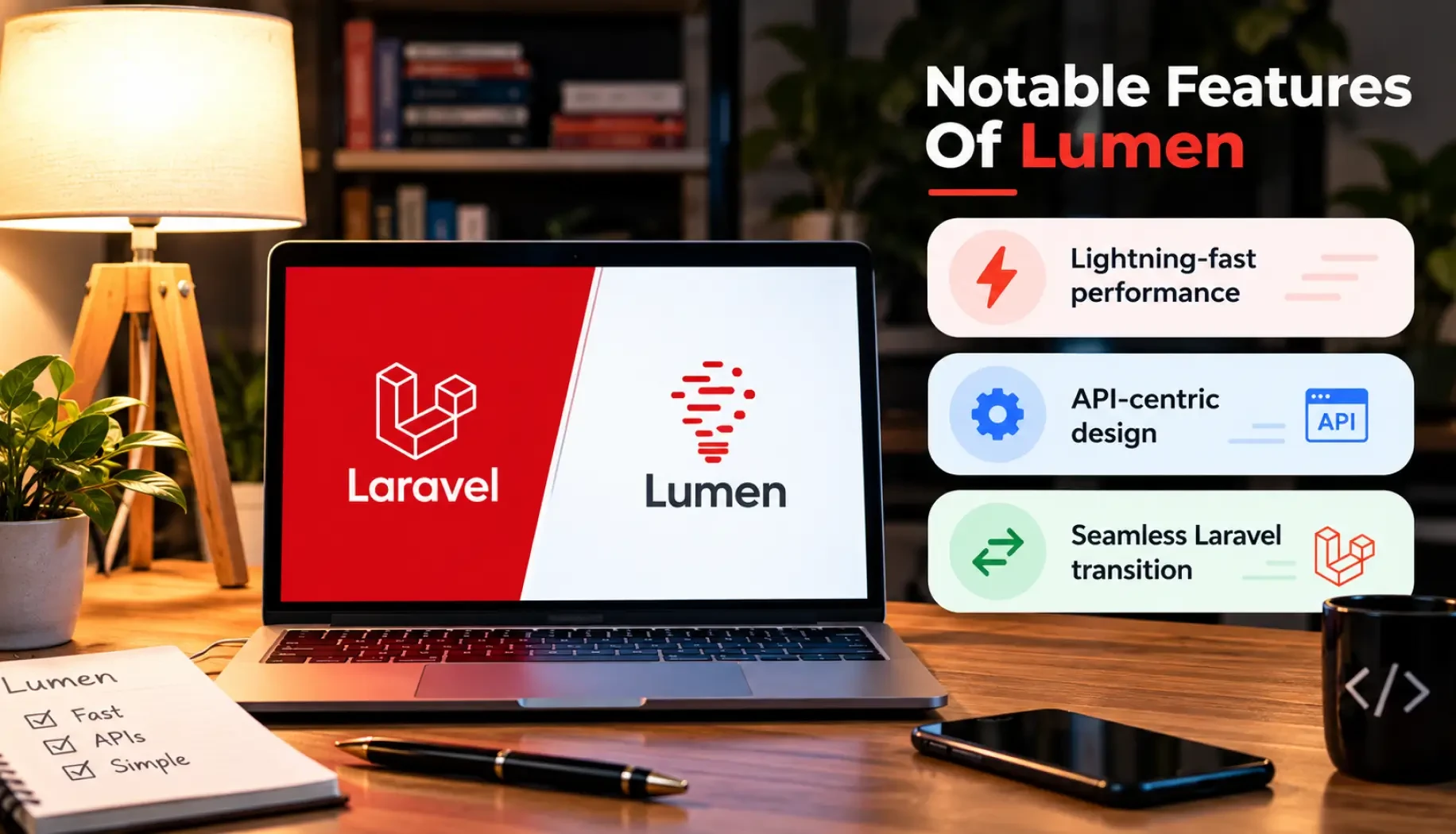
Lightning-fast performance: Lumen removes unnecessary middleware, services, and bootstrapping logic by default, so requests are processed faster than in full Laravel, ideal for systems handling thousands of requests per second.
API-centric design: It is purpose-built for RESTful API development, offering routing, request validation, caching, and authentication without the bloat of a full-stack framework.
Seamless Laravel transition: Lumen and Laravel share the same foundation (Illuminate components), so you can scale or upgrade a Lumen project to Laravel without starting from scratch.
Microservice-ready architecture: it is ideal for breaking monoliths into smaller, modular, independently deployable services that work cohesively together.
Routing made simple: routing mirrors Laravel's approach, supporting route parameters, named routes, middleware integration, and route groups.
Built-in caching and auth support: despite being a micro-framework, it supports caching, JWT-based authentication, and request validation, all essential for modern APIs.
Minimal configuration: it emphasizes convention over configuration, reducing setup overhead so you can focus on logic instead of boilerplate.
These traits make Lumen a natural fit for the modular, API-first designs described in Laravel microservices and API-first SaaS.
Migrating From Lumen To Laravel
Because both frameworks sit on the same Illuminate foundation, moving a Lumen service into full Laravel is far easier than a rewrite: your models, routes, and business logic largely carry over, and you gain sessions, Blade, and the wider ecosystem. Handling that jump cleanly is what Laravel upgrade services from Acquaint Softtech do.
Lumen, Laravel, Or Octane? Let's Pick The Right One
Acquaint Softtech helps teams choose between Lumen, Laravel, and Laravel Octane, and builds fast APIs and microservices to match. Book a free 30-minute consultation, no sales pitch, just honest advice.
Should You Use Lumen In 2026?
While Lumen remains a great tool for specific use cases, Laravel itself has become significantly more performant thanks to tools like Laravel Octane (powered by Swoole or RoadRunner). In fact, the Laravel team now recommends starting new projects with Laravel rather than Lumen, since modern PHP plus Octane closes most of the performance gap.
So if you are starting a new project that may need full-stack features later, Laravel is the safer, more future-proof choice; but for lean, single-purpose services or existing Lumen apps, Lumen still shines with its speed, simplicity, and easy integration into larger Laravel systems. The performance side of that decision is covered in Laravel performance optimization.
What Exactly Is Lumen, And What Is Lumen In Networking?
In the Laravel world, Lumen is a lightweight PHP micro-framework by Taylor Otwell, a faster, stripped-down version of Laravel for APIs and microservices.
Note that Lumen in networking is a completely different thing: there, Lumen usually refers to Lumen Technologies, a telecom and network-services company, not the framework. This answer is about the Laravel micro-framework.
What Are The Top 5 PHP Frameworks, And Is Laravel Still Relevant In 2026?
The most popular PHP frameworks are Laravel, Symfony, CodeIgniter, Yii, and Laminas (with Lumen sitting alongside as Laravel's micro-framework).
And Laravel is very much relevant: Laravel 13 shipped in March 2026 with a large community and yearly releases, which is why it anchors most modern PHP projects, including large Laravel enterprise development builds at Acquaint Softtech.
Choosing Lumen Or Laravel With A Team
The Lumen-or-Laravel question is really an architecture question: how many services you are running, how much traffic each handles, whether you need sessions and views, and whether the service might grow into a full application later. Picking wrong can mean either a bloated microservice or a Lumen app straining against its own limits.
If you would rather get that decision, and the build, right, you can hire Laravel developers from Acquaint Softtech, an Official Laravel Partner, whose engineers weigh Lumen, Laravel, and Octane against your real requirements and build fast, maintainable APIs and microservices that can scale up when you need them to.
Wrapping Up
Lumen is Laravel's answer to building fast, API-first, microservice-ready applications without the overhead of a full-stack framework, and it is perfect when performance is your primary goal, especially in cloud-native and serverless environments.
While Laravel continues to evolve and close the performance gap, Lumen still offers an elegant solution when minimalism and speed are at the forefront of your architectural needs, and both share the same DNA, so you are never locked out of the full framework.
India (Head Office)
203/204, Shapath-II, Near Silver Leaf Hotel, Opp. Rajpath Club, SG Highway, Ahmedabad-380054, Gujarat
USA
7838 Camino Cielo St, Highland, CA 92346
UK
The Powerhouse, 21 Woodthorpe Road, Ashford, England, TW15 2RP
New Zealand
42 Exler Place, Avondale, Auckland 0600, New Zealand
Canada
141 Skyview Bay NE , Calgary, Alberta, T3N 2K6