

How to Build an AI Voice Agent in 2026: The Pipeline, the Latency Budget, and What It Costs
How to build an AI voice agent in 2026: how it works, the STT-LLM-TTS pipeline, the latency budget that decides everything, component choices, build versus buy, real per-minute costs, consent law, and timeline.

Zubair Pateljiwala
Voice is the highest-velocity AI product category of 2026, and for one reason: the pieces finally work. A year ago, sub-second voice agents with clean interruption handling were research-grade. Today streaming speech-to-text runs under 300 milliseconds, text-to-speech returns first audio under 100, and fast language models answer in under 300, which means a natural, real-time phone conversation with an AI is now an engineering problem rather than a research one. The catch is that engineering problem is unforgiving. Get the latency budget wrong by a couple of hundred milliseconds and the whole illusion collapses into the awkward pauses that make callers hang up.
This guide is the complete build version: how a voice agent actually works, the pipeline and its components, the latency math that decides everything, the honest build-versus-buy choice, what it costs per minute, and the consent law you cannot skip. At Acquaint Softtech, a software development partner with 1,300+ projects across 13 years, we build these systems, so the focus here is on what holds up on a real phone line, not what looks good in a demo.

- Founders and product leads scoping a voice agent for support, booking, intake, or outbound calls
- Engineering leads choosing between a managed platform, an assembled stack, or open source
- Teams whose voice prototype sounds great in a demo but stumbles on latency or interruptions
- Anyone weighing the real per-minute cost of a voice agent against a human call centre
- Product teams in healthcare, finance, or any setting where call recording and consent law apply
What an AI Voice Agent Actually Is

An AI voice agent is software that holds a natural spoken conversation over the phone or in an app, understands what the caller wants, takes action through connected systems, and either completes the task or hands off to a human. It is not a recording, and it is not a menu.
Voice agent vs IVR vs chatbot
A traditional IVR plays fixed menus and waits for a keypress or a scripted phrase. A chatbot handles text. A voice agent listens to open speech, reasons about it with a language model, and speaks back in real time, so a caller can interrupt, change subject, or ask something unscripted and still be understood. The difference a caller feels is the difference between pressing one for billing and simply saying what they need.
Where voice agents are used
The strongest 2026 use cases are well-defined, high-volume calls: appointment booking and reminders, inbound support and triage, order status, lead qualification, and structured intake. Regulated workflows are a fast-growing area too, for example a claims line that captures structured detail through conversation, as we describe in our guide to insurance claims automation. The common thread is a clear job with a clear escalation path, not open-ended chat.
How an AI Voice Agent Works, Step by Step

The four components
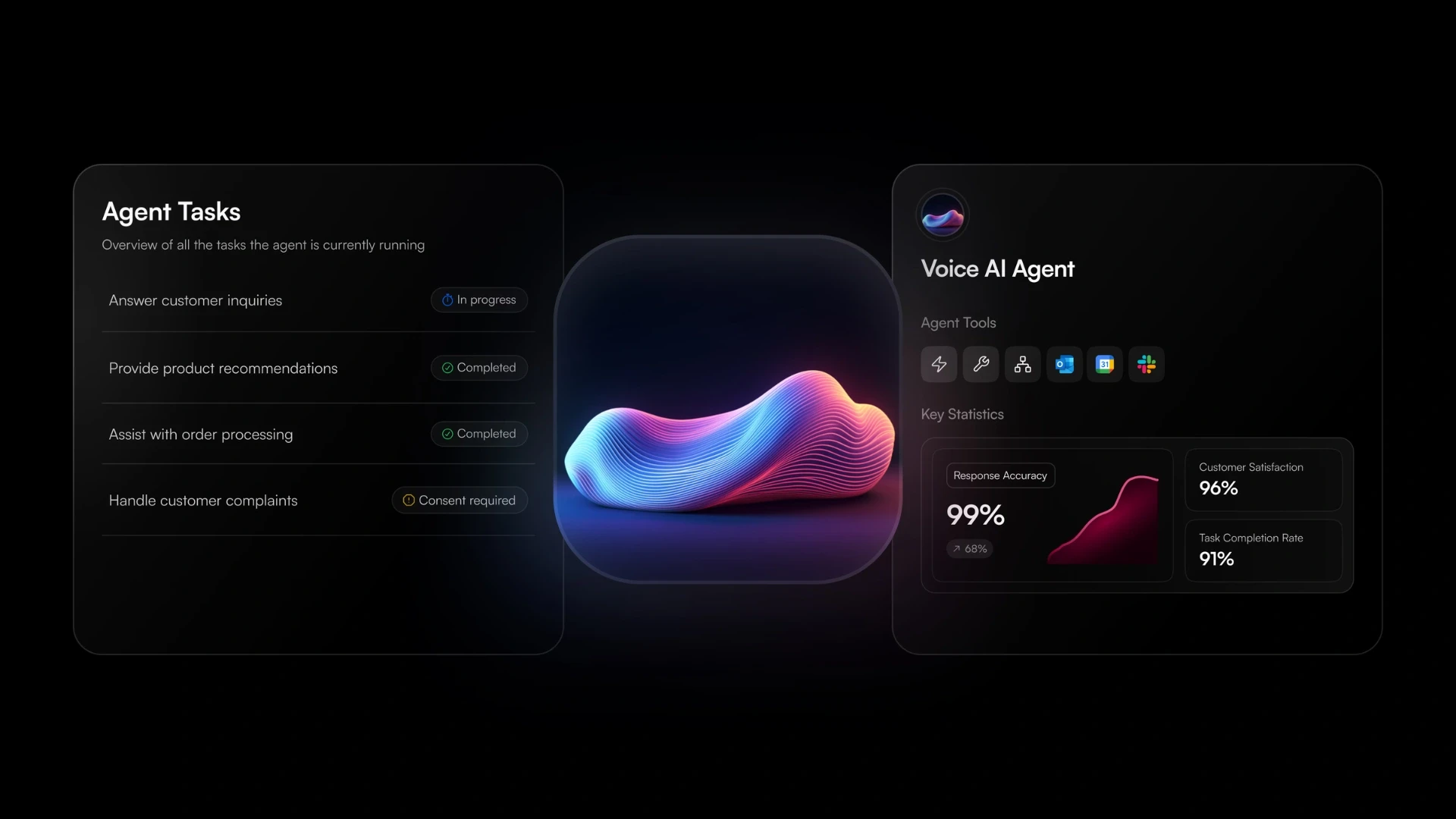
Almost every voice agent is built from four layers working in a tight loop. Speech-to-text, also called ASR, converts the caller’s audio to text. A language model reads that text, holds the conversation context, decides what to do, and generates a reply. Text-to-speech turns that reply into natural audio. And an orchestration and telephony layer manages the whole call: provisioning the phone number, streaming audio both ways, calling tools, and routing an escalation to a human.
Cascaded pipeline vs speech-to-speech
There are two architectures. The cascaded pipeline chains the four components above and remains the dominant, most controllable choice: you can swap any part, inspect the transcript, and tune each stage. The newer speech-to-speech approach uses a single model that hears audio and speaks audio directly, which cuts latency and sounds more fluid but gives you less control over what was understood and less ability to log and correct it. For most production agents in 2026, especially anything regulated, the cascaded pipeline is still the safer bet.
The conversation loop: turn-taking and barge-in
The hard part is not any single component, it is the timing between them. The agent has to detect when the caller has finished speaking, which is called end-of-turn detection, without cutting them off or leaving dead air. It has to handle barge-in, meaning the caller interrupting mid-sentence, by stopping its own speech instantly and listening. And it has to start speaking fast enough that the pause feels human. These behaviours, not voice quality, are what separate an agent that feels natural from one that feels broken.
Latency: The One Number That Decides Everything
The latency budget
Natural conversation has a rhythm, and humans notice when a reply is late. The target for the full round trip, from the moment the caller stops speaking to the moment the agent starts, is under 700 milliseconds, with sub-500 feeling instant and anything past 800 to 900 starting to feel like a bad line. That whole budget has to be shared across every stage, which is why each component has its own target.
Stage | Target | What it means |
|---|---|---|
Speech to text (STT) | Under 300 ms | Streams and transcribes as the caller is still speaking |
Language model (LLM) | Under 300 ms | A fast Flash or mini tier model, streaming its response token by token |
Text to speech (TTS) | Under 100 ms | Time to the first audio out, not the full sentence |
Telephony round trip | 50 to 150 ms | Network and carrier overhead, mostly outside your control |
End to end target | Under 700 ms | Sub-500 ms feels instant; under 800 to 900 ms still feels natural |
Why vendor latency numbers mislead
Every platform quotes an impressive latency figure, and every figure is measured in an optimised scenario. Real-world latency shifts with region, concurrent call load, and which language model and voice you wire in. The only number that matters is the one you measure yourself, end to end, on a real phone call with your own prompt and voice. Test that before you commit to any platform, because a demo that feels instant can become a laggy call under load.
Entity accuracy matters more than general accuracy
One accuracy number is quietly decisive: how well the system captures names, phone numbers, and confirmation codes. A speech-to-text model can have a strong average word error rate and still mangle a phone number, which is fatal for a booking or intake agent. When our AI/ML engineers evaluate speech components, entity accuracy on the details that must be exact is the metric they weight most, because it predicts whether the agent actually ships.
The Architecture and Component Choices
A voice agent is a specialised kind of AI agent, so the same design discipline from our AI agents and agentic workflows guide applies: keep each component behind a clean interface so none is load-bearing on its own. The table below is a 2026 snapshot of the main options at each layer.
Layer | Leading options (2026) | What to optimise for |
|---|---|---|
Speech to text | Deepgram Nova-3 and Flux, AssemblyAI Universal, ElevenLabs Scribe | Streaming latency and entity accuracy on names, numbers, and codes |
Language model | GPT-5 mini, Gemini 3.1 Flash, GPT-4o mini, Claude | Speed first, then reasoning; stream tokens so TTS can start early |
Text to speech | ElevenLabs, Cartesia Sonic, PlayHT | Naturalness against cost, and time to first audio |
Orchestration and telephony | Vapi, Retell, Deepgram Voice Agent, Twilio, LiveKit, Pipecat | Call lifecycle, barge-in, tool calling, and escalation to a human |
The practical pattern is to route each layer through your own interface so you can swap providers as they leapfrog each other, which they do every few months. A voice you love today may be beaten on latency or price next quarter, and you should be able to switch without rebuilding the agent.
Scoping a Voice Agent?
Acquaint Softtech builds production voice agents on MERN and MEAN stacks: the STT-LLM-TTS pipeline, barge-in and turn-taking, telephony, tool calls into your systems, and human escalation. Tell us the call flow and your stack. We will match you with vetted engineers and have them in your sprint in 48 hours.
Build Versus Buy: Platform, Assemble, or Open Source
The four honest paths
You do not have to build every layer from scratch. The real decision is how much of the orchestration you own, and it depends on your team, your compliance needs, and your call volume.
Option | What it is | Approx 2026 cost | Best when |
|---|---|---|---|
Managed platform | Vapi, Retell, ElevenLabs Agents | $0.05 to $0.15 per minute all-in | Fastest to production, standard call flows |
Bundled or self-host | Deepgram Voice Agent | Enterprise or usage-based | Data control, HIPAA, one vendor to manage |
Open-source stack | Pipecat, LiveKit Agents | Infra plus your engineering | Full control and unique flows, you own retries and barge-in |
No-code | Synthflow, Voiceflow | Per-minute plus subscription | Operator-led teams and simple flows |
What it really costs per minute
Voice agents are priced per minute, and the platform fee is only part of the bill. A managed platform might advertise five cents a minute for orchestration, but once you add a good language model and a natural text-to-speech voice, real production cost typically lands between eleven and fifteen cents a minute. Premium voice raises it; a cheaper voice lowers it and sounds it. Compliance adds more: some platforms include HIPAA, others charge around a thousand dollars a month for it. Model your cost at real volume with the voice you actually intend to ship, not the cheapest demo configuration.
Weighing Build Versus Buy for Voice?
Tell Acquaint Softtech your call flow, volume, and compliance needs. We will model the true per-minute cost of a managed platform versus an assembled or open-source stack, and recommend the path that fits, within 24 hours. No commitment required.
Recommended Tech Stack
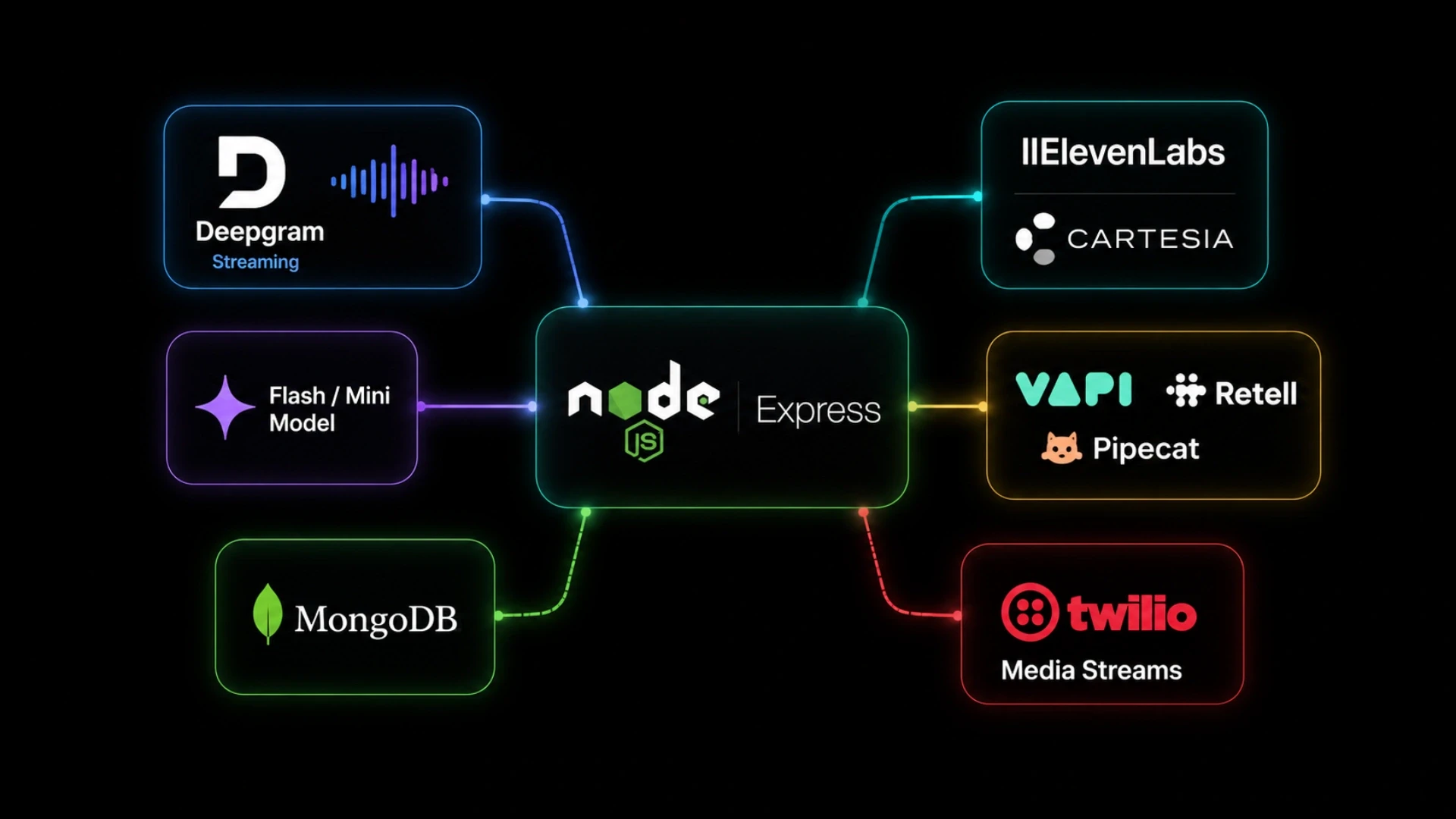
For teams building and owning the orchestration, the stack below is proven. It keeps every speech component swappable and puts your business logic in a MERN-family backend the agent calls during the conversation.
Layer | Recommended choice | Why it fits a voice agent |
|---|---|---|
Speech to text | Deepgram, streaming | Sub-300 ms streaming with strong accuracy on names and numbers |
Language model | A Flash or mini model behind a router | Fast enough for the latency budget and swappable as models change |
Text to speech | ElevenLabs or Cartesia behind a router | Natural voice, with a cheaper fallback when cost matters |
Orchestration | Vapi or Retell, or Pipecat if self-hosting | Handles call lifecycle, barge-in, tool calls, and escalation |
App backend | Node.js with Express | Coordinates the tools, CRM, and business logic the agent calls mid-call |
Data and logging | MongoDB | Stores transcripts, call events, and an audit log for compliance |
Telephony | Twilio Media Streams | Reliable phone number provisioning and low-latency audio streaming |
The design goal is a system where each speech provider is swappable, every call is logged for compliance, and the agent can call your real systems and escalate to a human cleanly. Teams that need to add this capacity bring in Node.js and MERN developers or a dedicated development team to own the build.
How to Measure a Voice Agent
Vanity metrics versus real ones
Call minutes and raw call counts tell you nothing about quality. Judge a voice agent on task completion rate, the share of calls it resolves without a human; on measured end-to-end latency on live calls, not vendor claims; on entity accuracy for the names and numbers it captures; on the escalation rate and how cleanly it hands off; and on caller sentiment or satisfaction. A voice agent that talks for a long time but resolves nothing is a cost, not a capability.
Compliance and Consent: What You Cannot Skip
Call recording and consent law
Recording a call is regulated, and the rules vary by place. Several US states require all-party consent to record, so the agent must disclose recording at the start of the call. In the EU and UK, GDPR governs how voice data and transcripts are stored and used. Build the consent disclosure into the opening of every call and keep proof of it, because this is the compliance gap regulators and plaintiffs look for first.
HIPAA, PII, and data handling
In healthcare and finance, verify HIPAA support and a signed business associate agreement before you send a single call through a platform. Redact sensitive personal information before transcripts are stored, keep an audit log of every call, and prefer providers that offer zero-retention or self-hosted options when data sovereignty matters. Treat the transcript as regulated data, because it is.
How Long It Takes and Who You Need
The roles involved
A working build needs a backend engineer comfortable with real-time audio and telephony, someone with AI or ML skill to tune the prompt, the speech components, and the evaluation, and a domain owner who writes the one-page call spec: the flow, the systems the agent must touch, and the escalation path. That spec is the single most valuable artefact in the whole project, and skipping it is why so many voice projects drift.
A realistic timeline
On a managed platform, a competent backend engineer can get a first live call working in one to three days, longer if the team has never handled telephony. A genuinely production-ready agent, tuned for latency, interruptions, entity accuracy, and clean escalation, is a matter of weeks. Teams without real-time audio experience usually add it through staff augmentation, so the learning curve does not stall the product.
A Realistic MVP and Rollout
The biggest mistake teams make is picking a platform first and then hunting for a use case. Do the opposite. Start from one specific job, appointment reminders, inbound intake, or outbound qualification, and write the one-page spec. Choose components that hit your latency budget, wire in the tools the agent needs, add the consent disclosure and logging, and test end-to-end latency on real calls before you widen. Ship that narrow agent, measure task completion, and expand only once it holds up. This is the same discovery-first discipline we bring to any AI application build.
Voice agents also pair naturally with outbound motions. If the job is qualification or follow-up, the same account context that powers an AI SDR or sales automation platform can drive the call, with a human taking over the moment a prospect engages. Build the parts unique to your call flow and rent the commodity speech components behind interfaces you control.
Ready to Build? Acquaint Softtech Has Vetted AI and MERN Engineers Available Now.
Pre-vetted engineers with production experience in real-time audio, STT and TTS integration, telephony, barge-in handling, and compliant call logging. Tell us your stack and we will send matched profiles within 24 hours. Engineer in your sprint in 48 hours.
Frequently Asked Questions
-
What is an AI voice agent?
An AI voice agent is software that holds a natural spoken conversation over the phone or in an app. It converts the caller’s speech to text, reasons about it with a language model, replies in a natural synthesised voice, and can take action through connected systems or hand off to a human. Unlike an IVR, it understands open speech rather than fixed menu options.
-
How does an AI voice agent work?
It runs a tight loop of four components: speech-to-text converts audio to text, a language model decides what to do and drafts a reply, text-to-speech turns that into audio, and an orchestration and telephony layer manages the call, tools, and escalation. The difficulty is the timing between them: detecting end of turn, handling interruptions, and replying fast enough to feel natural.
-
What is the difference between a voice agent and an IVR?
An IVR plays fixed menus and reacts to keypresses or scripted phrases. A voice agent listens to open, natural speech, reasons about it with a language model, and responds in real time, so callers can interrupt, change subject, and speak freely. It replaces "press one for billing" with simply saying what you need.
-
What latency does a voice agent need?
Aim for under 700 milliseconds from the moment the caller stops speaking to the moment the agent starts, with sub-500 feeling instant and anything past 800 to 900 starting to feel unnatural. That budget is shared across speech-to-text (under 300 ms), the language model (under 300 ms), and text-to-speech (under 100 ms to first audio), plus telephony overhead.
-
Should I use a cascaded pipeline or speech-to-speech?
A cascaded pipeline of separate speech-to-text, language model, and text-to-speech components is the dominant and most controllable choice, because you can swap parts, inspect transcripts, and log for compliance. Speech-to-speech models cut latency and sound more fluid but give less control, so for most production and regulated agents in 2026 the pipeline is the safer choice.
-
Which STT, LLM, and TTS should I use?
In 2026, common choices are Deepgram or AssemblyAI for speech-to-text, a fast Flash or mini tier language model for speed, and ElevenLabs or Cartesia for text-to-speech. The right mix depends on your latency budget, your accuracy needs on names and numbers, and your cost per minute. Keep each behind a router so you can switch as providers leapfrog each other.
-
Should I build on a platform or assemble my own stack?
Use a managed platform such as Vapi or Retell for the fastest path to production and standard call flows. Assemble your own or use an open-source stack like Pipecat or LiveKit when you need full control, unique flows, or data sovereignty, accepting that you then own retries and interruption handling. No-code tools suit operator-led teams and simple flows.
-
How much does an AI voice agent cost per minute?
Real production cost usually lands between eleven and fifteen cents a minute once you add a good language model and a natural voice on top of the platform fee. Premium voice pushes it higher, a cheaper voice lowers it. Compliance such as HIPAA may be included or may cost around a thousand dollars a month. Model cost at real volume with the voice you intend to ship.
-
Is it legal to record calls with an AI voice agent?
It is regulated and varies by location. Several US states require all-party consent, so the agent must disclose recording at the start of the call, and the EU and UK apply GDPR to voice data and transcripts. Build the consent disclosure into the opening of every call, keep proof, and redact sensitive data before storing transcripts.
-
How long does it take to build a voice agent?
On a managed platform, a first live call can work in one to three days for a competent backend engineer. A production-ready agent tuned for latency, interruptions, entity accuracy, and clean escalation is a matter of weeks. Starting from a clear one-page call spec is the single biggest factor in how smoothly it goes.
-
Can a voice agent handle interruptions?
Yes, and it must. Good agents implement barge-in, meaning they stop speaking instantly when the caller starts talking and begin listening, alongside reliable end-of-turn detection so they neither cut the caller off nor leave dead air. These timing behaviours matter more to how natural the agent feels than voice quality does.
I am Zubair Pateljiwala, a digital marketing professional with 15+ years of experience in SEO, content marketing, and performance marketing. As the Marketing Head at Acquaint Softtech, I focus on helping technology businesses improve their online visibility through SEO, GEO, AEO, and AI-driven content strategies. I enjoy transforming complex software development concepts into practical, easy-to-understand content that helps businesses make informed technology decisions.
Table of Contents
Get Started with Acquaint Softtech
- 13+ Years Delivering Software Excellence
- 1300+ Projects Delivered With Precision
- Official Laravel & Laravel News Partner
- Official Statamic Partner
Related Reading

How to Make a Website For Your Restaurant: A Complete Guide
To make a restaurant website, choose a platform (WordPress or a custom build), register a .com domain, add relevant content, and design a responsive, image-led site. Include the key pages (home, table reservation, contact, about, menu) and features like online booking, high-quality images, an availability calendar, and social integration. Use a stack such as Laravel with WordPress. A basic custom site costs 2,000 to 5,000 USD, and an advanced one 8,000 to 15,000 USD and up.

Mukesh Ram
September 30th, 2026
Laravel Development Trends: What to Expect in 2027
Yes, Laravel is still highly relevant in 2027, and remains one of the most popular PHP frameworks. The top Laravel development trends are AI and machine-learning integration, microservices, serverless (Laravel Vapor), cloud-native development, API-first design, containerisation, and stronger security. With Laravel 12 released and a strong ecosystem (Forge, Vapor, Sanctum, Pennant), Laravel is a future-proof choice for scalable, secure web and application development in 2027.
Mukesh Ram
September 30th, 2026
Telemedicine for Mental Health: Building a Therapy Platform That Protects Privacy
Building a secure mental health telemedicine platform means weaving privacy into every layer, from the video call to data storage, and adhering strictly to HIPAA in the US or GDPR in the UK and Europe. The essentials are end-to-end encryption for all video, audio, and chat; strict access control with multi-factor authentication and role-based permissions; encrypted data storage with regular backups; signed Business Associate Agreements with every vendor; data minimization; and audit logs that track who viewed each record and when.
Zubair Pateljiwala
September 30th, 2026
How to Build a Fishing Guide Website
To build a fishing guide website, create a responsive, image-led site with a secure online booking system, clear CTAs, testimonials, an image gallery and social integration. Add advanced features like interactive maps, real-time availability, weather forecasting and customisable trip packages. Use a secure stack such as Laravel with WordPress. A basic custom site costs 2,000 to 4,000 USD, and an advanced one 8,000 to 20,000 USD and up.
Mukesh Ram
September 29th, 2026
Top MERN Stack Development Companies in USA (2026)
The MERN Stack (MongoDB, Express.js, React, and Node.js) has become one of the most trusted JavaScript stacks for building modern, scalable web applications. According to the 2025 Stack Overflow Developer Survey, Node.js remains the #1 web framework with 40%+ developer usage, and React continues to dominate the frontend space. Because the entire MERN stack runs on JavaScript, teams can move faster, reuse code across the frontend and backend, and ship scalable products with fewer moving parts, making it the go-to choice for a modern MERN Stack Development Company.
However, searching for the top MERN Stack development companies in USA often reveals hundreds of agencies claiming expertise, which makes the evaluation process time-consuming for founders and product teams. We reviewed 100+ MERN service providers across industry directories, focusing on firms with 10+ years of experience, verified Clutch ratings, and proven large-scale project delivery, so you can confidently hire MERN Stack developers for your 2026 roadmap.
Zubair Pateljiwala
September 29th, 2026
Acquaint Softtech: Official Laravel Silver Partner Recognised for Excellence
A Laravel Partner is an agency officially recognised by the Laravel team for proven code quality, technical expertise and reliable delivery. Acquaint Softtech is an official Laravel Silver Partner, granted by Taylor Otwell and the Laravel core team.

Acquaint Softtech
September 29th, 2026
Hire On-Fly Developers and Get $4000 in Credits with Acquaint
Acquaint Softtech's Hire On-Fly Developers offer gives you pre-vetted, dedicated developers in as little as 48 hours, plus $4000 in credits redeemable as 10% off every billing. You can hire full-time, monthly, for a project, or as a full offshore team, with project management, QA, and technical support included. It saves the time and cost of screening, and reduces project risk. Availability is limited each month, so acting early secures the best talent.
Mukesh Ram
September 28th, 2026
How to Make an Interior Design Website
To make an interior design website, build a responsive, image-led site with the key pages (home, about, services or products, portfolio, contact) plus an image gallery, testimonials, and FAQs. Optimise loading speed for heavy visuals, add clear product or project pages, and make it mobile-friendly. Use a stack like WordPress or a custom Laravel build. A simple site costs 2,000 to 5,000 USD, and an advanced one 10,000 to 25,000 USD and up.
Mukesh Ram
September 28th, 2026
Payment Processing for Ride-Hailing: Card on File, Wallet, and Cash-on-Delivery Integration
Modern ride-hailing payment processing relies on a unified digital layer that seamlessly connects credit and debit cards, mobile wallets, and cash tracking. Cards run through gateways like Stripe or Adyen using tokenization and encryption for automated trip completion.

Manish Patel
September 28th, 2026India (Head Office)
203/204, Shapath-II, Near Silver Leaf Hotel, Opp. Rajpath Club, SG Highway, Ahmedabad-380054, Gujarat
USA
7838 Camino Cielo St, Highland, CA 92346
UK
The Powerhouse, 21 Woodthorpe Road, Ashford, England, TW15 2RP
New Zealand
42 Exler Place, Avondale, Auckland 0600, New Zealand
Canada
141 Skyview Bay NE , Calgary, Alberta, T3N 2K6