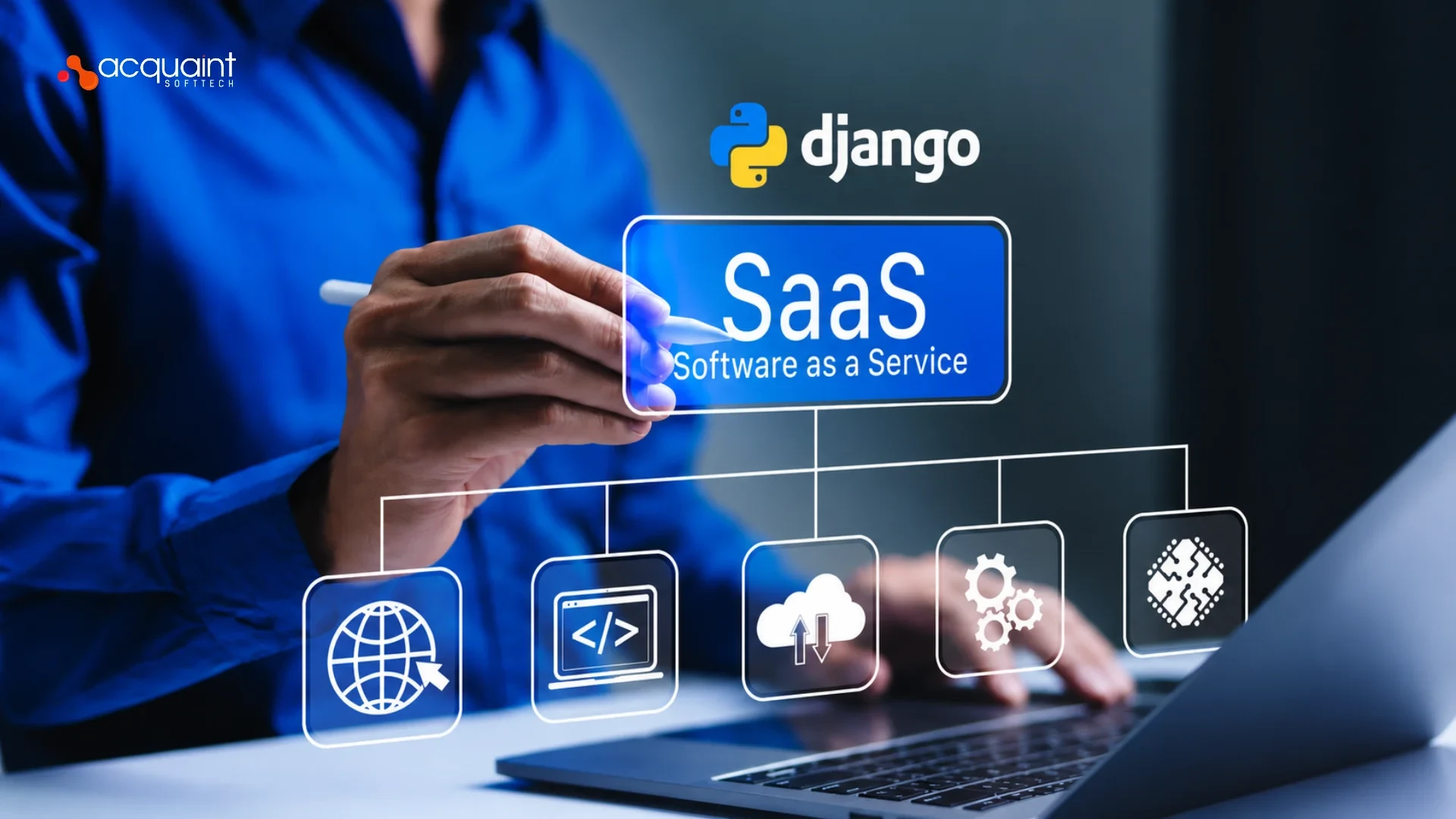
Django is one of the best frameworks for building Software-as-a-Service (SaaS) applications. Its batteries-included philosophy means core requirements like security, user authentication and database management are built right in, so you focus on your product rather than plumbing. A Django SaaS build breaks into clear layers: a multi-tenancy model that isolates each customer's data, an authentication layer, Stripe-based subscription billing, asynchronous tasks, and a frontend strategy that fits your team.

Automated tenant provisioning is the foundational process of programmatically setting up databases, user roles, infrastructure, and configurations for new customers in a multi-tenant Software-as-a-Service (SaaS) application. Done well, it replaces manual account setup that once took days with a repeatable pipeline that brings a new tenant live in minutes, with strict data isolation and zero human touch.

A ChatGPT wrapper SaaS is a product built on top of a large language model API that adds real value around it: your own data, workflows, interface, and accounts. The ones that last go beyond a thin prompt box by layering retrieval, guardrails, evaluation, multi-tenant billing, and integrations the base model cannot offer.

End-to-end SaaS product development is the full journey of building a software product from a raw idea to a fundable company, handled as one continuous process rather than disconnected projects. It moves through six stages: validation, discovery, MVP build, launch, traction and product-market fit, and scaling toward a Series A raise. Each stage has its own goal and its own exit criteria. Working with one partner across all of them keeps the architecture, the data, and the product vision consistent, which is what prevents the costly rebuilds that derail many startups between MVP and scale.
A project management SaaS helps teams plan, assign, track, and complete work in one platform. It combines task management, scheduling, real-time collaboration, and integrations, with features like multi-tenancy, user roles, and fast syncing for scalable performance.
To validate a SaaS idea before writing code, you test four things in order: that the problem is real and painful, that a specific audience has it, that there is genuine demand, and that people will pay. You do this with customer interviews, a landing page, and a no-code or concierge MVP, not by building software. The goal is evidence that people want and will pay for the solution. Roughly 42% of startups fail because they build products nobody wants, and validation is how you avoid becoming one of them.
A SaaS mobile app lets users access your platform on iOS and Android with push notifications, offline access, and a native-like experience. For most SaaS businesses, React Native is the most cost-effective choice, using one codebase for both platforms.

A SaaS reporting engine is the system that lets each tenant generate reports from their own data on demand, without one tenant's heavy report slowing the product for everyone else. To build one, you separate reporting queries from the live application database using read replicas or a dedicated analytics store, enforce tenant isolation on every query, run report generation as asynchronous background jobs, cache repeated results, and deliver output as on-screen dashboards or exportable files such as PDF and CSV. The hard part is not the charts; it is isolating tenant data and keeping heavy queries off the path that serves live users.

SOC 2 Type II is an independent audit, defined by the AICPA Trust Services Criteria, that verifies a SaaS company's security controls actually work over a period of time, usually three to twelve months. Unlike Type I, which checks that controls exist at a single point, Type II tests that they operate consistently. The core technical controls a SaaS product must implement are role-based access control, encryption at rest and in transit, comprehensive audit logging, change management, vulnerability management, and continuous monitoring, all producing evidence the auditor can review.

-copy.webp "End-to-End SaaS Product Development: From Idea to Series A")

.webp "Building a Native Mobile App for Your SaaS: Strategic and Technical Trade-Offs")